
Statin Discontinuation Risk Assessment Tool
How to Use This Tool
This tool helps you assess if discontinuing statins might be appropriate based on your current health circumstances. It is NOT medical advice. Your results should be discussed with your doctor.
Based on information from the article, the tool considers:
- Age and life expectancy
- History of heart events
- Current side effects
- Other health conditions
Note: This assessment is for informational purposes only. Your doctor knows your complete medical history and can provide personalized recommendations.
Stopping statins isn’t as simple as just skipping a pill. For millions of people, these drugs have been a daily part of life-often for decades-because they lower cholesterol and reduce the risk of heart attacks and strokes. But what happens when the benefits no longer outweigh the downsides? When should you consider stopping? And how do you do it without putting your heart at risk?
Why People Stop Statins
Nearly one in five people who take statins stop them for at least a year. That’s not just a few outliers-it’s a widespread pattern. And the main reason? Side effects. Most people don’t have issues, but for those who do, muscle pain, weakness, or fatigue can be enough to make them quit. Many assume the problem is the statin, and they’re right to wonder. But sometimes, it’s not the drug-it’s aging, other medications, or even just getting older and feeling more sensitive to everything. A 2019 study found that fear of side effects was the top reason patients stopped. Muscle pain came in second. Some worry about developing type 2 diabetes, though the actual increase in risk is small. Others just feel tired of taking a pill every day, especially if they’re older and on five or six other medications. The truth? Many people stop without ever talking to their doctor. And that’s where things get dangerous.Who Should Consider Stopping
Not everyone needs to stay on statins forever. There are clear situations where stopping makes sense. If you’re over 75 and have never had a heart attack or stroke, the evidence for continuing statins gets weaker. For people with multiple chronic illnesses-like advanced kidney disease, dementia, or cancer-the long-term benefits of statins often don’t outweigh the daily burden of taking them. A 2023 review found that for patients with a life expectancy of less than two years, stopping statins is safe and often improves quality of life. No need to keep taking a pill that won’t help you live longer. The same goes for people in hospice care or those with terminal cancer. If you’re months away from the end of life, continuing statins won’t change your outcome. In fact, it adds unnecessary side effects and pill burden. Doctors often keep prescribing them out of habit, not because it’s right. But here’s the flip side: if you’ve had a heart attack, stroke, or had a stent placed, stopping statins is risky. A 2021 study showed that for these patients, stopping led to one extra major heart event for every 77 people who quit in a year. That’s not a small number. For people without prior heart disease, the risk is lower-but still real. One extra event per 112 people who stopped. So if you’re young and healthy with high cholesterol, stopping isn’t a good idea unless your doctor says so.What Happens When You Stop
Your cholesterol will rise again-usually within weeks. That’s normal. Statins work by blocking cholesterol production in the liver. Once you stop, your liver goes back to making it. But rising cholesterol doesn’t automatically mean you’re in danger. What matters is your overall risk. If you’re healthy and stopped because of side effects, your doctor might suggest switching to a different statin, lowering the dose, or trying it every other day. Some people find that taking rosuvastatin or pravastatin causes fewer muscle issues than others. Others do well with intermittent dosing-like taking it only three or four days a week. If you’re older and stopping because your life expectancy is short, then the rise in cholesterol doesn’t matter as much. Your body isn’t going to have time to build up dangerous plaque. The goal shifts from preventing heart disease decades from now to feeling better today.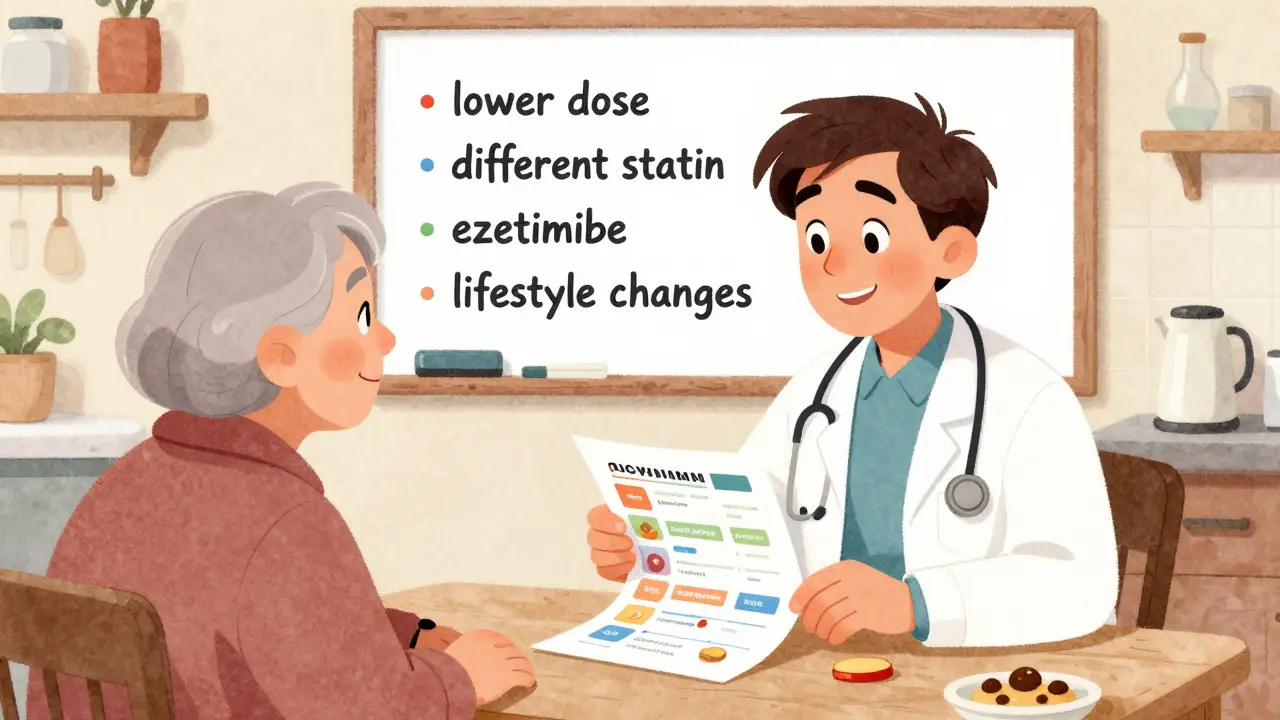
How to Stop Safely
Never stop cold turkey without talking to your doctor. Even if you’re sure you want out, you need a plan. First, review why you started. Was it for primary prevention (no heart disease yet) or secondary (you’ve already had an event)? That changes everything. Next, assess your current health. Are you in good shape? Do you have other conditions? Are you taking other drugs that could interact? Your doctor should look at your full medication list-not just the statin. Then, talk about your goals. Do you want to reduce side effects? Cut down on pills? Improve your daily life? Be honest. Your doctor can’t help if you don’t say what matters to you. If you’re stopping because of muscle pain, your doctor might try a lower dose first. Or switch you to a different statin. Some, like fluvastatin or pitavastatin, are less likely to cause muscle issues. If that doesn’t work, they might suggest non-statin options like ezetimibe or PCSK9 inhibitors. But these are more expensive and require injections in some cases. For people with limited life expectancy, stopping can be straightforward. No tapering needed. Just stop. But it must be documented. Too often, medical records just say “no longer necessary”-which hides the real reason. Was it because of side effects? Because of poor health? Because the patient asked? That matters for future care.What to Watch For After Stopping
After you stop, keep an eye on how you feel. If your muscle pain goes away, that’s a good sign. But if you start feeling chest tightness, shortness of breath, or unusual fatigue, call your doctor. Those could be signs your heart is under stress. Your doctor may want to check your cholesterol again in 6 to 12 weeks. Not because it’s urgent, but to see how much it went up. That helps them understand your baseline risk. If your LDL jumped from 100 to 180, that’s a red flag. If it went from 160 to 220, and you’re 87 with advanced dementia, it’s not a crisis. Also, pay attention to your overall health. Are you eating better? Moving more? Managing blood pressure? These things matter more than a single number. Statins aren’t magic-they’re one tool. Lifestyle still counts.Alternatives to Statins
If you can’t tolerate statins, there are other options-but they’re not always better. Ezetimibe lowers cholesterol by blocking absorption in the gut. It’s a pill, cheaper than newer drugs, and has fewer side effects. It’s not as strong as a statin, but it’s a solid backup. PCSK9 inhibitors like evolocumab and alirocumab are injections given every two weeks. They lower LDL dramatically-sometimes by 60% or more. But they cost thousands a year. Most insurance won’t cover them unless you’ve tried everything else and still have high cholesterol. Fibrates and omega-3 fatty acids help with triglycerides, not LDL. So they’re not direct replacements. They’re used in specific cases, like very high triglycerides, not general cholesterol control. Lifestyle changes-diet, exercise, weight loss-work. But they take time. And for people with genetic high cholesterol, they’re not enough on their own. That’s why statins were created in the first place.
What’s Changing in the Field
A major clinical trial called Discontinuing Statins in Multimorbid Older Adults is wrapping up in 2025. It’s tracking 1,800 older adults with multiple health issues who’ve never had heart disease. Half are stopping statins. Half are continuing. The goal? To see if stopping is safe for quality of life, muscle strength, falls, and overall health-not just heart events. This is the first large study designed to answer what patients really care about: Can I feel better without the pill? Will I live as long? Will I be less likely to fall or get weaker? Meanwhile, guidelines are slowly changing. The American Geriatrics Society now recommends considering stopping statins in older adults with poor health or limited life expectancy. It’s not a rule-it’s a conversation starter. The biggest shift? We’re moving away from “take it for life” to “re-evaluate regularly.” Your health changes. Your needs change. Your statin prescription should too.What You Can Do Today
If you’re on a statin and wondering if you should stop:- Write down why you started. Was it a heart attack? High cholesterol? Family history?
- Make a list of how you feel. Any muscle pain? Fatigue? Trouble sleeping?
- Check your current life expectancy. Are you managing multiple chronic conditions? Are you in hospice? Are you in good shape?
- Ask your doctor: “Based on my health now, do I still need this?”
- Ask: “What happens if I stop? What happens if I keep going?”
Amy Cannon
December 30, 2025 AT 13:03Statins have been a cornerstone of preventive cardiology for decades, but the narrative around their universal necessity is beginning to unravel-especially in older adults with multimorbidity. I’ve seen patients in my practice who’ve been on statins since their 50s, now in their 80s with dementia, renal failure, and frailty, still prescribed these pills because ‘that’s what the algorithm says.’ The real issue isn’t cholesterol-it’s the medicalization of aging. When your goal shifts from longevity to comfort, every pill becomes a burden. The Discontinuing Statins trial is long overdue, and I hope it finally gives clinicians permission to de-prescribe without fear of litigation or guilt. Medicine isn’t about ticking boxes-it’s about listening to the person in front of you.
Jim Rice
December 31, 2025 AT 10:07Wow. So now we’re just gonna stop statins because someone’s old? Next thing you know, we’ll stop blood pressure meds for diabetics too. This is why America’s healthcare is falling apart-people think they know better than science. You think your LDL of 220 at 87 isn’t gonna cause plaque? It’s not about feeling tired-it’s about surviving long enough to see your grandkids graduate. Stop being lazy and take your pill. Science didn’t invent statins so you could feel ‘better’-it invented them so you don’t die at 65.
Alex Ronald
January 1, 2026 AT 04:07Jim, I get where you’re coming from-but you’re conflating risk with fear. For someone with advanced cancer or dementia, statins aren’t preventing heart attacks-they’re just adding another pill to the nightstand. The real science isn’t about LDL numbers-it’s about net benefit. A 2023 JAMA paper showed that in patients with life expectancy under 2 years, stopping statins didn’t increase cardiac events-it improved quality of life. That’s not giving up. That’s honoring the patient’s values. If your grandkid’s gonna remember you, it won’t be because you took a statin. It’ll be because you were present. And sometimes, that means fewer pills.
Nisha Marwaha
January 2, 2026 AT 08:03From a clinical pharmacology standpoint, the discontinuation paradigm must be contextualized within the pharmacokinetic profile of statin isoforms. Rosuvastatin and pitavastatin demonstrate lower myotoxic potential due to reduced CYP3A4 metabolism, whereas simvastatin and lovastatin exhibit higher muscle penetration. Intermittent dosing regimens (e.g., 3x/week) have been shown in RCTs to maintain LDL reduction by 40–50% while mitigating myalgia. Furthermore, ezetimibe’s mechanism-NPC1L1 inhibition-provides additive LDL-lowering without mitochondrial toxicity. For geriatric polypharmacy patients, deprescribing should be guided by frailty indices and NOT chronological age alone. The ACC/AHA guidelines remain insufficiently granular for complex multimorbidity.
Paige Shipe
January 3, 2026 AT 01:25So let me get this straight-you’re saying if you’re old and tired, you should just stop taking the one thing keeping you from a heart attack? You know how many people die because they listened to their ‘feelings’ instead of their doctor? I’ve seen it. My uncle stopped his statin because he ‘felt fine.’ Two months later, he had a massive MI. He was 78. He didn’t even make it to the hospital. This isn’t about feeling better. It’s about surviving. And if you’re too lazy to take a pill, maybe you shouldn’t be allowed to make medical decisions. Sad.
David Chase
January 3, 2026 AT 18:43USA = free country. You wanna stop your statin? Go ahead. But don’t come crying to Medicare when your artery explodes. 😂💉📉 This is why we can’t have nice things. People think medicine is a buffet. ‘I’ll take the statin, but skip the cholesterol check.’ ‘I’ll take the insulin, but not the diet.’ Now we’re downgrading statins to ‘optional wellness supplement’? This isn’t progress-it’s idiocy. 🇺🇸💀 #TakeYourPills #NoMoreCulturalNarcissism
Samar Khan
January 4, 2026 AT 03:57Everyone’s so quick to say ‘stop the statin’-but nobody talks about what happens when the plaque ruptures. You think your 87-year-old body is gonna handle a 90% blockage? You think your ‘quality of life’ matters more than your daughter losing her dad to a sudden cardiac death? The data says stopping increases events. Period. You’re romanticizing death. This isn’t philosophy-it’s physiology. And your ‘feelings’ don’t override biology. 🤡🩺
Russell Thomas
January 5, 2026 AT 14:06Wow. Just… wow. You people are ridiculous. So if you’re old, you just give up? You stop taking care of yourself because you’re tired? Newsflash: life doesn’t get easier as you age. It gets harder. And if you’re gonna die anyway, why not die with a few more years? Why not die with your arteries intact? Statins aren’t about living forever-they’re about living long enough to enjoy your grandkids. Not just ‘feeling better’ while your heart slowly gives out. You’re not brave. You’re just lazy. And you’re making it harder for the rest of us who actually care.