
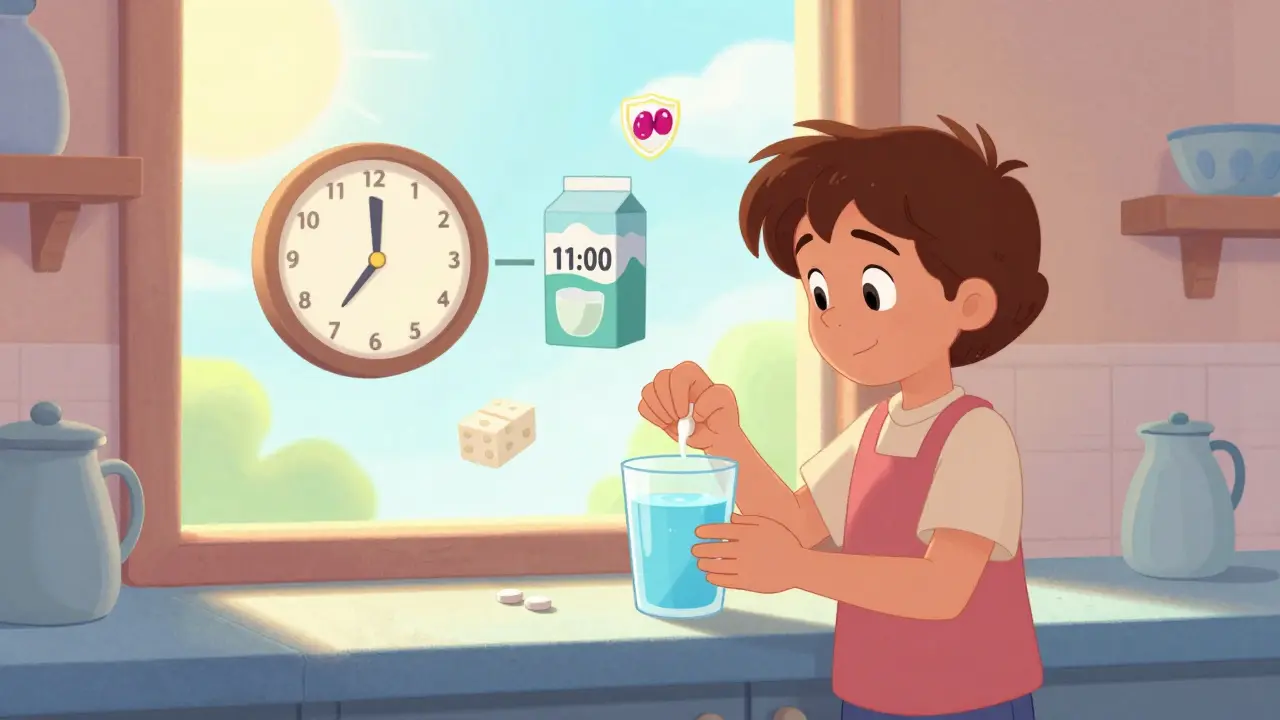
If you’re taking levothyroxine for hypothyroidism and you love tofu, soy milk, or edamame, you’re not alone. But here’s the thing: soy can mess with how well your thyroid medication works. It doesn’t mean you have to give up soy forever. It just means you need to know when to eat it - and when to wait.
Why Soy Interferes with Thyroid Medication
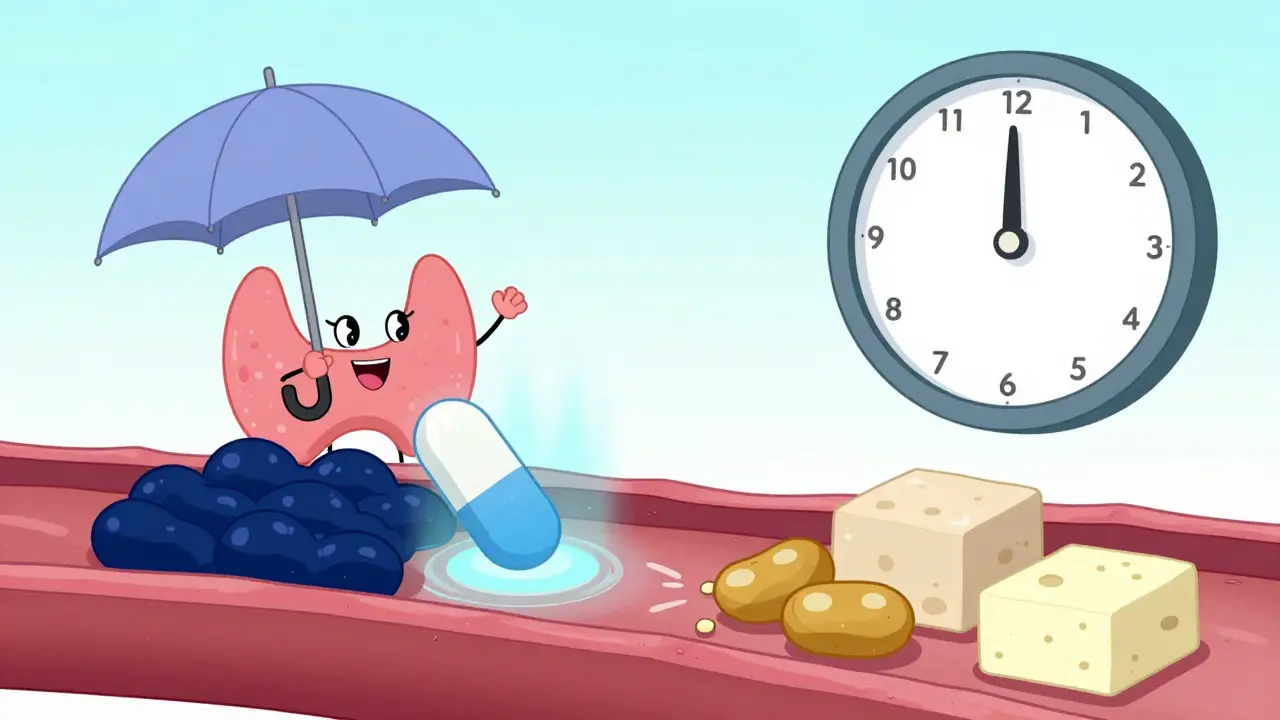
Soy doesn’t make your thyroid worse. It doesn’t cause hypothyroidism. But it can stop your body from absorbing levothyroxine properly. The culprits are soy isoflavones - compounds like genistein and daidzein - that bind to the medication in your gut. Think of it like a sponge soaking up the drug before it can get into your bloodstream. Studies show soy can reduce levothyroxine absorption by 9% to 30%, depending on how much you eat and when. One case from 2006 tracked a woman who needed her dose bumped up to 200 mcg because she was drinking soy protein shakes right after her pill. Her TSH jumped, her energy dropped, and she felt like her medication wasn’t working - until she stopped eating soy at the same time. It’s not just soy milk. Tofu, tempeh, soy sauce, soy-based protein bars, and even some vegan meat alternatives can cause the same issue. The more soy protein you consume at once, the stronger the effect.How Much Does Soy Actually Affect Your TSH?
You might hear conflicting stories. Some people say they’ve eaten soy with their pill for years with no problems. Others had to increase their dose by 25 mcg or more after starting daily soy milk. Here’s what the science says: In healthy people with normal thyroid function, soy doesn’t change TSH or hormone levels. But if you’re already hypothyroid and taking levothyroxine, your body is finely tuned. Even a small drop in absorption can push your TSH up. A 2019 meta-analysis of 3,600 people found that soy increased TSH by just 0.35 mIU/L on average - which sounds tiny. But for someone whose target TSH is 1.0 to 2.0, that bump can push them into the high-normal or even hypothyroid range. That’s why some patients see their TSH climb from 1.8 to 5.2 after switching to soy milk every morning. The effect is cumulative. If you eat soy every day and take your pill at the same time, your body slowly adapts to lower hormone levels. That’s when your doctor starts talking about increasing your dose - not because your thyroid is failing, but because your medication isn’t getting absorbed.How Soy Compares to Other Food Interactions
Soy isn’t the only thing that blocks levothyroxine. Calcium, iron, and coffee are bigger offenders. Here’s the ranking from most to least disruptive:- Calcium supplements - can block up to 36% absorption
- Iron supplements - up to 30% reduction
- Soy products - 9% to 30% reduction
- High-fiber foods (like psyllium) - around 9% reduction
- Coffee - about 20% reduction
Best Practices: When to Eat Soy and When to Wait
There are two reliable ways to avoid the problem:Option 1: Morning Routine (Most Common)
Take your levothyroxine first thing in the morning, on an empty stomach, with a full glass of water. Wait at least 60 minutes before eating or drinking anything else. Then wait another 2 to 3 hours before having soy. That means:- 7:00 AM - Take pill with water
- 8:00 AM - Breakfast (oatmeal, eggs, fruit - no soy)
- 11:00 AM - Lunch with tofu or soy milk
Option 2: Bedtime Dosing
If mornings are chaotic, taking levothyroxine at bedtime can be just as effective - as long as you haven’t eaten in the last 3 to 4 hours.- 9:00 PM - Take pill
- 5:00 PM - Last meal (including soy)
What About Soy Supplements?
Soy isoflavone pills - the kind marketed for menopause or breast health - are more concentrated than food. They’re not necessarily worse, but they’re less predictable. The European Food Safety Authority says these supplements don’t affect thyroid function in healthy women. But if you’re hypothyroid? Play it safe. Take them at least 2 hours after your pill. And tell your doctor you’re taking them - they can check your TSH more often.Real Stories: What Patients Actually Experience
Reddit’s r/Thyroid community is full of stories: - One user went from 75 mcg to 100 mcg after switching to soy milk every morning with breakfast. Her TSH jumped from 1.8 to 5.2. After switching to a 3-hour gap, her TSH dropped back to 1.9. - Another said she’s taken Synthroid with soy milk for five years and her TSH has stayed at 1.5. Her endocrinologist says she’s just lucky - her body absorbs the drug well despite the soy. The truth? Everyone’s different. Genetics, gut health, and even how fast your stomach empties can change how soy affects you. That’s why blanket rules don’t always work.What Your Doctor Should Tell You
In 2015, only 42% of endocrinologists routinely warned patients about soy. By 2023, that number jumped to 68%. That’s progress. But not all doctors are clear. Some just say, “Avoid soy.” Others say, “It’s fine if you space it out.” Ask your doctor:- Do I need to avoid soy completely?
- How long should I wait after taking my pill before eating soy?
- Should I check my TSH more often if I eat soy regularly?
What About Vegans and Vegetarians?
About 74% of plant-based eaters with hypothyroidism say their doctor talked to them about soy and levothyroxine. That’s higher than the general population. But being vegan doesn’t mean you have to give up soy. It just means you need to plan. Swap your soy milk for almond or oat milk in the morning. Have tofu at lunch or dinner, not breakfast. Use soy sauce sparingly - it’s low in protein, so it’s not a big issue. Many plant-based patients find that switching to bedtime dosing solves the problem entirely. No morning rush. No soy conflicts. Just a simple routine.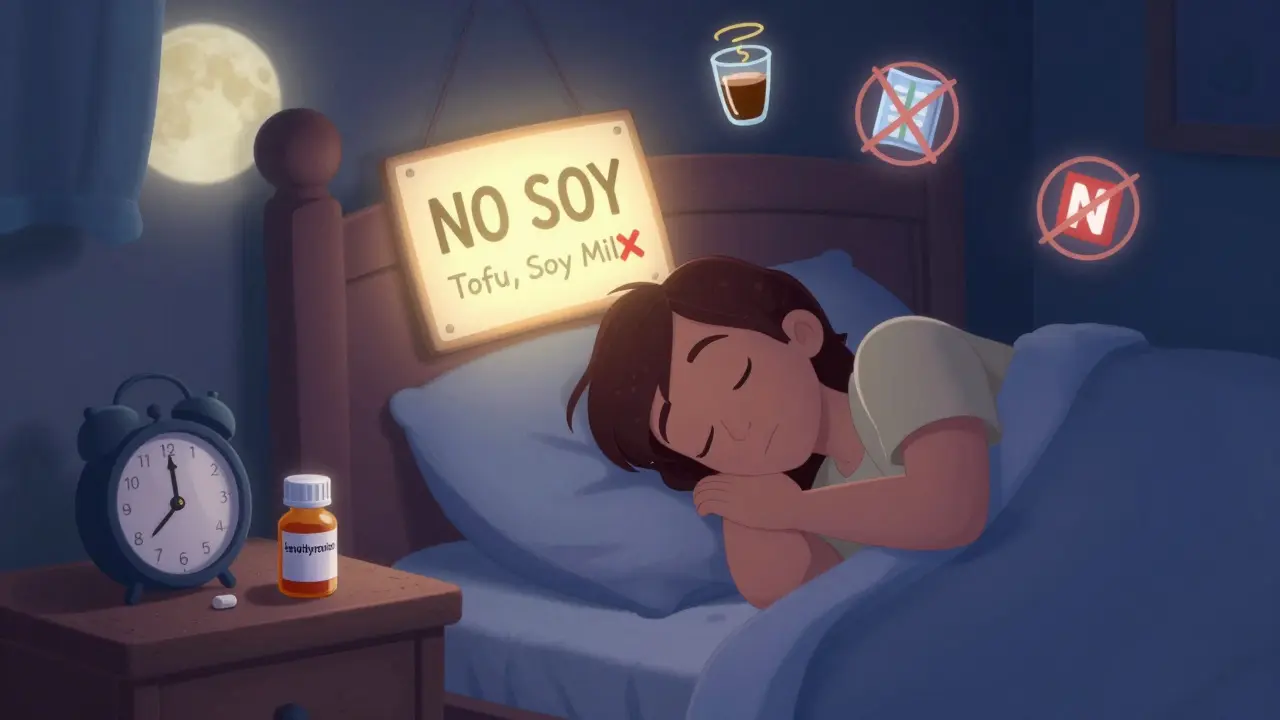
What If You Forgot and Ate Soy With Your Pill?
Don’t panic. One slip-up won’t ruin your treatment. If you ate soy within an hour of your pill:- Don’t take another dose - that’s dangerous.
- Wait until tomorrow and stick to your 2- to 3-hour rule.
- Let your doctor know. They might want to check your TSH in 6 to 8 weeks.
Final Rule: Consistency Beats Perfection
You don’t need to be perfect. You just need to be consistent. Pick one routine - morning with 3-hour gap, or bedtime with no food after 6 PM - and stick with it. Don’t switch back and forth. That’s what confuses your body and makes your TSH swing. And if you ever feel tired, gain weight, or get cold easily again - even if you’re taking your pill - think about soy. Or coffee. Or calcium. Timing matters more than you think.Quick Summary
- Soy doesn’t cause hypothyroidism, but it can block levothyroxine absorption by 9-30%.
- Wait at least 2-3 hours after taking your pill before eating soy products.
- For children, infants, or large soy meals, wait 3-4 hours.
- Bedtime dosing can avoid morning conflicts - as long as you haven’t eaten in 3-4 hours.
- Soy supplements need the same timing as food - 2 hours after your pill.
- Consistency is more important than total avoidance.
Can I drink soy milk with my levothyroxine?
No. Drinking soy milk at the same time as your levothyroxine can reduce how much of the medication your body absorbs. Wait at least 2 to 3 hours after taking your pill before drinking soy milk or eating any soy product. If you take your medication at bedtime, make sure your last soy-containing meal was at least 3 to 4 hours earlier.
Does all soy affect thyroid medication the same way?
No. Whole soy foods like tofu, edamame, and soy milk have the strongest effect because they contain more soy protein and isoflavones. Soy sauce, miso, and tempeh have less protein and are less likely to interfere. Soy isoflavone supplements are concentrated, so they still need to be spaced out - but their impact is less predictable. Stick to the 2-3 hour rule for all forms unless your doctor says otherwise.
I’ve been eating soy with my pill for years and feel fine. Do I need to change?
Maybe. Feeling fine doesn’t mean your thyroid levels are optimal. Many people with stable TSH levels are still in the high-normal range - which isn’t ideal for long-term health. A simple blood test can tell you if your current routine is working. If your TSH is above 2.5 or you’ve had to increase your dose recently, soy timing could be the reason. Even if you’re fine now, switching to a consistent 2-3 hour gap reduces future risk.
What if I accidentally eat soy right after my pill?
Don’t take another dose. One mistake won’t cause harm. Just go back to your normal routine tomorrow. If this happens often - say, every day - schedule a TSH check in 6 to 8 weeks. Your doctor may want to adjust your dose. Occasional slips aren’t a crisis, but repeated ones can lead to under-treatment.
Are there alternatives to soy milk if I’m avoiding it in the morning?
Yes. Almond milk, oat milk, rice milk, and coconut milk don’t interfere with levothyroxine. Just check the label - some brands add calcium or vitamin D, which can interfere. Stick to plain, unsweetened versions without added minerals. You can still enjoy soy later in the day - just not within 2-3 hours of your pill.
Next Steps
- Check your current routine: Are you eating soy within 2 hours of your pill?
- Ask your doctor for a TSH test if you’ve changed your soy intake recently.
- Set a daily alarm to remind yourself to wait before eating soy.
- If you’re vegan or vegetarian, work with a dietitian to plan meals that avoid timing conflicts.
Sue Stone
January 23, 2026 AT 09:26soy milk with my levothyroxine? yeah i did that for like 2 years and never thought twice. then my TSH went nuts. turned out i was absorbing like 30% less. now i take it at 6am, wait till 9am for my smoothie. life’s easier when you’re not constantly tired.
also, oat milk is my new best friend.
Stacy Thomes
January 23, 2026 AT 16:01IF YOU’RE TAKING LEVOTHYROXINE AND YOU EAT SOY BEFORE 9AM YOU’RE DOING IT WRONG. I WAS FELT LIKE A ZOMBIE UNTIL I FIGURED THIS OUT. NOW I HAVE ENERGY. I CAN RUN. I CAN LAUGH. I CAN BE HUMAN AGAIN. DON’T BE LIKE ME. DON’T WAIT 5 YEARS.
Janet King
January 23, 2026 AT 20:08The pharmacokinetic interaction between soy isoflavones and levothyroxine is well-documented in peer-reviewed literature. The mechanism involves competitive inhibition of intestinal absorption via binding to the thyroxine transporter. A two-hour interval significantly mitigates this effect, as demonstrated in the 2023 European Thyroid Journal study referenced. Consistency in timing is critical for therapeutic efficacy.
Patients should be advised to maintain a standardized daily regimen.
Oladeji Omobolaji
January 24, 2026 AT 05:09in nigeria we don’t even have soy milk. we drink coconut water and eat yam. my cousin in usa told me about this and i was like… wait, you people eat soy like it’s cereal? lol. but yeah, i get it. timing matters. my aunt takes her med at night and eats beans for dinner. no problem.
dana torgersen
January 25, 2026 AT 06:48so… soy… isoflavones… genistein… daidzein… it’s like your body’s got a bouncer at the door of your gut, right? and soy’s the guy in the leather jacket trying to sneak in with a fake ID… and levothyroxine? she’s just trying to get to the party… and the bouncer says ‘nope, you’re not getting past me today.’
so you wait. you wait 2 hours. you let the bouncer chill. then you let levothyroxine in. it’s not about fear. it’s about respect. for your hormones. for your body. for your right to feel… not like a zombie.
also. i misspelled ‘levothyroxine’ three times in this comment. i’m sorry.
!!
Andrew Smirnykh
January 25, 2026 AT 23:56I’ve been vegan for 12 years and on levothyroxine for 8. I eat tofu daily. I take my pill at 7am. I eat soy at lunch. My TSH has been stable at 1.7 for years. I know people say ‘everyone’s different,’ but I’m living proof that blanket warnings don’t always apply. My doctor says I’m lucky. Maybe I am. But I’m also consistent.
Don’t panic if you’re doing the same. Just test your levels. If they’re good, don’t fix what isn’t broken.
Susannah Green
January 27, 2026 AT 14:48Okay, real talk: I used to eat edamame with my breakfast and wonder why I was always cold. Then I read this. I switched to almond milk. I wait 3 hours. I take my pill on an empty stomach. My TSH dropped from 5.1 to 2.0 in 8 weeks. I have energy. I’m not crying over spilled milk anymore.
Also, if you’re vegan, try flaxseed instead of soy protein powder. It’s not perfect, but it doesn’t fight your meds. And it’s good for your heart.
Don’t let fear stop you from eating plants. Just time it right.
ps: your doctor should’ve told you this. if they didn’t, ask again.
pps: i’m not a doctor. but i am a person who used to feel like garbage and now i don’t.
Kerry Evans
January 28, 2026 AT 16:12People who eat soy with their thyroid meds are just being lazy. You think your body is special? You think you’re exempt from the science? I’ve seen it a hundred times: ‘I feel fine!’ Yeah, you feel fine because your TSH is 6.2 and you’re just used to being tired. You’re not ‘lucky.’ You’re in denial. And you’re going to pay for it later with heart issues, weight gain, depression.
Stop making excuses. Wait 3 hours. Or get off the soy train. It’s not that hard.
Vanessa Barber
January 29, 2026 AT 22:02Yeah but what if you’re on a keto diet and your only protein source is soy? You gonna eat chicken? That’s not vegan. And if you’re plant-based and you give up soy, what’s left? Seitan? Textured vegetable protein? Same issue.
So maybe the real problem is that doctors don’t give us better options. Not that we’re dumb.
charley lopez
January 31, 2026 AT 10:22The clinical significance of soy-induced levothyroxine malabsorption is modulated by several variables: gastric emptying rate, intestinal pH, concurrent mineral intake, and genetic polymorphisms in thyroid transporter proteins. The 2-3 hour separation window is a population-based heuristic, not a universal threshold.
For individuals with delayed gastric motility (e.g., post-bariatric patients), a 4-hour interval may be required. Conversely, those with rapid transit may tolerate 90 minutes.
Individualized monitoring via serial TSH assays remains the gold standard.
Anna Pryde-Smith
February 2, 2026 AT 04:31I DIDN’T KNOW THIS AND NOW I’M SO ANGRY. I’VE BEEN TAKING MY MEDS WITH SOY MILK FOR 7 YEARS. I’VE BEEN TIRED. I’VE BEEN DEPRESSED. I’VE BEEN CRYING IN THE SHOWER EVERY MORNING. AND NO ONE TOLD ME? NOT MY DOCTOR. NOT MY NUTRITIONIST. NOT EVEN MY FRIEND WHO’S A PHARMACIST?
THIS IS A SCANDAL. I’M GOING TO POST THIS ON EVERY FORUM. I’M GOING TO TAG MY DOCTOR. I’M GOING TO MAKE THEM PAY.
AND NOW I’M GOING TO DRINK ALMOND MILK AND CRY AGAIN. BUT THIS TIME, IT’S BECAUSE I’M HAPPY.
Kerry Moore
February 3, 2026 AT 21:45Thank you for the thorough and evidence-based overview. I appreciate the nuanced distinction between soy as a dietary component and its pharmacological interaction. The data on TSH elevation, while modest on average, carries meaningful clinical implications for individuals operating near the upper limits of the reference range.
It is imperative that clinicians not only educate patients on timing but also reinforce the importance of routine thyroid function testing, particularly after dietary modifications. Consistency, as noted, is paramount.
Well-articulated and clinically sound.
Dawson Taylor
February 4, 2026 AT 08:49Timing matters. Not because soy is evil. But because biology is precise. Your body doesn’t care about your intentions. It cares about absorption.
Fix the rhythm. Not the food.
Sallie Jane Barnes
February 5, 2026 AT 08:57I’m a vegan mom of two. My 8-year-old has hypothyroidism. We switched to bedtime dosing. She takes her pill at 9pm, we stop eating after 6pm. No soy at breakfast. No stress. No panic. She’s thriving. Her TSH is perfect.
Don’t let fear stop you from feeding your kid plants. Just plan ahead. And if your doctor says ‘avoid soy completely’? Ask them to explain the science. They might not know it.
Also - oat milk with no added calcium is our hero.
Laura Rice
February 6, 2026 AT 02:10i just want to say thank you to whoever wrote this. i’ve been on levothyroxine for 10 years and i thought i was just… broken. tired all the time. gaining weight. crying for no reason. my doctor kept saying ‘your levels are fine’ but i didn’t feel fine. then i read this. i switched to almond milk. waited 3 hours. took it at night. and now? i can wake up without hitting snooze 5 times. i can walk up stairs without panting. i can laugh again.
i’m not ‘fixed’ but i’m not broken anymore.
thank you for not just saying ‘avoid soy.’ you gave me a way to keep my life. my food. my peace.