
Blood Thinner Reversal Agent Checker
Recommended Action
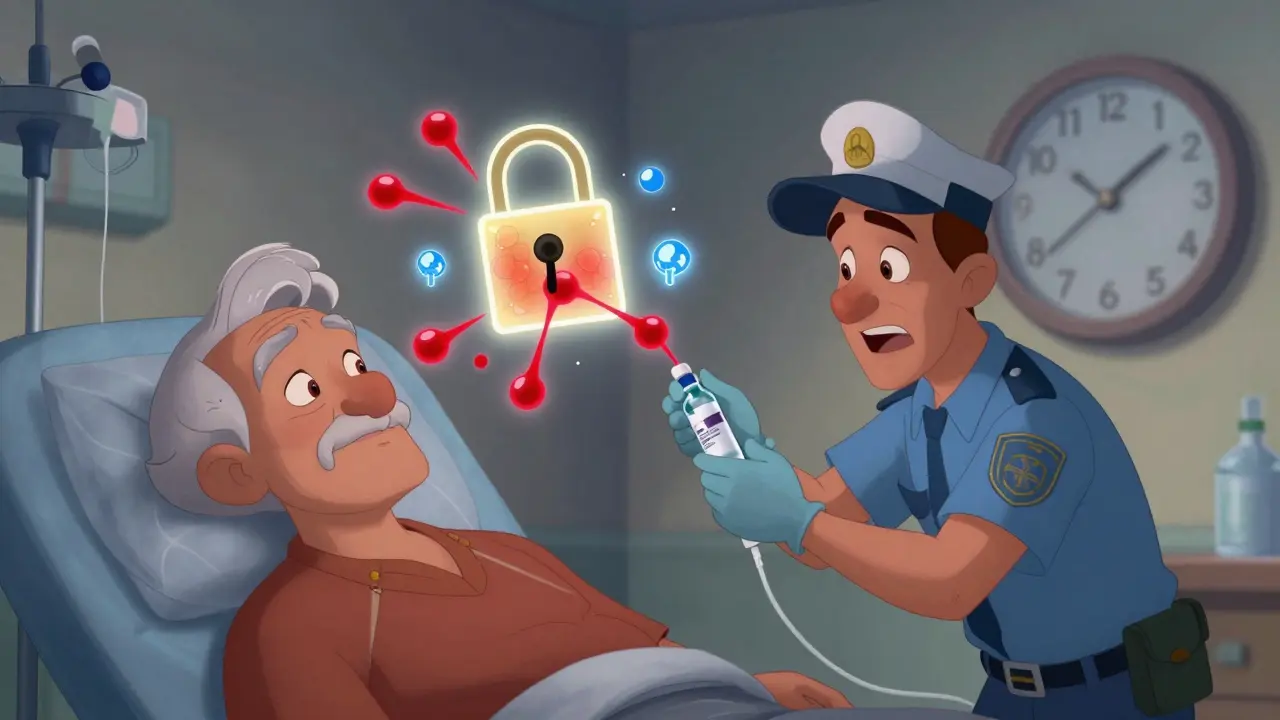
When someone on blood thinners suffers a major bleed - a fall, a car crash, a brain hemorrhage - time isn’t just money. It’s life. These medications, meant to prevent deadly clots, can turn dangerous in an emergency. But there’s good news: we now have tools to reverse them quickly. Not all blood thinners are the same, and neither are their reversal agents. Knowing which one to use - and when - can mean the difference between survival and tragedy.
Why Blood Thinners Need Reversal Agents
Blood thinners like warfarin, dabigatran, rivaroxaban, and apixaban keep clots from forming in people with atrial fibrillation, artificial heart valves, or a history of deep vein thrombosis. But when a patient hits their head or starts bleeding internally, those same drugs become a threat. Without a way to stop their effect, bleeding can spiral out of control. Before 2015, doctors had limited options. For warfarin, vitamin K and clotting factor concentrates worked. But for the newer drugs - called NOACs (novel oral anticoagulants) - there was nothing reliable. That changed with the approval of idarucizumab and andexanet alfa.The Two Main Reversal Agents and How They Work
There are two specific reversal agents for NOACs, each targeting a different class of drug.Idarucizumab (Praxbind) is made to reverse dabigatran, which works by blocking thrombin - the enzyme that turns fibrinogen into clots. Idarucizumab is a monoclonal antibody fragment that binds directly to dabigatran like a lock and key. In clinical trials, it achieved 100% reversal of dabigatran’s effect within minutes. Two vials (2.5g each) given IV are enough for most patients. The result? Bleeding stops faster, surgery can proceed sooner, and survival rates improve.
Andexanet alfa (AndexXa) reverses Factor Xa inhibitors: rivaroxaban, apixaban, and edoxaban. These drugs block Factor Xa, a key step in clot formation. Andexanet alfa is a modified version of Factor Xa itself - it acts like a sponge, soaking up the drug and pulling it away from its target. In the ANNEXA-4 trial, it stopped bleeding in 83% of patients within 2.5 hours on average. It’s especially critical for intracranial hemorrhage, where every minute counts.
What About Non-Specific Reversal? 4F-PCC
Not every hospital can afford or stock idarucizumab or andexanet alfa. That’s where four-factor prothrombin complex concentrate (4F-PCC) comes in. It’s a mix of clotting factors II, VII, IX, and X, originally developed for warfarin reversal. It’s not targeted - it floods the system with clotting proteins - but it works. Studies show it achieves hemostasis in about 77% of cases for NOAC-related bleeds. It’s cheaper - around $1,500 to $3,000 per dose - compared to $17,900 for andexanet alfa or $3,800 for two vials of idarucizumab. But it’s not perfect. It doesn’t reverse the drug itself; it just tries to outpace its effect. And it carries a higher risk of clots.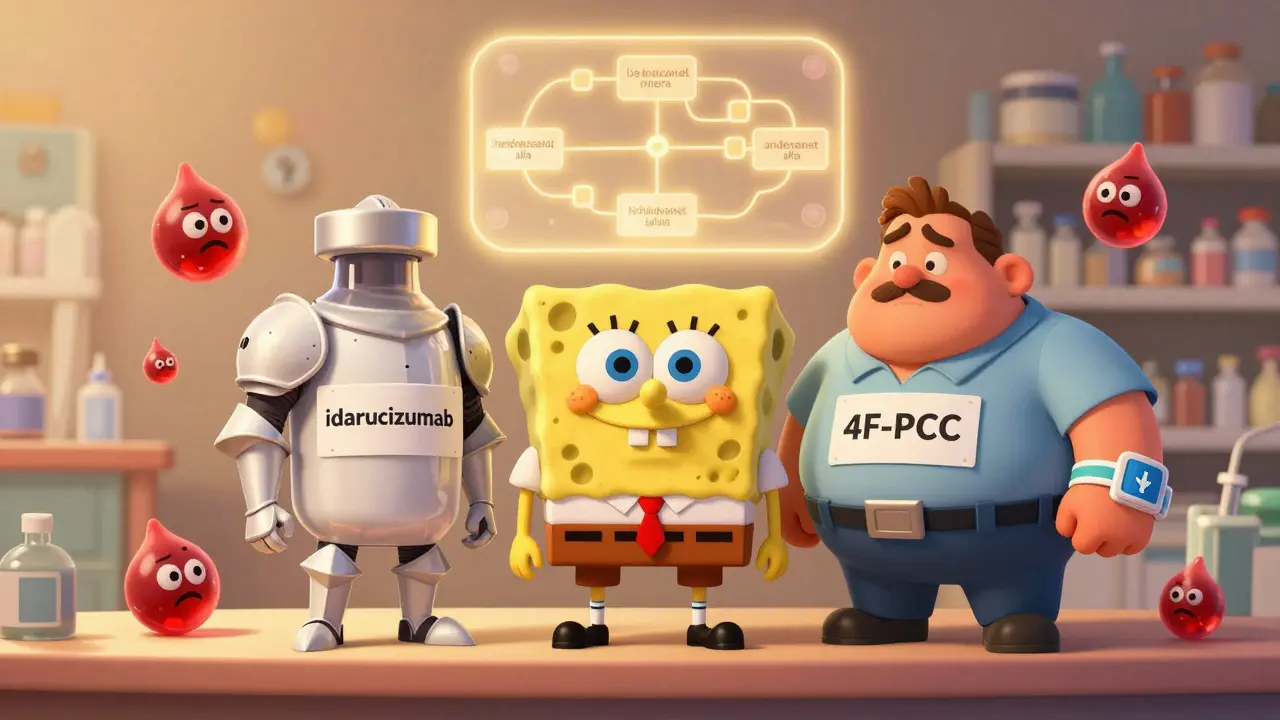
Cost, Risk, and Real-World Trade-Offs
Money matters. Andexanet alfa’s $17,900 price tag means many community hospitals reserve it only for the most severe cases - like active brain bleeds. Some pharmacies limit it to one dose per patient per year. Idarucizumab is more affordable but still expensive. 4F-PCC is the budget option, but it’s less predictable.Then there’s safety. Andexanet alfa has a 14% rate of thromboembolic events - new clots forming after reversal. That’s nearly double the 8% seen with 4F-PCC. Idarucizumab has the lowest clot risk at just 5%. But here’s the catch: mortality rates are similar across all three. Around 17.7% of patients still die even after reversal. Why? Because the reversal agent fixes the bleeding, but not the reason the person was on the blood thinner in the first place. If they have advanced heart disease, kidney failure, or multiple strokes, the underlying condition still carries risk.
What Happens After Reversal? Rebound Bleeding
One of the biggest hidden dangers is rebound. Dabigatran has a long half-life - it lingers in the body. Idarucizumab clears it quickly, but if the drug is still being absorbed from the gut, levels can rise again. In 23% of patients, dabigatran levels creep back above the safe threshold after 24 hours. That’s why monitoring doesn’t stop after the IV drip. Patients need to be watched for at least 24 to 48 hours. In the RE-VERSE AD trial, 10 patients had recurrent bleeding and needed a second dose of idarucizumab. Emergency teams now keep extra vials on hand.How Do Doctors Decide What to Use?
It’s not guesswork. There’s a clear decision path:- Confirm the drug: Was it dabigatran? Or one of the Factor Xa inhibitors? Blood tests like dilute thrombin time (for dabigatran) or anti-Factor Xa activity (for rivaroxaban/apixaban) are critical. Don’t assume - test.
- Assess severity: Is it a minor bruise or a massive brain bleed? For life-threatening bleeding, use the specific agent if available.
- Check availability: If idarucizumab or andexanet alfa isn’t stocked, go straight to 4F-PCC. Don’t delay.
- Plan for rebound: If you used idarucizumab, schedule follow-up labs at 24 hours. Have a second dose ready.
For urgent surgery, idarucizumab wins. Median time to start surgery after administration? Just 1.6 hours. With 4F-PCC, it’s over 4 hours. In neurosurgery, that’s the difference between saving a brain and losing it.

What’s Coming Next? Ciraparantag
The holy grail is a universal reversal agent - one drug that works on all anticoagulants. That’s ciraparantag (PER977). Early trials show it reverses dabigatran, rivaroxaban, apixaban, and even heparin within 5 to 10 minutes. It’s not a monoclonal antibody or a modified protein - it’s a small molecule that binds directly to anticoagulants. Phase III trials wrapped up in late 2024. If approved, it could replace all current agents. Imagine one vial in the ER for any blood thinner. No more confusion. No more delays. Just speed and simplicity.Bottom Line: Reversal Is Possible - But It’s Not Simple
Blood thinners save lives. But when things go wrong, we now have powerful tools to fix it. Idarucizumab for dabigatran. Andexanet alfa for rivaroxaban and apixaban. 4F-PCC when nothing else is available. Each has strengths, weaknesses, and costs. The key is knowing which drug the patient took - and acting fast. Hospitals that train their ER teams, stock reversal agents, and have clear protocols see better outcomes. For patients, the message is simple: if you’re on a blood thinner, carry a card or app listing your drug and dose. In an emergency, that information could save your life.Can you reverse blood thinners at home?
No. Reversal agents like idarucizumab and andexanet alfa require intravenous administration and continuous monitoring for clotting risks. They’re only given in hospitals or emergency settings under medical supervision. There are no oral or at-home reversal options.
How long does it take for a reversal agent to work?
Idarucizumab works almost instantly - within minutes. Andexanet alfa starts working in under 10 minutes, with bleeding typically stopping within 2.5 hours on average. 4F-PCC takes longer, often 30 to 60 minutes to show effect, and may require repeat doses.
Do reversal agents prevent future clots?
No. Reversal agents only stop the current anticoagulant effect. They don’t treat the reason the person needed the blood thinner in the first place - like atrial fibrillation or a mechanical heart valve. After bleeding stops, doctors must decide whether to restart anticoagulation, switch drugs, or use mechanical alternatives like left atrial appendage closure.
Is there a blood test to check if reversal worked?
Yes. For dabigatran, doctors use dilute thrombin time or ecarin clotting time. For Factor Xa inhibitors, they use anti-Factor Xa activity. These tests are not routine in most ERs, so many rely on clinical improvement - stopped bleeding, stable vitals - as the main indicator. Hospitals with specialized labs can confirm reversal, but in emergencies, time often overrides testing.
What if I don’t know which blood thinner someone took?
If the drug is unknown, treat it as a high-risk situation. Give 4F-PCC immediately if there’s life-threatening bleeding. Don’t wait for lab results. If the patient is stable, try to get their medication list, pharmacy records, or a medical alert bracelet. In doubt, err on the side of caution - faster reversal is better than delay.
What to Do If You’re on a Blood Thinner
If you take dabigatran, rivaroxaban, apixaban, or edoxaban, keep a wallet card or digital note with:- Your exact drug name and dose
- When you take it
- Your doctor’s name and phone number
- Any known allergies
Wear a medical alert bracelet if you’ve had bleeding before or have kidney disease. Tell every ER doctor you see - even for a broken arm - that you’re on a blood thinner. And never skip follow-up labs. Your doctor needs to know how your body is handling the drug.
Reversal agents are a medical breakthrough. But they’re not magic. They work best when used quickly, correctly, and with full awareness of the risks. The goal isn’t just to stop the bleeding - it’s to get you back to living without another clot, another fall, another hospital stay.
chandra tan
January 10, 2026 AT 15:03Man, I never thought about how crazy it is that we can just flip a switch and undo a blood thinner in minutes. Back home in India, my uncle had a stroke on warfarin and they had to fly him to Delhi for anything like this. Now we got these magic bullets? Wild.
Still, the cost... my cousin’s hospital couldn’t even afford 4F-PCC last year. They just prayed and hoped. Hope we don’t leave the poor behind just because they can’t pay for the fancy stuff.
Dwayne Dickson
January 11, 2026 AT 10:54One must observe, with profound intellectual rigor, that the pharmacological architecture of reversal agents represents not merely a clinical innovation, but a paradigmatic shift in the ontological relationship between anticoagulation and hemostasis. The monoclonal antibody-mediated sequestration of dabigatran via idarucizumab is, in fact, a triumph of structural complementarity over biochemical chaos.
Yet, one cannot ignore the systemic pathology of healthcare commodification - wherein the life-saving efficacy of andexanet alfa is constrained by the arbitrary caprices of insurance reimbursement schedules and hospital formularies. One might even posit that the true antagonist in this narrative is not the coagulopathy, but the profit motive.
Ted Conerly
January 11, 2026 AT 21:34This is one of those posts that makes you feel good about medicine. Seriously - we went from "hope for the best" to having targeted, fast-acting reversal agents in less than a decade. That’s insane progress.
And yes, cost is a nightmare. But hospitals that invest in this stuff? They save lives. Period. If your ER doesn’t have idarucizumab or andexanet on the shelf, they’re playing Russian roulette with brain bleeds. Push your hospital to stock them. Or at least make sure they have 4F-PCC ready to go.
Faith Edwards
January 13, 2026 AT 06:30How quaint. We now have molecularly engineered antidotes for pharmaceuticals that were, themselves, designed to circumvent the archaic, labor-intensive, and frankly barbaric regime of warfarin monitoring. One cannot help but marvel at the hubris of modern pharmacology - we now believe we can outmaneuver nature’s delicate equilibrium with a $17,900 vial.
And yet, we still don’t teach patients to carry their medication cards. How tragic. The irony is not lost on those of us who still remember when a simple INR test was the height of sophistication - not this grotesque, overpriced, corporate pharmacopoeia.
Jay Amparo
January 13, 2026 AT 12:37I’ve seen this play out in our rural clinic - a guy falls, hits his head, on apixaban, no lab results, no andexanet. We give 4F-PCC and pray. It’s not glamorous, but it’s real.
What keeps me going? Knowing that if we had just one more vial, one more trained nurse, one more protocol - we could turn that prayer into a promise. We’re not perfect. But we’re trying. And that’s worth something.
Lisa Cozad
January 13, 2026 AT 14:07Rebound bleeding is the silent killer nobody talks about. I had a patient come back two days later with a new bleed after idarucizumab. We didn’t even know to check his dabigatran level again until it was too late.
Now we have a checklist: 24-hour labs, extra vials in the fridge, a note on the chart. Small things. Big difference. If you’re a provider - don’t skip the follow-up. It’s not just protocol. It’s survival.
Saumya Roy Chaudhuri
January 13, 2026 AT 20:15Let’s be honest - ciraparantag is going to make all these other agents obsolete. Why waste money on three different drugs when one molecule can bind to everything? The science is already proven. The only reason it’s not approved yet is because Big Pharma wants to milk andexanet for another five years.
And don’t even get me started on how most ER docs still don’t know how to interpret anti-Xa levels. They rely on "clinical impression" like it’s 1995. Pathetic.
Ian Cheung
January 15, 2026 AT 18:06Reversal agents are like emergency brakes on a sports car you didn’t know you were driving
One minute you’re fine next minute you’re bleeding out and suddenly there’s this magic wand that just says nope
But here’s the kicker nobody tells you - the drug’s still in your gut for hours after you took it so even if you reverse it you’re not safe
And yeah the cost is insane but imagine if you had to pay for every single dose you ever needed
And also why do we still not have universal ID cards for these meds like we do for insulin
Someone’s getting rich off this chaos and it’s not the patients
anthony martinez
January 17, 2026 AT 12:25Of course the reversal agents work - they’re designed to. The real tragedy is that we’re still treating this like a fire drill instead of a routine part of care.
Every hospital should have a protocol. Every patient should have a card. Every ER nurse should know which test to order. But nope - we wait for the disaster to happen, then scramble like we’re in a bad movie.
It’s not incompetence. It’s neglect dressed up as resource scarcity.
Mario Bros
January 18, 2026 AT 06:17Just had to share this - my dad’s on rivaroxaban and I made him a little card with his drug, dose, and our doc’s number. He’s got it in his wallet next to his insurance card.
Worst case? He gets in a wreck, they see it, and they save his life without wasting 45 minutes guessing.
It’s not fancy. It’s not expensive. But it’s everything.
Do it. Your future self will thank you 😊