
QT Prolongation Risk Calculator
How Your Medications Affect Your Heart
This tool helps you assess your risk of QT prolongation based on medications you take and other factors. Risk is calculated using clinical guidelines and current research.
Risk Assessment:
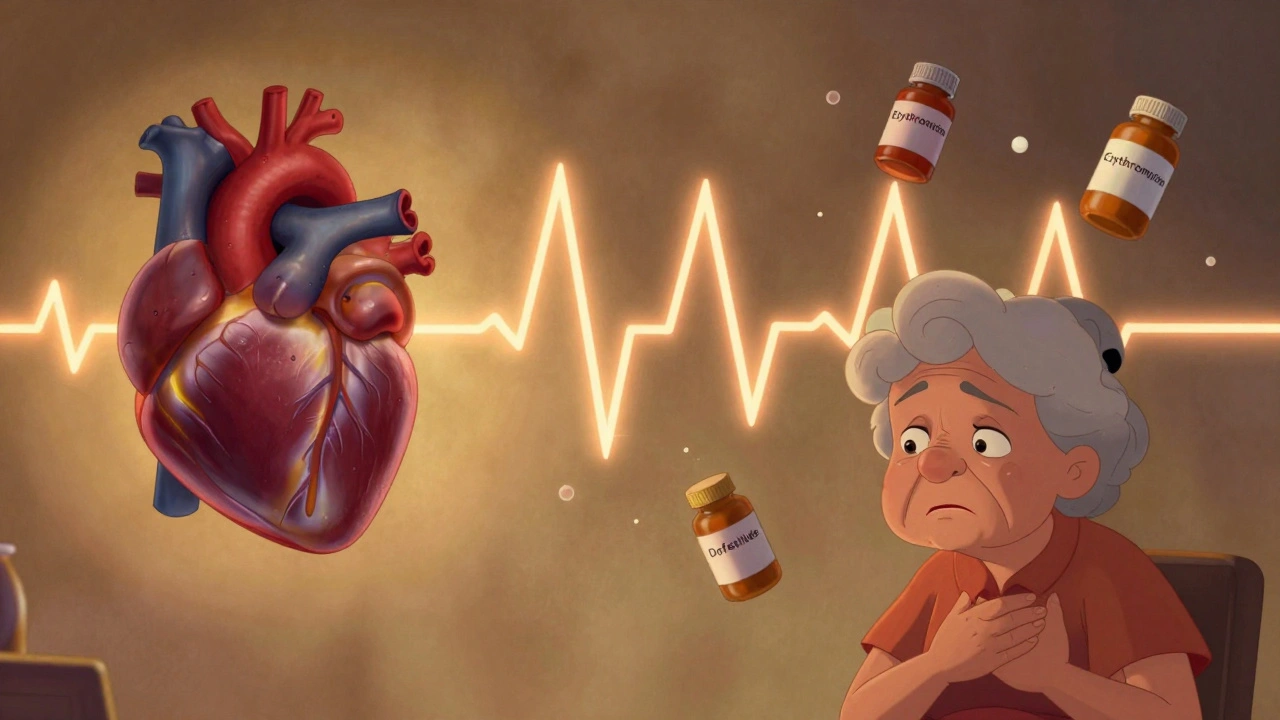
Low RiskWhen a medication changes your heart’s rhythm in ways you can’t see, the consequences can be deadly. QT prolongation isn’t something you feel until it’s too late. It’s a hidden electrical delay in the heart’s pumping cycle that can spiral into Torsades de Pointes - a chaotic, life-threatening arrhythmia - and lead to sudden cardiac death. This isn’t rare. Over 100 common prescription drugs carry this risk, from antibiotics to antidepressants, and the danger isn’t just in the drug itself - it’s in how it interacts with your body.
What Exactly Is QT Prolongation?
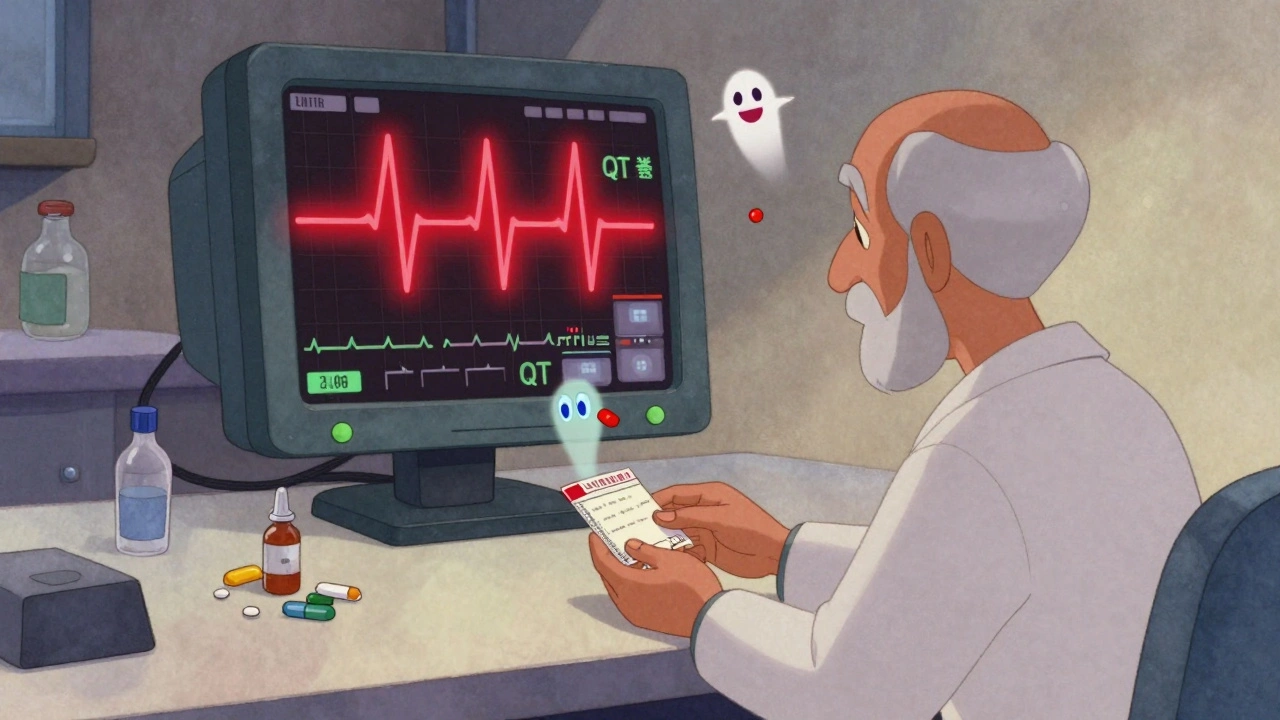
The QT interval on an ECG measures how long it takes your heart’s ventricles to recharge between beats. When that interval stretches too long - usually defined as a corrected QT (QTc) over 450 ms in men or 470 ms in women - the heart becomes electrically unstable. The longer it goes, the higher the chance of a dangerous rhythm. A QTc over 500 ms or a spike of more than 60 ms from your baseline is considered high risk. But here’s the catch: not everyone with a prolonged QT will have an event. And not everyone who has a sudden cardiac death had a dramatically prolonged QT before it happened.
The real danger lies in the T-wave shape. Research from the ARIC study found that the time between the start of the T-wave and its peak is a stronger predictor of death than the overall QT length. Each standard deviation increase in this T-peak to T-end interval raised the risk of sudden death by 21%. That’s why newer guidelines now look beyond just the number on the screen - they’re studying the shape of the wave too.
Which Medications Are the Biggest Risks?
Not all QT-prolonging drugs are created equal. Some are far more dangerous than others, especially when combined with other factors.
- Class III antiarrhythmics like dofetilide and sotalol are the most dangerous. Dofetilide alone causes Torsades de Pointes in about 3.3% of patients at standard doses.
- Antibiotics vary widely. Moxifloxacin can lengthen QT by 6-15 ms - enough to be risky in vulnerable people. Ciprofloxacin? Almost no effect. Erythromycin, especially when taken with drugs that block its breakdown (like certain antifungals or HIV meds), can double your risk of sudden death - and push it up fivefold if you’re on a CYP3A4 inhibitor.
- Antidepressants like citalopram (40 mg/day) average an 8.5 ms QTc increase. Escitalopram at the same dose? Only 4.2 ms. That’s a big difference. Sertraline and fluoxetine carry lower risk than citalopram, making them safer choices for patients with heart concerns.
- Antipsychotics like haloperidol and ziprasidone are also on the list. Even over-the-counter antihistamines like diphenhydramine can pose a risk in older adults or those with existing heart conditions.
What makes this worse is reverse use dependence - some drugs like sotalol prolong the QT more when your heart is slow. That means the risk spikes at night, during sleep, or if you’re on beta-blockers. You might feel fine during the day, but your heart is quietly setting itself up for disaster.
Who’s Most at Risk?
It’s not just about the drug. It’s about you.
- Women are more sensitive. Their baseline QT is naturally longer, so they hit dangerous thresholds faster.
- Older adults take more medications - on average 7.8 per person over 65. Nearly one in three are on at least one QT-prolonging drug.
- People with heart disease face 10 to 100 times higher risk than those with healthy hearts. If you’ve had a heart attack, heart failure, or cardiomyopathy, your heart is already electrically fragile.
- Electrolyte imbalances - low potassium, low magnesium, or low calcium - make QT prolongation much worse. Correcting potassium to above 4.0 mEq/L cuts risk by 62%.
- Drug interactions are a silent killer. Taking two QT-prolonging drugs together multiplies the danger. Even more dangerous is combining a QT drug with something that blocks its metabolism - like fluoxetine with citalopram, or erythromycin with clarithromycin. Avoiding CYP3A4 inhibitors reduces risk by 78%.
- Genetics play a role too. Some people have inherited mutations in ion channels that make them far more susceptible, even with normal QT intervals. The NIH’s All of Us program is now collecting genetic data to help identify these people before they’re ever prescribed a risky drug.
Why Do So Many People Get Caught Off Guard?
Because the system is broken.
Doctors rely on ECG alerts in electronic health records. But a 2022 JAMIA study found that 78% of those alerts are false positives. Clinicians get bombarded with warnings for low-risk drugs like ondansetron - and eventually, they start ignoring them. That’s alarm fatigue. It’s not laziness. It’s burnout.
Meanwhile, patients panic. A 2021 survey of 347 people on citalopram showed 22% stopped the drug because they were scared of QT prolongation - even though only 3% actually had a QTc over 500 ms. Fear drives behavior, not data.
And here’s the most unsettling part: the POST SCD study found that 78% of people who died suddenly while on QT-prolonging drugs had no arrhythmia at autopsy. Their deaths were caused by other things - heart failure, stroke, infection. The drug didn’t kill them. But it may have been the final trigger.
That’s why experts like Dr. Dan M. Roden say we’ve oversimplified the problem. QT prolongation is a marker, not a sentence. The real issue is the combination of drug, underlying disease, and individual vulnerability.

What Should You Do?
If you’re on a medication that can prolong QT, here’s what actually works:
- Check your baseline QTc. If you’re over 65, on multiple meds, or have heart disease, ask for an ECG before starting any new drug. Don’t wait for symptoms.
- Test your electrolytes. Low potassium and magnesium are easy to fix. Get a simple blood test. Correcting them reduces risk dramatically.
- Review every drug you take. Use the AZCERT.org database - updated weekly - to check if your meds are known, possible, or conditional risks. Your pharmacist can help.
- Avoid combinations. Never take two QT-prolonging drugs together unless absolutely necessary. And never mix them with CYP3A4 inhibitors unless under close supervision.
- Know your symptoms. Dizziness, palpitations, or fainting aren’t normal. If you feel them, get checked immediately. Don’t wait for your next appointment.
There’s no need to stop all medications. Many people take QT-prolonging drugs safely every day. But you need to be informed. Ask your doctor: "Is this drug on the list? Do I have any risk factors? Should I get an ECG?"
The Future Is Personalized
Things are changing. The FDA’s new AI-based QT monitoring system, QTguard, uses machine learning to analyze ECG patterns and cuts false alarms by over half. The International Council for Harmonisation now requires drug makers to study T-wave morphology - not just QT length - before approval. That’s a big step forward.
And in the next few years, genetic testing could become routine. If you carry a variant in the KCNH2 or KCNQ1 gene, you might be flagged before you even get your first prescription. That’s the future: not one-size-fits-all warnings, but personalized risk scores.
For now, the best protection is awareness. Know your meds. Know your body. Ask the right questions. Sudden cardiac death from a medication isn’t inevitable - it’s preventable.
Can a normal QT interval still mean I’m at risk?
Yes. A normal QT doesn’t guarantee safety. Some people have hidden electrical instability that doesn’t show up on a standard ECG. Factors like genetic mutations, electrolyte imbalances, or underlying heart disease can make even a normal QT dangerous when combined with certain drugs. That’s why experts now look at T-wave shape and clinical context - not just the number.
Is it safe to take citalopram if I have a slightly prolonged QT?
Citalopram is not recommended if your QTc is over 450 ms in men or 470 ms in women. Even at lower doses, it can push your interval into the danger zone. Escitalopram is a safer alternative - it causes about half the QT prolongation. If you need an antidepressant and have heart concerns, ask your doctor about sertraline or fluoxetine, which have much lower risk profiles.
Can I get an ECG just to check my QT interval?
Yes - and you should, if you’re over 65, on multiple medications, or have heart disease, diabetes, or kidney problems. Many clinics offer basic ECGs as part of medication reviews. Don’t wait for symptoms. A simple 10-second test can prevent a life-threatening event.
What should I do if I start feeling dizzy or my heart races after starting a new drug?
Stop the medication and seek medical help immediately. Dizziness, palpitations, or fainting could signal a dangerous arrhythmia. Don’t assume it’s just anxiety or dehydration. Call your doctor or go to urgent care. Bring a list of all your medications - including supplements and over-the-counter drugs. Time matters.
Are natural supplements safe if I’m on a QT-prolonging drug?
Not necessarily. Some supplements like licorice root, bitter orange, and high-dose green tea extract can prolong QT or interfere with drug metabolism. Even magnesium supplements can interact with certain heart meds. Always tell your doctor about everything you take - including vitamins, herbs, and CBD. What’s natural isn’t always safe.
Chris Jahmil Ignacio
December 4, 2025 AT 07:36Paul Corcoran
December 4, 2025 AT 20:43Colin Mitchell
December 5, 2025 AT 00:40Susan Haboustak
December 6, 2025 AT 04:47Pooja Surnar
December 6, 2025 AT 18:14Sandridge Nelia
December 7, 2025 AT 03:53Mark Gallagher
December 8, 2025 AT 08:40Wendy Chiridza
December 9, 2025 AT 18:52Pamela Mae Ibabao
December 11, 2025 AT 17:45Gerald Nauschnegg
December 13, 2025 AT 00:34Palanivelu Sivanathan
December 13, 2025 AT 18:37Ethan McIvor
December 14, 2025 AT 07:44Mindy Bilotta
December 14, 2025 AT 13:05Michael Bene
December 15, 2025 AT 14:07Brian Perry
December 16, 2025 AT 02:44