

When someone starts hearing voices that aren’t there, or becomes convinced that neighbors are spying on them, it’s not just odd behavior-it’s a red flag. These aren’t just "stress reactions" or "phase they’re going through." They could be the earliest signs of psychosis, a serious but treatable mental health condition. The truth? Most people don’t recognize these signs until it’s too late. And that delay costs them time, relationships, and sometimes, their future. But here’s the good news: if caught early, psychosis doesn’t have to define someone’s life. In fact, with the right support, most people recover fully. The key is knowing what to look for-and acting fast.
What psychosis really means
Psychosis isn’t a diagnosis. It’s a symptom. Think of it like a fever: it doesn’t tell you what’s wrong, but it tells you something’s seriously off. People experiencing psychosis lose touch with reality in ways that feel real to them. They might hear voices others can’t hear, believe things that aren’t true (like being followed or controlled), or struggle to organize their thoughts so much that conversations fall apart. These aren’t choices. They’re neurological events, often triggered by a mix of genetics, brain chemistry, and environmental stress.
It’s not rare. About 3 in 100 people will experience psychosis at least once in their lifetime. For many, it shows up between ages 15 and 30-right when school, work, and relationships are supposed to take off. That’s why timing matters more than anything else.
The early warning signs you can’t ignore
Before someone fully loses touch with reality, there’s a window-sometimes months or even years-when subtle changes start creeping in. These aren’t dramatic. They’re quiet. And they’re easy to miss. But if you notice a pattern, don’t wait.
- Drop in performance: A straight-A student suddenly fails classes. A reliable worker starts missing shifts. This isn’t laziness. It’s the brain struggling to focus. Studies show 78% of first-episode psychosis cases had a noticeable drop in grades or job performance.
- Social withdrawal: They stop hanging out. Cancel plans. Stop answering texts. Not because they’re "introverted," but because they feel unsafe, misunderstood, or overwhelmed. About 71% of people show this before full-blown psychosis hits.
- Strange thoughts or beliefs: They say things like, "The TV is sending me messages," or "My phone is stealing my thoughts." These aren’t jokes. They’re early delusions. Ideas of reference-where normal events feel personally directed-are common. A car honking? "It’s a warning." A stranger smiling? "They know what I did."
- Speech that doesn’t make sense: They jump from topic to topic mid-sentence. Or they stop talking mid-thought, like their brain just shut off. Sometimes, they use made-up words or repeat phrases over and over.
- Emotional shifts: They laugh at sad things. Cry for no reason. Get angry over small things. Or they show no emotion at all. Mood changes often come before hallucinations or delusions.
- Personal hygiene decline: They stop showering. Wear the same clothes for days. This isn’t rebellion. It’s a loss of motivation and awareness.
- Increased suspicion: They think people are talking about them. Believe friends are lying. Worry about being poisoned or watched. This isn’t paranoia from anxiety-it’s a new, persistent belief that doesn’t change, even with evidence.
Here’s what’s critical: people in this early stage often know something’s wrong. They say things like, "I know this isn’t normal," or "I’m scared of what’s happening to me." That’s your cue. Don’t dismiss it. Don’t wait. Help is available-and it works.
What is Coordinated Specialty Care (CSC)?
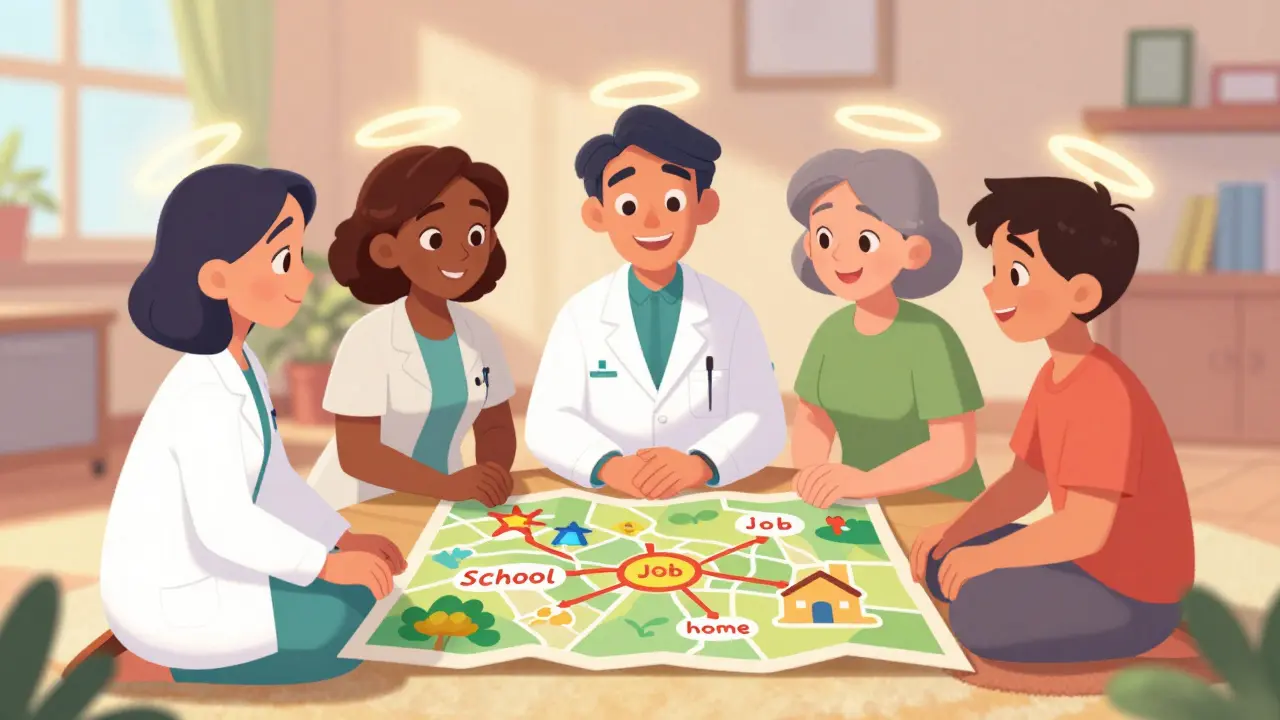
CSC isn’t just another therapy program. It’s the gold standard for treating first-episode psychosis-and it’s built on one simple idea: treat the whole person, not just the symptoms.
Before CSC, people with psychosis were often thrown into a system that treated them like cases, not people. They got a medication, maybe a therapist, and were told to come back in six months. Many dropped out. Many ended up in emergency rooms or jail. CSC changed all that.
Launched after the 2008 RAISE study by the National Institute of Mental Health, CSC brings together a team of specialists who work with the person-weekly, sometimes daily-for up to two years. It’s not one-size-fits-all. It’s personalized. And it’s proven.
Here’s what a full CSC program includes:
- Case management: A dedicated case manager visits at home, helps with appointments, transportation, housing, and daily needs. They’re the anchor when everything else feels chaotic.
- Family support: Families aren’t bystanders-they’re part of the team. Weekly education sessions teach them how to communicate, reduce stress, and support recovery without enabling symptoms.
- Individual therapy: Cognitive Behavioral Therapy for psychosis (CBTp) helps people understand their experiences, challenge false beliefs, and build coping skills. It’s not about "fixing" them. It’s about helping them regain control.
- Education and employment support: 80% of CSC participants return to school or work within three months. Whether it’s tutoring, resume help, or job coaching, this isn’t optional. It’s essential to rebuilding identity.
- Medication management: Medications are used, but carefully. Second-generation antipsychotics are started at low doses and slowly adjusted. The goal isn’t to sedate-it’s to reduce distress without side effects that make people quit.
The results? People in CSC programs are 58% more likely to see symptom improvement, 42% more likely to function well at work or school, and 35% more likely to stick with treatment. And here’s the kicker: for every $1 spent on CSC, society saves $17.50 in emergency care, hospital stays, and lost productivity.
Why timing is everything
On average, people in the U.S. wait 74 weeks-over a year and a half-before getting help after psychosis starts. That’s too long. Each extra month without treatment makes recovery harder.
Dr. Lisa Dixon from Columbia University says: "Each additional month of untreated psychosis increases recovery time by 5-7% and reduces the chance of full functional recovery by 3.2%." That’s not a small number. It’s life-changing.
Why the delay? Many don’t recognize the signs. Others fear stigma. Some don’t know where to turn. And too often, primary care doctors don’t ask the right questions.
But places like Oregon’s EASA program have proven it’s possible to cut that delay. Through school screenings and training for teachers and doctors, they reduced the average time to treatment from 112 weeks to just 26 weeks. That’s not magic-it’s strategy.
How to get help
If you or someone you care about is showing signs, here’s what to do:
- Don’t wait for it to get worse. Early action saves futures.
- Use the PQ-16 screening tool. It’s a simple 16-question checklist used by clinics nationwide. A score of 8 or higher means a full evaluation is needed.
- Find a CSC program. There are 347 certified programs across 48 states. You can search by zip code through the SAMHSA website or call 1-800-950-NAMI.
- Go to the ER if there’s danger. If someone is suicidal, violent, or completely disconnected from reality, go to the nearest emergency room. They’re required to connect you to a specialist.
- Don’t try to reason with delusions. Saying "That’s not real" makes people feel attacked. Instead, say: "I see this is really scary for you. Let’s get you some help."
The "golden hour" concept-getting help within 72 hours of first signs-isn’t hype. It’s science. The sooner someone gets into CSC, the better their odds.

What’s changing now
The field is moving fast. In 2023, the Early Psychosis Intervention Network (EPINET) launched to track outcomes across 200+ programs. Preliminary data shows 63% of participants reach symptom remission within a year. That’s groundbreaking.
Research is also unlocking biomarkers. A 2022 study in Nature Medicine identified 12 blood markers that predict psychosis with 82% accuracy. That means one day, a simple blood test could flag risk before symptoms even start.
And policy is catching up. The 21st Century Cures Act now requires Medicaid programs to cover CSC by 2025. Thirty-two states have already created billing codes so clinics can get paid. That’s huge.
But gaps remain. Rural areas still lack access. Only 28% of rural counties have CSC programs, compared to 84% of urban ones. And Black Americans wait 2.4 times longer for treatment than White Americans. That’s not just a gap-it’s a crisis.
What to expect if you start CSC
You won’t be "cured" overnight. But you will feel better. Faster.
Week 1-4: You’ll meet your team. You’ll get a full assessment. Medication may start at a very low dose. Your family will attend their first education session.
Month 2-6: You’ll be in therapy twice a month. You’ll start working on goals-whether it’s returning to school, getting a job, or reconnecting with friends. Your case manager will help with housing, food, or transportation if needed.
Months 6-18: Symptoms usually drop sharply. You’ll learn to recognize triggers. You’ll build routines. You’ll start to feel like yourself again.
By year two: Most people are working, studying, or living independently. Many stop medication entirely. All have tools to stay well.
It’s not easy. But it’s possible. And it’s worth it.
Can psychosis be cured?
Psychosis isn’t "cured" like an infection, but it can be fully managed. With early intervention through Coordinated Specialty Care, up to 63% of people reach symptom remission within a year. Many return to work, school, and relationships without needing long-term medication. Recovery means living a full life-without symptoms controlling you.
Is psychosis the same as schizophrenia?
No. Psychosis is a symptom. Schizophrenia is one possible diagnosis that includes psychosis, along with other symptoms lasting over six months. Many people experience one episode of psychosis and never develop schizophrenia. Others may have psychosis due to bipolar disorder, trauma, drug use, or medical conditions. The goal of early treatment isn’t to label-it’s to heal.
Do people with psychosis become violent?
The vast majority of people with psychosis are not violent. In fact, they’re more likely to be victims than perpetrators. Media often links psychosis with violence, but research shows only 3-5% of violent acts are committed by people with mental illness. Fear of violence is one reason people delay seeking help-but the real danger is untreated illness, not the person.
Can teens get Coordinated Specialty Care?
Yes. In fact, CSC was designed specifically for young people ages 15-30. Many programs have adolescent specialists who understand school pressures, peer relationships, and developmental needs. Treatment is adapted for teens-therapy topics, medication dosing, and family involvement are all age-appropriate.
What if I’m not sure it’s psychosis?
If you’re unsure, get an evaluation anyway. There’s no harm in ruling it out. Screening tools like the PQ-16 are designed for uncertainty. Even if it’s anxiety, depression, or burnout, getting help early improves outcomes. Waiting to see if it gets worse is the biggest risk.
How do I find a CSC program near me?
Go to SAMHSA.gov and use their treatment locator, or call the National Alliance on Mental Illness helpline at 1-800-950-NAMI. They’ll connect you to the nearest certified program. Most accept Medicaid and private insurance. Many offer sliding-scale fees if you’re underinsured.
Kenzie Goode
February 25, 2026 AT 20:23Dominic Punch
February 26, 2026 AT 00:54Valerie Letourneau
February 26, 2026 AT 13:56Khaya Street
February 27, 2026 AT 15:31Christina VanOsdol
February 28, 2026 AT 13:05Brooke Exley
February 28, 2026 AT 14:07Alfred Noble
March 1, 2026 AT 12:22Matthew Brooker
March 2, 2026 AT 14:53Emily Wolff
March 4, 2026 AT 04:16Lou Suito
March 6, 2026 AT 01:08Joseph Cantu
March 6, 2026 AT 22:03Jacob Carthy
March 6, 2026 AT 22:29Lisandra Lautert
March 7, 2026 AT 08:26