

Giving medication to a child isn't as simple as just dividing an adult dose in half. Kids aren't just small adults; their bodies process drugs differently, and their organs-especially the liver and kidneys-mature at different rates. This is why pediatric medication dosing relies on precise calculations based on a child's actual size. A small mistake in a decimal point or a mix-up between pounds and kilograms can lead to a serious medical emergency. In fact, medication errors happen twice as often in kids as they do in adults.
| Method | Primary Use Case | Accuracy Level | Key Requirement |
|---|---|---|---|
| Weight-Based (mg/kg) | Most common medications | High | Accurate weight in kg |
| Body Surface Area (BSA) | High-alert drugs (e.g., Chemotherapy) | Very High | Height and weight |
| Age-Based | Very basic over-the-counter guidelines | Low | Chronological age |
Why Weight Matters More Than Age
You might wonder why we don't just use age. Think about two different 2-year-olds. One might weigh 9 kg while the other weighs 15 kg. That is a massive 67% difference in body mass. If you gave them the same "age-based" dose, one child would likely be underdosed (meaning the medicine doesn't work) and the other could be overdosed, leading to toxicity. This is why clinicians use Weight-Based Dosing as the gold standard. By calculating the dose in milligrams per kilogram (mg/kg), the medication is tailored to the child's actual physiology.
The Golden Rule of Conversion: Pounds to Kilograms
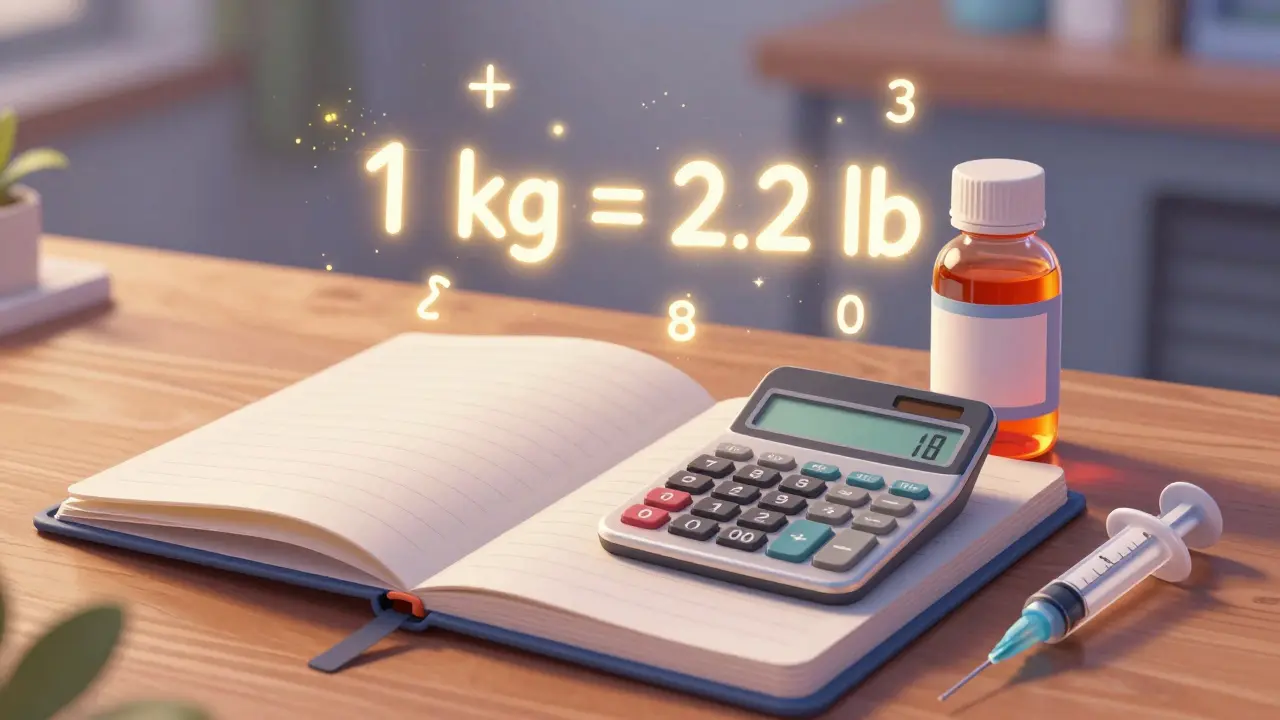
In the US, many parents and clinics still record weight in pounds, but medical calculations almost always require kilograms. This is where the most dangerous mistakes happen. The non-negotiable conversion factor is 1 kg = 2.2 lb. According to the Institute for Safe Medication Practices, about 80% of pediatric calculation errors stem from this single conversion step.
If a child weighs 56 pounds, you don't just guess. You divide the weight by 2.2. For example: 56 lb ÷ 2.2 = 25.45 kg. Always perform this conversion first before looking at the drug dosage. If you skip this or move a decimal point by mistake, you could accidentally give a child ten times the intended dose, which can lead to severe gastrointestinal toxicity or organ failure.
Step-by-Step Guide to Weight-Based Calculations
Calculating a dose requires a logical sequence. Whether you use dimensional analysis or a simple formula, the process follows these specific steps:
- Get an Accurate Weight: Use a calibrated scale. Do not rely on a growth chart from six months ago.
- Convert to Kilograms: If the weight is in pounds, divide by 2.2.
- Calculate the Total Daily Dose: Multiply the child's weight (kg) by the prescribed dose (mg/kg/day). For instance, if a child is 10 kg and the dose is 40 mg/kg/day, the total is 400 mg per day.
- Divide by Frequency: If the medication is given twice a day (BID), divide that total by two. (400 mg ÷ 2 = 200 mg per dose).
- Convert Dose to Volume: Check the concentration on the bottle. If the drug is 40 mg/mL, you divide the dose by the concentration (200 mg ÷ 40 mg/mL = 5 mL).

Advanced Dosing: Body Surface Area (BSA)
For certain high-risk medications, like Chemotherapy, weight alone isn't precise enough. These drugs have a narrow therapeutic index, meaning the gap between a working dose and a toxic dose is tiny. In these cases, doctors use Body Surface Area (BSA), which considers both height and weight.
The standard for this is the Mosteller formula. It looks like this: √([height(cm) × weight(kg)] / 3600).
For example, a child who is 97 cm tall and weighs 16.8 kg would have a BSA of 0.67 m². This allows for a much more granular level of dosing that accounts for the child's overall growth patterns rather than just their mass.

Common Pitfalls and Safety Red Flags
Even for professionals, pediatric dosing is tricky. One of the biggest points of confusion is the notation "mg/kg/d." Some people mistake this for the dose per single administration, but it actually means the total dose for the entire day. If a nurse or parent gives the full daily amount in one single dose, the result can be catastrophic.
Another danger is concentration confusion. Many medications, like acetaminophen, come in different strengths. You might have one bottle that is 160 mg/5mL and another that is 500 mg/5mL. If you use the volume from a low-concentration bottle for a high-concentration drug, you are significantly overdosing the child. Always read the label to confirm the mg per mL before drawing the liquid into the syringe.
Lastly, be aware of age-specific contraindications. For example, Diphenhydramine (Benadryl) is generally avoided in infants under 6 months and children under 2 years unless a doctor specifically monitors it, regardless of what the weight calculation suggests.
Modern Systems and the Future of Safety
To fight these errors, hospitals are moving away from manual math. Electronic Health Records (EHR) like Epic and Cerner now include integrated calculators. These systems force the user to enter the weight in both pounds and kilograms, which acts as a built-in safety check. Studies show that these automated systems can reduce calculation errors by over 50%.
Looking ahead, we are seeing the rise of AI-assisted verification. Some top children's hospitals are testing machine learning algorithms that cross-reference a calculated dose against thousands of historical patient data points to flag any dose that looks "off" for a child of that size and age. Eventually, we may even move toward pharmacogenomics, where dosing is adjusted based on a child's specific genetic ability to metabolize a drug.
Why can't I just use the dosage chart on the medicine bottle?
While bottle charts provide general guidance, they are often based on age ranges. Because children of the same age can vary wildly in weight, these charts are not as accurate as a personalized weight-based calculation from your pediatrician.
What is the difference between mg/kg and mg/m²?
mg/kg refers to milligrams of drug per kilogram of body weight. mg/m² refers to milligrams per square meter of Body Surface Area (BSA). BSA is used for very potent drugs because it more accurately reflects the body's metabolic activity.
What should I do if I'm not sure about a dose?
Never guess. If the prescription is written as "mg/kg/d" and you aren't sure if that's the daily or per-dose amount, contact the prescriber for clarification. Double-checking with a pharmacist is always the safest route.
Is Clark's Rule still used today?
Clark's Rule (Adult Dose x [weight in lb / 150]) is largely considered outdated. It is far less precise than modern mg/kg calculations and is rarely used in contemporary clinical practice.
Why do some medications have a "dose cap"?
Some drugs follow a linear weight-based rule up until a certain point, after which the dose is capped. This is because once a child reaches a certain size, their metabolism starts to mimic an adult's, and continuing to increase the dose based on weight could lead to toxicity.