
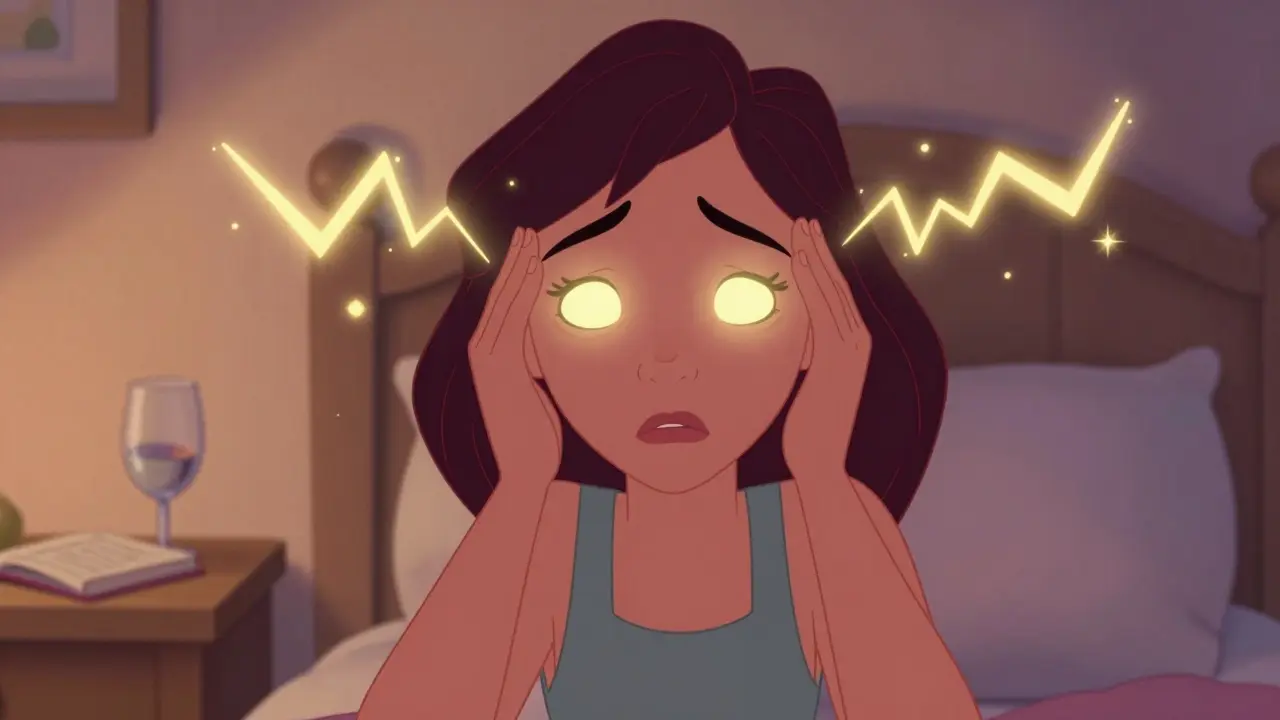
When your vision suddenly flashes with zig-zag lines, blind spots, or shimmering lights, it’s easy to panic. Is this a stroke? A brain tumor? Or just a weird migraine? The truth is, what most people call an "ocular migraine" isn’t one thing-it’s two very different conditions with wildly different risks. One is common and mostly harmless. The other is rare but could signal something serious. Knowing the difference isn’t just helpful-it could protect your vision.
What You’re Probably Experiencing: Migraine with Visual Aura
More than 25% of people who get migraines experience visual aura. This isn’t an eye problem. It’s a brain thing. A wave of electrical activity-called cortical spreading depression-spreads across the visual part of your brain. That’s what causes the weird visual effects.
These symptoms hit both eyes at once. Even if you close your eyes, you’ll still see them. Common signs include:
- Scintillating scotomas (sparkling blind spots that grow over time)
- Zig-zag lines like fortress walls (called fortification spectra)
- Flashing lights or stars
- Blurred or tunnel vision
These usually start in the corner of your vision and slowly spread outward. They last between 5 and 60 minutes, with most people experiencing them for about 27 minutes. Often, a headache follows-but not always. About 30% of people get the aura without any head pain at all.
This type of migraine affects mostly women between 35 and 45. Hormones, stress, lack of sleep, red wine, aged cheese, and artificial sweeteners are common triggers. If you’ve had these symptoms before and they’re consistent, you’re likely dealing with migraine with aura. It’s uncomfortable, sometimes scary, but rarely dangerous.
The Rare One: True Retinal Migraine
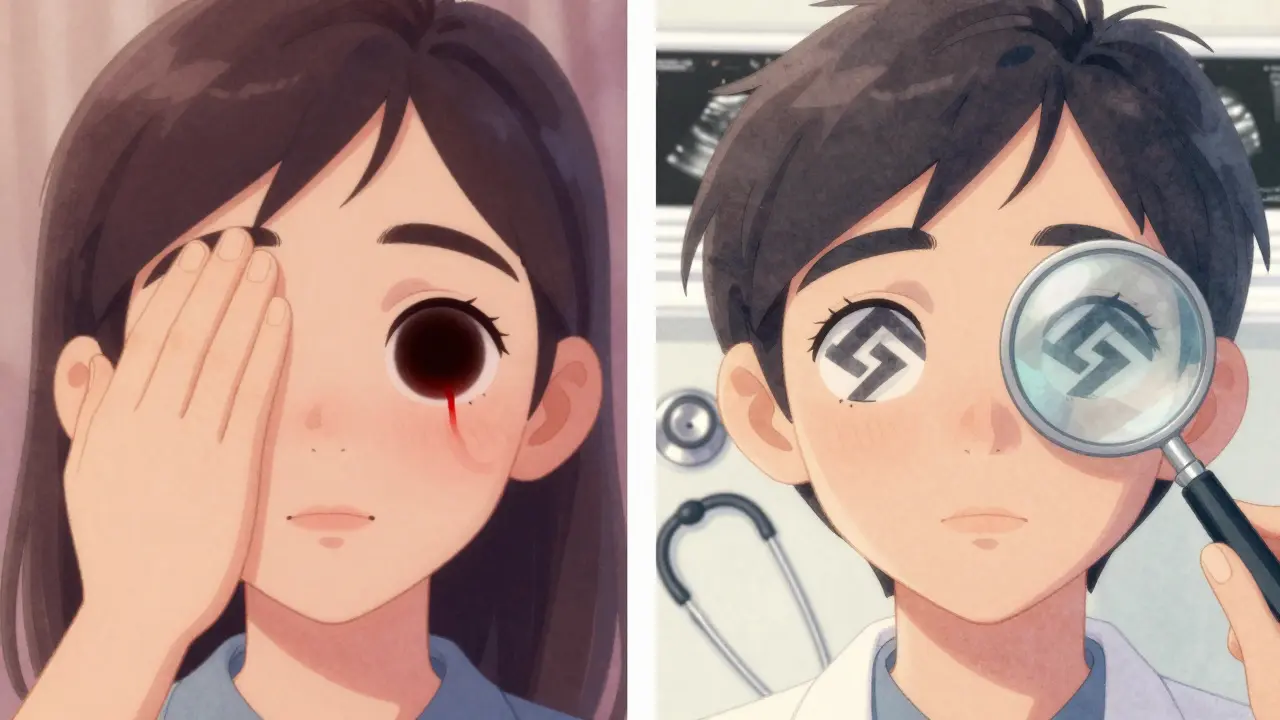
True ocular migraine-also called retinal migraine-is extremely rare. It affects less than 1% of migraine sufferers. Unlike aura, this is a problem in the eye itself. Something interrupts blood flow to the retina or optic nerve in one eye only.
The symptoms are different:
- Complete or partial vision loss in one eye
- Gray or dark spots in that eye’s vision
- Flashing lights only in one eye
You can test this easily: Cover one eye. If the symptoms disappear, it’s likely not aura. If they’re still there, it’s probably the other eye. Retinal migraine symptoms usually last less than 20 minutes-often just 10 to 14. And unlike migraine with aura, you won’t get tingling, speech trouble, or weakness on one side of your body.
The big concern? Retinal migraine might be a warning sign of something else. It’s often linked to blood vessel spasms or reduced blood flow. In some cases, it’s the first clue to carotid artery narrowing or other vascular issues. That’s why even if it’s brief and goes away, it needs evaluation.
When to Worry: The Red Flags
Most visual disturbances from migraine are harmless. But some signs mean you need to see a doctor right now. The American Academy of Neurology lists six red flags:
- Symptoms last longer than 60 minutes
- First-time aura after age 50
- Weakness or numbness on one side of your body
- Symptoms that don’t follow the usual pattern (e.g., sudden total blindness without warning)
- No headache after the visual symptoms, especially if you’re over 50
- Repeated episodes in the exact same spot of your vision
These aren’t just "maybe" signs. They’re emergency indicators. Stroke, transient ischemic attack (TIA), or giant cell arteritis can mimic migraine aura-but they don’t go away on their own. Giant cell arteritis, for example, can cause permanent blindness in a week if untreated. It’s more common in people over 50 with jaw pain when chewing, scalp tenderness, or unexplained weight loss.
Carotid stenosis (narrowing of the neck artery) also looks like retinal migraine. In fact, about 23% of people diagnosed with retinal migraine turn out to have significant carotid blockage. That’s why a simple carotid ultrasound can be life-changing.
What Doctors Look For
There’s no single test for migraine with aura. Diagnosis is based on your symptoms, history, and ruling out other causes. For retinal migraine, doctors may:
- Perform a visual field test during an episode
- Check your blood pressure and cholesterol
- Order blood tests for inflammation (ESR, CRP) if you’re over 50
- Recommend an ultrasound of your carotid arteries
- Refer you to a neuro-ophthalmologist
One patient on Reddit described how her neuro-ophthalmologist did a visual field test while she was having an episode. "That confirmed it was retinal migraine-not stroke. That validation changed everything." Many people wait years for the right diagnosis. On average, it takes over three years. Don’t be afraid to push for testing if something feels off.
Treatment: What Works and What Doesn’t
For migraine with aura, treatment depends on frequency and severity. If it’s occasional, over-the-counter pain relievers like ibuprofen or acetaminophen can help. For frequent or disabling attacks, doctors may prescribe:
- Triptans (like sumatriptan nasal spray)-effective for 72% of people within two hours
- Gepants (like rimegepant)-a newer option that doesn’t constrict blood vessels
But here’s the catch: Triptans are dangerous for retinal migraine. Because they narrow blood vessels, they could worsen the ischemia in your eye. If you’ve ever had vision loss in one eye, avoid triptans unless a specialist confirms it’s not retinal migraine.
Prevention is key for frequent aura. Studies show:
- Propranolol (a beta-blocker) reduces aura frequency by 58%
- Calcium channel blockers like verapamil help stabilize blood vessels
- CGRP monoclonal antibodies (like erenumab) cut aura days by over half
- Magnesium supplements (600mg daily) reduce aura frequency by 41.6%
- Mindfulness and regular sleep cut episodes by 30% or more
Many people find that tracking triggers helps. Keep a journal: What did you eat? How much sleep did you get? Were you stressed? Over time, patterns emerge. Avoiding red wine or skipping late-night work sessions might be enough to cut episodes in half.
Long-Term Outlook
The good news? Most people with migraine with aura live normal, healthy lives. A 20-year Mayo Clinic study found 98% retained full vision with proper management. The risk of stroke is slightly higher-especially in women under 45 who smoke or use birth control pills. That’s why doctors strongly advise against hormonal contraceptives if you have aura.
Retinal migraine is trickier. While the episodes themselves are temporary, they may point to underlying vascular disease. About 12% of people with repeated retinal migraine develop permanent vision changes if the root cause isn’t addressed. That’s why follow-up care matters-even if the episodes stop.
Research is moving fast. New drugs targeting cortical spreading depression are in trials. Blood tests for CGRP levels and EEG patterns during aura might soon help diagnose these conditions faster. For now, the best tools are awareness, careful tracking, and knowing when to act.
What You Can Do Today
If you’ve had visual disturbances:
- Write down exactly what you saw, how long it lasted, and if it was one eye or both
- Note any triggers: stress, food, sleep, hormones
- Don’t assume it’s "just migraines"-especially if you’re over 50
- If symptoms last longer than an hour or come with weakness, go to the ER
- Ask your doctor about ESR/CRP tests if you’re over 50 and have scalp or jaw pain
- Get your blood pressure and cholesterol checked if you’ve had vision loss in one eye
You don’t need to live in fear. But you do need to be informed. Most people with visual aura are fine. A small number are at risk-and they’re the ones who get missed because everyone assumes it’s "just a migraine." Don’t be one of them.
Can ocular migraines cause permanent vision loss?
Migraine with visual aura almost never causes permanent vision loss. But true retinal migraine, if linked to underlying vascular disease like carotid stenosis or giant cell arteritis, can lead to permanent damage if untreated. About 12% of people with repeated retinal migraine episodes develop lasting vision changes when the root cause isn’t addressed.
Are ocular migraines a sign of stroke?
Not usually-but they can mimic stroke symptoms. About 15% of posterior circulation strokes present with aura-like visual disturbances. The key differences are duration (stroke symptoms don’t resolve in 60 minutes), new-onset after age 50, and accompanying weakness or speech issues. If you’re over 50 and have sudden vision changes, assume it’s a stroke until proven otherwise.
Should I avoid triptans if I have ocular migraines?
Yes-if you’ve had vision loss in one eye, avoid triptans unless a specialist confirms it’s migraine with aura and not retinal migraine. Triptans constrict blood vessels and could worsen retinal ischemia. Gepants are a safer alternative for people with possible retinal involvement.
Can stress trigger ocular migraines?
Yes. Stress is the most commonly reported trigger, cited by 78% of patients in large registries. High-pressure work environments, sleep deprivation, and emotional strain can all set off both migraine with aura and retinal migraine. Managing stress through mindfulness, regular sleep, and exercise can reduce episodes by up to 32%.
Is it safe to use birth control if I have ocular migraines?
No-not if you have migraine with aura. The combination of estrogen-containing birth control and aura increases stroke risk by more than double, especially in women under 45 who smoke. Doctors strongly recommend non-hormonal contraception or progestin-only options for anyone with aura symptoms.
How do I know if it’s retinal migraine or something else?
Cover one eye at a time. If symptoms affect only one eye and include complete or partial vision loss, it’s likely retinal migraine. If both eyes are affected and you see zig-zags or flashing lights even with eyes closed, it’s migraine with aura. But don’t self-diagnose-see a doctor. Conditions like carotid stenosis, giant cell arteritis, or retinal detachment can look identical.
John Ross
January 4, 2026 AT 09:45Let’s cut through the noise: cortical spreading depression isn’t some mystical phenomenon-it’s a neurovascular cascade with documented propagation velocity of 2-6 mm/min across the occipital cortex. The fortification spectra? That’s the BOLD fMRI signature of transient hypoperfusion in V1-V3. If you’re not tracking your aura with a structured diary and EEG correlation, you’re not managing it-you’re just surviving it.
jigisha Patel
January 5, 2026 AT 23:14It is imperative to note that the diagnostic criteria for migraine with aura, per ICHD-3, require at least two of the following: fully reversible symptoms, gradual development over ≥5 minutes, duration of 5–60 minutes, and association with headache in ≥2 attacks. Failure to meet these thresholds warrants neuroimaging, particularly in patients over 50. The article understates the necessity of MRI with DWI sequences to exclude posterior circulation infarcts.
Michael Rudge
January 6, 2026 AT 15:10Oh wow, another ‘it’s probably just migraines’ feel-good piece. You know what else looks like a migraine? A slow-growing occipital glioma. Or a carotid dissection. Or a clot riding the vertebral artery like a lazy surfer. And you’re telling people to ‘track triggers’? Like, drink less wine and maybe you won’t go blind? Please. If your vision goes weird, you don’t get to decide if it’s ‘harmless.’ You go to the ER. Period.
Doreen Pachificus
January 8, 2026 AT 01:19Interesting. I’ve had the zig-zags for years, always both eyes, no headache. Never thought to check if it was aura vs retinal. I’ll cover one eye next time. Also-magnesium 600mg? I tried that once and it gave me the worst diarrhea of my life. Maybe try the citrate form?
Jack Wernet
January 9, 2026 AT 21:40Thank you for this clear, evidence-based breakdown. Too often, patients are dismissed with ‘it’s just migraines’ when the real concern is vascular pathology. I’ve seen patients with giant cell arteritis lose vision within weeks because their symptoms were mislabeled as aura. This post could save someone’s sight.
Charlotte N
January 11, 2026 AT 02:01so i had this thing last week… like… flickery lights in the corner of my left eye? lasted like 15 mins? then poof gone? i thought it was my screen? but then i closed my eyes and still saw it?? and i didn’t have a headache?? so i just… kept going?? maybe i should get it checked??
Catherine HARDY
January 12, 2026 AT 13:14They don’t want you to know this-but the pharmaceutical industry funds most migraine research. Triptans are profitable. CGRP inhibitors cost $10,000 a year. Meanwhile, the real cause? Fluoride in the water. It calcifies the pineal gland, disrupts melatonin, and triggers cortical spreading depression. They won’t tell you that. But if you’re seeing zig-zags… you’re being targeted. Drink reverse-osmosis water. Take iodine. And stop trusting doctors who prescribe pills.
bob bob
January 12, 2026 AT 23:42Man, I used to get these all the time back in college-like, every other week. Started meditating, got sleep down, cut out the red wine and aged cheese… haven’t had one in 3 years. It’s not magic, it’s just life stuff. You don’t need a fancy drug if you’re treating the root. Also-your brain is not your enemy. It’s trying to tell you something.
Vicki Yuan
January 14, 2026 AT 12:20Correction: The Mayo Clinic study referenced tracked 1,207 patients over two decades and found 98% retained full visual acuity. However, the relative risk of ischemic stroke in women under 45 with migraine with aura is 2.3-fold higher than in controls. Hormonal contraception is contraindicated not because of anecdotal evidence, but because of pooled meta-analyses from the MIGRASAFE and SMART trials. Please cite your sources accurately.
Enrique González
January 15, 2026 AT 00:41Been there. Did the whole triptan thing. Got the vision loss in one eye after. Turned out to be retinal. Now I take verapamil. No more episodes. Just wanted to say-don’t ignore it. Go get the carotid ultrasound. It’s a 15-minute test. Could save your eye.
Aaron Mercado
January 15, 2026 AT 07:07WHAT?!?!?! YOU’RE TELLING ME I COULD’VE GONE BLIND BECAUSE I TOOK SUMATRIPTAN?!?!?! I’VE BEEN TAKING IT FOR 12 YEARS!!! I’M 43, FEMALE, HAD AURA SINCE I WAS 18, AND I’VE BEEN SELF-MEDICATING WITH TRIPTANS LIKE THEY’RE SKITTLES!!! I’M GOING TO THE ER RIGHT NOW!!!
saurabh singh
January 15, 2026 AT 18:48bro this is gold. i’m from delhi, had this once last monsoon-thought it was my eyes drying out. then i read this and realized it was aura. now i track my sleep and stress. no more chai after 4pm. also-magnesium worked better than any pill. thanks for the real talk.
Dee Humprey
January 16, 2026 AT 06:19My mom had retinal migraines. She ignored it for years. Then one day-permanent blind spot in her left eye. Turned out to be carotid stenosis. She’s fine now after stent, but I wish she’d listened. Please, if you see this-get checked. Even if it’s "just" a migraine. Don’t wait.
Vikram Sujay
January 17, 2026 AT 05:53One must consider the phenomenological dimension of visual aura: it is not merely a neurological event, but an ontological rupture in the perceptual field. The scintillating scotoma, in its slow expansion, mirrors the Buddhist concept of impermanence-each flicker a reminder that sensory reality is contingent, unstable, and ultimately illusory. To treat it as a mere pathology is to reduce the sublime to the mechanical.
Shanna Sung
January 18, 2026 AT 07:37So let me get this straight… they say it’s harmless unless you’re over 50… but what if you’re 49 and on birth control and your boss is a narcissist and you’re sleep-deprived and you live near a 5G tower? Is it still harmless? Or are they hiding the truth? I think the CDC knows. I think the FDA knows. I think they’re letting people go blind so the drug companies can sell more pills. I’m not going to the doctor. I’m going to the news.