
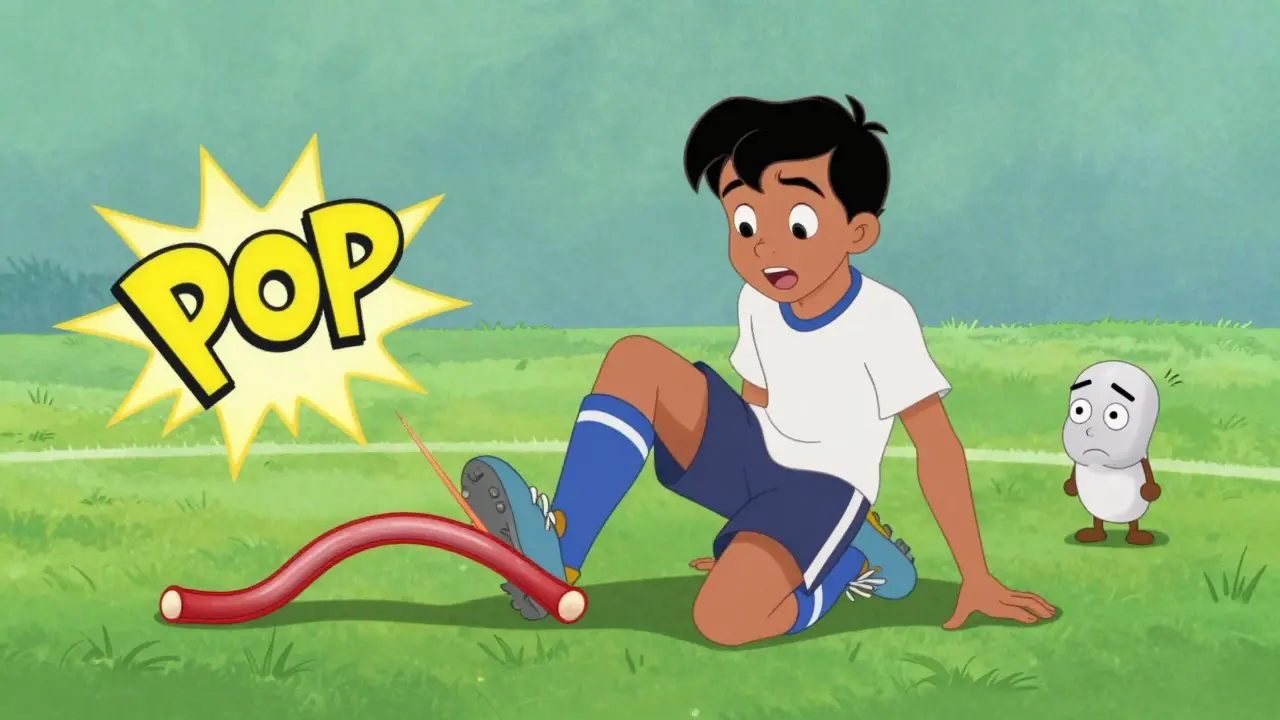
When your knee gives out during a quick turn on the soccer field, or you hear a loud pop while landing from a jump, it’s not just pain-it’s a signal that something serious has happened. Two of the most common and debilitating knee injuries are tears in the anterior cruciate ligament (ACL) and the meniscus. Both cause swelling, instability, and long-term risks if not handled right. But they’re not the same. Understanding the difference isn’t just academic-it can change whether you need surgery, how long you’re out of action, and even whether you’ll develop arthritis in your 40s.
What Exactly Is the ACL and Meniscus?
The ACL is a strong, rope-like ligament that runs diagonally in the middle of your knee. It stops your shinbone from sliding too far forward under your thighbone and helps control rotation. Without it, your knee feels loose, especially when you stop suddenly or change direction. Think of it like the steering cable on a bike-if it snaps, you lose control.
The meniscus is different. There are two of them-medial and lateral-each shaped like a C. They’re made of tough cartilage, acting like shock absorbers between your thighbone and shinbone. They spread weight evenly across the joint and protect the bone surfaces. Unlike ligaments, they don’t have much blood supply, especially in the inner part. That’s why some tears can’t heal on their own.
ACL tears are usually complete ruptures. Meniscus tears come in many forms: radial, horizontal, bucket-handle. Location matters. A tear in the outer edge (red-red zone) has a better shot at healing because it gets blood. A tear in the center (white-white zone)? Forget about healing without help.
How Do You Know Which One You Have?
There’s no guessing with these injuries. Symptoms overlap, but the patterns are distinct.
ACL tears often happen without contact. You’re sprinting, plant your foot, and your knee gives way. About 90% of people hear or feel a pop. Swelling hits fast-within two hours in 85% of cases. You can’t fully straighten your leg. The knee feels unstable, like it might buckle. A doctor can test this with the pivot shift maneuver-it’s highly accurate.
Meniscus tears? They’re sneakier. You might not even realize you hurt it at first. Swelling comes later-6 to 24 hours after. You don’t feel like your knee is going to collapse. Instead, you feel catching, locking, or a clicking sensation. Pain is sharp and focused along the joint line. Try to squat or twist? It hurts. Press on the side of your knee? Tenderness there is a strong clue.
Studies show 78% of meniscus tear patients report locking. Only 12% of ACL patients do. That’s a clear differentiator.
Do You Need Surgery?
This is where most people get stuck. The answer isn’t yes or no-it’s "it depends."
For ACL injuries, surgery is almost always recommended for active people under 40 who play sports that involve cutting, pivoting, or jumping. That’s because the ACL doesn’t heal on its own. Without reconstruction, you’re at high risk for further damage to the meniscus and cartilage. The American Orthopaedic Society for Sports Medicine says 95% of young athletes should have ACL reconstruction. Non-surgical options exist for older or sedentary people, but they come with trade-offs: higher chance of future meniscus tears and early arthritis.
Meniscus tears? Only 30-40% need surgery. The rest can improve with physical therapy, activity modification, and time. If your tear is small, stable, and not causing locking, conservative care works. But if you’re locked up, can’t straighten your leg, or have persistent pain after 6 weeks of rehab, surgery becomes the next step.
And here’s the catch: the longer you wait on a meniscus tear, the worse it gets. If you delay beyond 3 months, tissue degenerates. Repair becomes impossible. You’re more likely to end up with a partial removal (meniscectomy) instead of a repair. That’s bad news long-term. Every 10% of meniscus removed raises your arthritis risk by 14%.
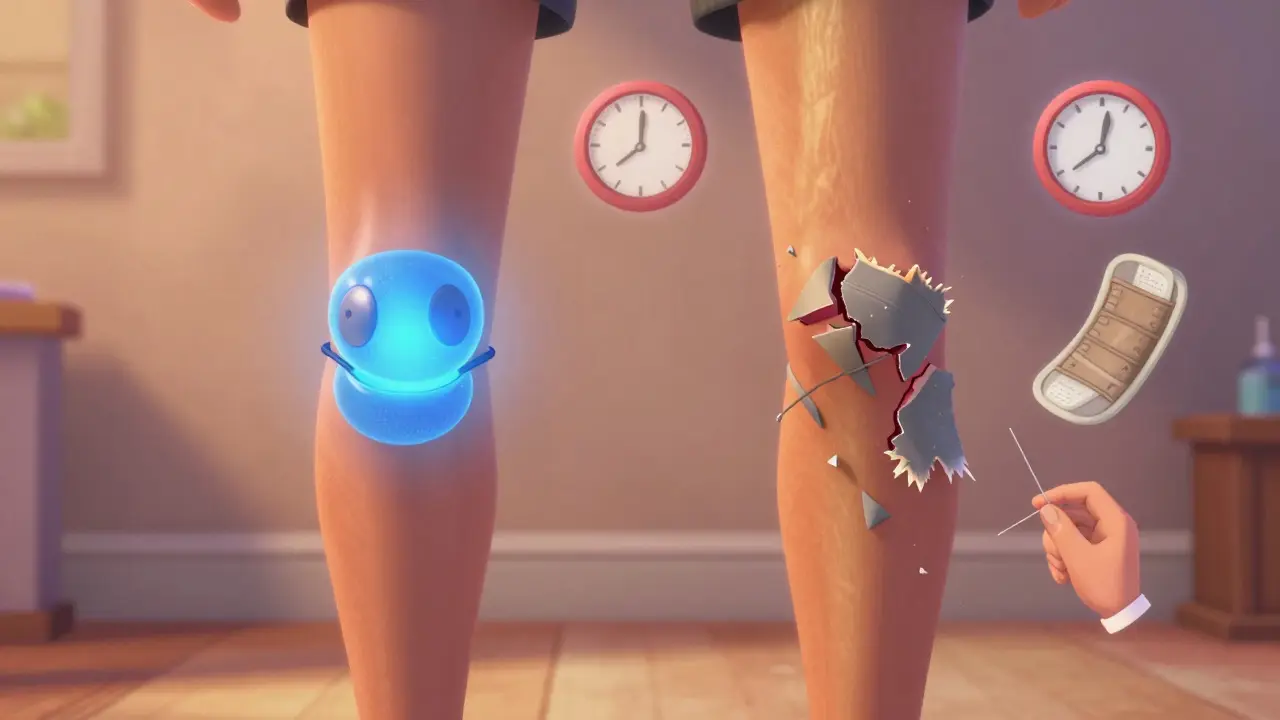
Surgery Types and Recovery Timelines
ACL reconstruction means replacing the torn ligament. Surgeons usually use your own tissue-either the hamstring tendon or the patellar tendon. Hamstring grafts are more common now because they cause less front-knee pain. Bone-patellar-tendon-bone grafts are stronger but harder on the kneecap. Allografts (donor tissue) are used sometimes, especially in older patients, but they have higher failure rates in young athletes.
Recovery isn’t quick. You’re not back on the field at 3 months. You need 9 months. Why? Because the graft needs to become a real ligament. It takes time for blood vessels and nerves to grow into it. Jumping back too early? You’re 5 times more likely to re-tear it. Studies show 22% re-injury rate at 8 months versus 4.5% at 12 months.
Meniscus repair? That’s a different game. If the tear is in the red zone, surgeons stitch it up with sutures. But you can’t put weight on it right away. You’re in a brace for 6 weeks, with limited bending. Full recovery takes 4 to 6 months. Return to sports? Around 6 months. That’s longer than meniscectomy, where you can walk the next day and return to light activity in 2-4 weeks. But here’s the trade-off: meniscectomy removes part of your shock absorber. Repair keeps it intact.
Healing rates tell the story. Meniscus repairs in the red-red zone heal in 89% of cases if done within 8 weeks. After 3 months? It drops to 40%. That’s why timing matters more than you think.
Costs and Real-World Outcomes
ACL reconstruction costs between $15,000 and $25,000 in the U.S. Meniscectomy? $6,000-$12,000. Meniscus repair? $9,000-$18,000. Insurance covers most of it, but deductibles and copays add up. Physical therapy is a hidden cost-many patients need 6-12 months of rehab.
Success isn’t just about pain going away. It’s about function.
For ACL reconstruction, 82-92% of patients report good to excellent outcomes at 2 years. But 20-30% develop osteoarthritis within 10 years. That’s not a failure of surgery-it’s a consequence of the original injury. Even with a perfect reconstruction, the joint has been damaged.
Meniscectomy gives quick relief. 85-90% feel better in the short term. But 14% more arthritis risk per 10% of meniscus removed. A 2020 study showed people who had half their meniscus taken out were 3 times more likely to need a knee replacement by age 50.
Patients on Reddit and Healthgrades say it best. One man with an ACL tear: “I had hamstring graft. Got strong, but my quad never fully came back. MRI showed 15% less muscle mass.” Another woman with a meniscus repair: “The brace kept me from bending past 90 degrees for 6 weeks. Now I can’t fully straighten my leg. Permanent deficit.”

What Should You Do Next?
If you’ve injured your knee:
- Get an MRI within 2 weeks. Don’t wait. Every week you delay reduces repair options for the meniscus.
- See a sports medicine specialist-not just any orthopedist. They know the latest protocols.
- Start physical therapy immediately, even if you’re considering surgery. Prehab improves outcomes. Strengthening your quad before ACL surgery cuts post-op weakness by 60%.
- Ask about graft options. If you’re under 25, insist on an autograft. Allografts have higher failure rates.
- For meniscus tears, ask: "Can this be repaired?" Not "Can this be trimmed?"
And remember: the goal isn’t just to get back on the field. It’s to keep your knee healthy for decades. That means preserving the meniscus, rehabbing properly, and resisting the urge to rush back too soon.
What’s Changing in Treatment?
The field is shifting. Surgeons used to remove meniscus tissue freely. Now, they’re fighting to save it. In Europe, 40% of meniscus tears are repaired. In the U.S., it’s only 25%. Why? Incentives. Repair is more expensive and takes longer. But long-term, it’s cheaper-fewer joint replacements down the road.
New techniques are emerging. Meniscus allografts (donor meniscus transplants) are helping people who’ve lost large portions. Biologics like platelet-rich plasma are being tested to boost healing in poor-blood-supply zones. Early results show 25% higher healing rates.
Prevention is growing too. Programs like FIFA 11+ reduce ACL tears by 50% in soccer players. Neuromuscular training-balance, landing mechanics, core strength-is becoming standard in high schools and clubs.
By 2030, experts predict half of all meniscus tears will be repaired, not removed. And ACL surgery rates may drop as prevention catches on.
Can a meniscus tear heal without surgery?
Yes, about 60-70% of meniscus tears can be managed without surgery, especially if they’re small, stable, and don’t cause locking or persistent pain. Conservative treatment includes physical therapy, activity modification, anti-inflammatory medication, and time. Healing is more likely if the tear is in the outer third (red-red zone), where blood supply exists. Tears in the inner zone rarely heal on their own and may require surgery if symptoms persist.
How long does ACL recovery really take?
Full recovery from ACL reconstruction takes 9 to 12 months. Most people can walk without crutches in 2-4 weeks, and return to light activities like cycling or swimming by 3-4 months. But returning to pivoting sports like soccer, basketball, or football requires at least 9 months. Studies show returning before 9 months increases re-injury risk by 5 times. Physical therapy is critical-regaining full strength, balance, and neuromuscular control takes time. Skipping steps or rushing back leads to failure.
Is ACL surgery better with hamstring or patellar tendon graft?
Both are effective, but hamstring grafts are now preferred for most patients. They cause less pain in the front of the knee, allow quicker initial recovery, and have similar long-term strength and stability. Patellar tendon grafts are slightly stronger (2,900N vs. 2,400N) and may be chosen for high-demand athletes or revision surgeries. However, they carry a higher risk of anterior knee pain and patellar fracture. The choice depends on your activity level, anatomy, and surgeon’s experience.
Why is timing so important for meniscus repair?
Meniscus tissue degenerates quickly after injury. If you wait more than 3 months, the edges become frayed and weak, making sutures ineffective. Healing rates drop from 80-90% when repaired within 8 weeks to 40-50% after 3 months. Delayed treatment also increases the chance you’ll need a partial removal instead of a repair. Early diagnosis and intervention are critical to preserving the meniscus and preventing future arthritis.
Do I need surgery if I’m over 40?
Not necessarily. For ACL injuries in patients over 40, non-surgical treatment is often successful if you’re not playing high-impact sports. Many older adults adapt by modifying activities, strengthening muscles, and using braces. Meniscus tears in this age group are often degenerative, not traumatic. Physical therapy and injections can manage pain effectively. Surgery is considered only if conservative care fails and symptoms severely limit daily function.
Melissa Stansbury
March 18, 2026 AT 06:17I tore my ACL playing soccer in college and skipped surgery because I was scared. Big mistake. Two years later, I couldn't walk down stairs without my knee buckling. Got the reconstruction at 28 and it saved my life-but now I have early arthritis at 34. Don't be like me. Get the surgery. Rehab hard. Don't rush back. Your future self will thank you.
cara s
March 19, 2026 AT 08:53It is, of course, profoundly noteworthy that the medical community has, over the past decade, undergone a paradigmatic shift in its approach to meniscal pathology-particularly with regard to the preservationist ethos now championed by leading orthopedic institutions in Scandinavia and Germany. One must consider, in light of longitudinal cohort studies published in The Lancet and JAMA Orthopaedics, that partial meniscectomy is, in fact, an iatrogenic pathway to accelerated osteoarthritis, especially when performed in patients under the age of forty-five. The economic burden, while substantial in the short term, pales in comparison to the lifetime cost of total knee arthroplasty. One wonders why U.S. insurers still incentivize removal over repair.
Amadi Kenneth
March 19, 2026 AT 23:33They don't want you to know this-but ACL reconstruction is a billion-dollar scam. The grafts? Made in China. The hardware? Imported. The whole system is rigged to keep you in physical therapy for years while they bill your insurance. I had my ACL done and my surgeon admitted in private: 'We don't fix knees-we manage symptoms.' And the meniscus? They cut it out because it's faster. No one tells you that 80% of meniscus tears are degenerative-not traumatic. They're just aging. But you? You're told you need surgery. Wake up.
Shameer Ahammad
March 21, 2026 AT 17:49It is an absolute moral failing that insurance companies in the United States refuse to cover meniscus repair unless the tear is classified as 'acute' and 'repairable'-a definition so narrow that it excludes 70% of patients who could benefit. This is not medicine; it is profit-driven triage. A 2022 study from Johns Hopkins demonstrated that early repair reduces long-term joint replacement risk by 62%. Yet, surgeons are paid 3x more for a meniscectomy. The system is broken. And if you're not outraged, you're complicit.
Alexander Pitt
March 22, 2026 AT 16:46Prehab is non-negotiable. If you're getting ACL surgery, start quad strengthening now. Even if you're waiting for the op. Studies show 60% less post-op weakness if you enter surgery with at least 85% of your quad strength intact. Also, don't skip the proprioception drills. Balance boards, single-leg stands, heel-to-toe walks-these aren't optional. They're the difference between walking normally and limping for life. And yes, 9 months is the minimum. No shortcuts.
Manish Singh
March 23, 2026 AT 01:56In India, we don't have access to the same care. I tore my meniscus playing cricket. The local ortho said, 'Just rest.' I did. For 6 months. Pain went away, but my knee never locked again. I didn't need surgery. I adjusted. I stopped jumping. I stopped twisting. I built strength around it. Sometimes, the body knows what to do. You don't always need a scalpel. You need patience. And a good physio.
Nilesh Khedekar
March 24, 2026 AT 00:57Did you know the FDA doesn't require long-term studies on ACL grafts? None. Zero. They approve them based on 'short-term stability'-like 1 year. But we all know arthritis shows up at 10 years. So who's really being tested? The patients. The companies? They're laughing all the way to the bank. And don't get me started on allografts. Donor tissue? Yeah, that's from dead people. What if it's infected? What if it's from a drug user? They don't screen for that. You're playing Russian roulette with your knee.
Robin Hall
March 25, 2026 AT 08:56It is a matter of profound public health concern that the majority of ACL reconstructions in the United States are performed on adolescents between the ages of 15 and 19. This demographic exhibits the highest rate of re-injury, particularly when returning to sport before 12 months. Furthermore, the use of allografts in this group is statistically associated with a 3.7-fold increase in graft failure. The medical community must implement mandatory pre-operative counseling on long-term outcomes, and insurance providers must be held accountable for covering extended rehabilitation protocols. Failure to do so constitutes a breach of the standard of care.
Suchi G.
March 26, 2026 AT 16:51I had a meniscus repair and it was the worst 6 months of my life. The brace was like a prison. I couldn't hug my kid properly. Couldn't sit cross-legged. Couldn't even put on socks without crying. My husband said I was a monster. I was. I was in pain, and tired, and scared I'd never play tennis again. And now? I can't fully straighten my leg. I have a permanent 10-degree bend. I don't regret the surgery. I regret the lack of warning. They didn't tell me about the stiffness. They just said, 'You'll be fine.' I'm not fine. I'm just… adapted.
becca roberts
March 27, 2026 AT 01:58So let me get this straight: You're telling me the U.S. does 25% meniscus repairs and Europe does 40%… because we're too cheap to pay for the longer surgery? That's not a medical decision. That's a corporate one. And yet we act like we're the global leaders in sports medicine? Please. We're the land of 'fix it quick, bill it hard.' Meanwhile, German surgeons are teaching U.S. residents how to suture meniscus like it's embroidery. And we're still cutting it out like it's a weed. I'm embarrassed.
Andrew Muchmore
March 28, 2026 AT 20:09Paul Ratliff
March 29, 2026 AT 11:03My bro had ACL surgery. Hamstring graft. Came back in 6 months. Blew out his other knee 3 months later. Dude didn't do PT. Just thought 'I'm good.' Now he's on disability. Surgery's not magic. Rehab is. And no one talks about how hard that part is. You gotta want it. Or you're just another statistic.