
Lithium Thyroid Medication Calculator
Adjust Your Levothyroxine Dose
Lithium users often need 20-30% more levothyroxine than others. This tool helps estimate your adjusted dose based on your thyroid function and lithium levels.
Adjusted Levothyroxine Dose:
-- mcg
Based on your inputs, you likely need 20-30% more levothyroxine than usual
Note This is an estimate. Your doctor should determine your final dose.
When you’re taking lithium for bipolar disorder, the goal is simple: keep your mood stable. But for many people, that stability comes with an unexpected cost - your thyroid. Lithium doesn’t just affect your brain. It quietly interferes with how your thyroid works, often without warning. By the time symptoms like fatigue, weight gain, or cold intolerance show up, your thyroid may already be struggling. The good news? You don’t have to live with it. With the right monitoring and management, you can keep both your mood and your thyroid in check.
How Lithium Disrupts Thyroid Function
Lithium doesn’t cause thyroid disease outright. Instead, it messes with the natural process of making and releasing thyroid hormones. Your thyroid uses iodine to build T4 and T3 - the hormones that control your metabolism, energy, and body temperature. Lithium blocks two key steps: it stops iodine from attaching to tyrosine (a building block of thyroid hormone), and it prevents the thyroid from releasing the hormones it already made. Think of it like jamming a lock - the keys are there, but you can’t turn them.
Over time, this leads to two main problems: goiter and hypothyroidism. Goiter means your thyroid gland swells up as it tries harder to produce hormones. About 30% to 59% of people on long-term lithium develop a noticeable goiter. Hypothyroidism - when your thyroid doesn’t make enough hormone - affects roughly 20% of lithium users. In one 2023 study of over 1,200 patients, 32% developed thyroid issues, and nearly 8 out of 10 of those were hypothyroid.
It’s not just about hormone levels. Lithium also changes the structure of thyroglobulin, the protein that holds thyroid hormones in place. It even interferes with tubulin, a protein that helps thyroid cells function properly. These changes can cause the gland to grow and become less efficient. The result? A thyroid that’s working overtime but delivering less.
Who’s Most at Risk?
Not everyone on lithium gets thyroid problems - but some people are far more likely to. Women under 60 are at the highest risk, developing hypothyroidism more than three times as often as men on the same dose. Age matters too. The longer you take lithium, the higher your risk. Studies show that after 10 years, about half of patients develop goiter. And it’s not just time - dose plays a role. Each extra 100 mg per day increases your odds of thyroid dysfunction by 27%, according to a 2024 study.
Where you live also matters. In places like Denmark, where iodine intake is lower, goiter rates hit 50%. In the U.S., where salt is iodized, the rate is closer to 30%. This shows that your environment interacts with lithium in ways doctors are still learning to predict.
There’s also a genetic component. Some people develop antithyroid antibodies - signs of autoimmune activity - after starting lithium. While not everyone does, those who do are more likely to develop lasting thyroid problems. Still, research is mixed. Some studies show a clear link to autoimmunity; others don’t. The bottom line: if your thyroid starts acting up, it’s not your fault. It’s a known side effect of a powerful medication.
Hyperthyroidism on Lithium: Less Common, But Still Dangerous
Most people on lithium develop hypothyroidism. But about 3% to 5% experience the opposite - hyperthyroidism. This usually isn’t Graves’ disease. Instead, it’s painless thyroiditis: the thyroid gets inflamed, leaks stored hormones, and causes temporary symptoms like rapid heartbeat, weight loss, or anxiety. It often resolves on its own within 3 to 6 months.
But here’s the catch: stopping lithium suddenly can trigger a dangerous spike in thyroid hormones. There’s only one documented case of thyroid storm - a life-threatening surge of thyroid hormone - after a patient had lithium removed via dialysis. That’s rare, but it shows why you never stop lithium on your own, even if your thyroid is acting up.
If you do develop true Graves’ disease (which is rare), you’ll need antithyroid drugs like carbimazole. But for most cases of lithium-induced hyperthyroidism, the best treatment is patience - and monitoring.
Monitoring: What You Need to Do
You can’t manage what you don’t measure. That’s why thyroid testing is non-negotiable for anyone on lithium. The American Thyroid Association says you need a baseline TSH and free T4 test before starting lithium. After that, test every 6 months for the first year, then annually if things are stable.
But here’s what many doctors miss: it takes 6 to 8 weeks for TSH to rise after lithium starts. If your doctor panics at a slightly elevated TSH after 4 weeks, they might overreact. A 2022 JAMA study found that 23% of primary care doctors wrongly stopped lithium because of early, temporary TSH changes. Don’t let that happen to you. Wait. Test again. Let the pattern emerge.
Also, don’t rely on TSH alone. Some patients have normal TSH but low free T4 - meaning their thyroid is struggling even if the brain signal looks okay. That’s why both tests matter.
Managing Hypothyroidism While Staying on Lithium
If you develop hypothyroidism, you don’t have to quit lithium. Most people can stay on it - and take levothyroxine to replace what their thyroid can’t make. Dosing starts at 25 to 50 mcg per day, then gets adjusted based on TSH levels.
But here’s something surprising: people on lithium often need 20% to 30% more levothyroxine than others with the same TSH level. Why? Because lithium interferes with how the body uses thyroid hormone. Your cells may be resistant to it. So even if your TSH looks normal, you might still feel tired, cold, or heavy.
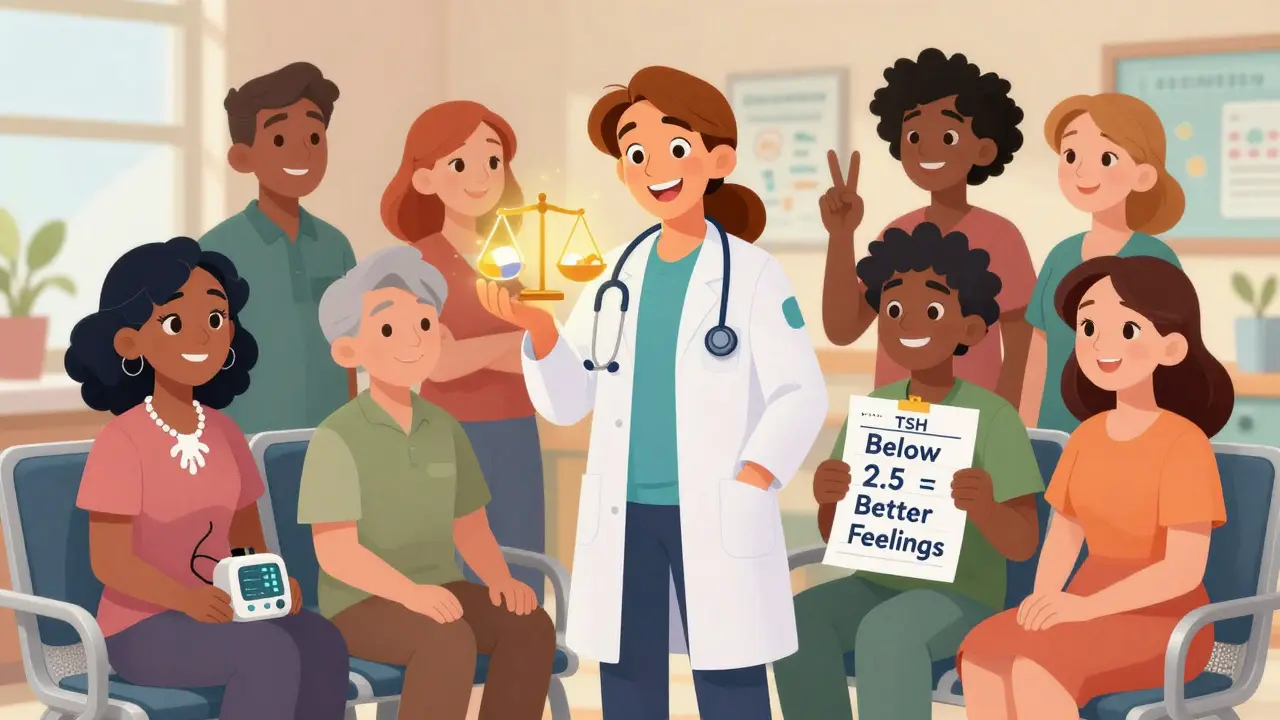
That’s why symptoms matter as much as numbers. If your TSH is 4.5 and you’re still exhausted, ask your doctor about raising your dose - even if it’s still in the “normal” range. Many patients report feeling better when their TSH is kept below 2.5 while on lithium.
And yes - some people still feel off even with perfect labs. Fatigue and unexplained weight gain are common complaints. That’s not always your fault. It’s the lingering effect of thyroid disruption. Don’t give up. Keep working with your team.
What About Other Mood Stabilizers?
If thyroid problems are getting too hard to manage, you might wonder: could another medication work better?
Valproate (Depakote) has a 5% to 10% risk of thyroid issues - mostly mild TSH spikes that don’t need treatment. Carbamazepine barely affects the thyroid. But here’s the trade-off: lithium is still the most effective at preventing suicide and keeping mood episodes away. A 2017 meta-analysis showed it reduces any mood episode by 39% compared to placebo. No other mood stabilizer comes close.
And it’s not just about mood. Lithium is the only medication proven to reduce suicide attempts by 14% compared to alternatives. That’s huge. For many, the thyroid side effects are worth it.
Still, if you’re struggling with constant fatigue, weight gain, or frequent lab changes, talk to your psychiatrist. Maybe you’re a candidate for a different drug - or a combination. But don’t assume the alternative is easier. Each has its own risks.
New Hope: What’s Changing in 2026
Research is moving fast. A 2024 study introduced a predictive tool that uses your age, gender, baseline TSH, and other meds (like gabapentin) to estimate your risk of thyroid decline. It’s 82% accurate - meaning doctors can now spot high-risk patients before problems start.
Another promising area: selenium. A 2023 trial gave 100 mcg of selenium daily to lithium users. After two years, hypothyroidism dropped from 24% to 14%. Selenium helps protect the thyroid from oxidative stress - something lithium seems to worsen. It’s not a cure, but it’s a simple, low-risk addition many doctors are now recommending.
And in the future? A new lithium-like drug called RG101 is in Phase II trials. Early results show it stabilizes mood just as well - but without raising TSH. If it works, it could change everything.
What Patients Are Saying
On Reddit, one person wrote: ‘My TSH went from 1.8 to 8.7 in 18 months. I’m on levothyroxine now, but my psychiatrist won’t lower my lithium dose.’ That’s a common story. Many feel stuck - grateful for mood stability but drained by thyroid symptoms.
Others say: ‘I’ve been on 900 mg for 8 years. My thyroid is perfect.’ They’re the lucky ones. But they’re the minority.
On Drugs.com, 41% of positive reviews say: ‘Better than the alternative.’ That’s the real story. Lithium isn’t perfect. But for many, it’s the best shot they’ve got at living a full life.
Final Thoughts: You’re Not Alone
Lithium and thyroid disease go hand in hand. It’s not a failure. It’s a known, manageable side effect. The key is vigilance - not fear. Test regularly. Track your symptoms. Don’t let a high TSH scare you into stopping lithium too soon. And don’t ignore your fatigue just because your labs look ‘normal.’
You’re not choosing between your mood and your thyroid. You’re learning to manage both. With the right care, you can stay on lithium - and still feel like yourself.
Does lithium always cause thyroid problems?
No. About 20% of people on long-term lithium develop hypothyroidism, and 30% to 59% develop goiter. But many others - especially those with good monitoring and healthy iodine intake - never have issues. Risk depends on dose, gender, age, genetics, and iodine levels in your diet.
Can I stop lithium if my thyroid gets worse?
Don’t stop lithium on your own. Stopping suddenly can trigger a dangerous spike in thyroid hormones - even thyroid storm in rare cases. If your thyroid gets worse, work with your psychiatrist and endocrinologist. You can often manage it with levothyroxine and keep lithium. Only consider switching if thyroid problems are severe and unmanageable despite treatment.
How often should I get my thyroid checked on lithium?
Get a TSH and free T4 test before starting lithium. Then every 6 months for the first year. After that, once a year if your levels are stable. If your dose changes or you develop symptoms, test sooner. Don’t wait for symptoms - lithium’s effects can build slowly.
Will levothyroxine fix all my symptoms?
Not always. Many people on lithium still feel tired or gain weight even with normal TSH. That’s because lithium makes your body less responsive to thyroid hormone. You may need a higher levothyroxine dose than usual - sometimes 20% to 30% more. Always pair lab results with how you feel.
Can selenium help protect my thyroid on lithium?
Yes. A 2023 clinical trial showed that taking 100 mcg of selenium daily reduced the risk of developing hypothyroidism from 24% to 14% over two years. It’s not a guarantee, but it’s a safe, low-cost option many doctors now recommend alongside regular monitoring.
Stacey Marsengill
January 17, 2026 AT 07:09Been on lithium for 12 years. TSH at 8.9 last check. Levothyroxine at 125 mcg. Still feel like a zombie in November. Doctors say 'it's normal.' Normal is not waking up exhausted after 8 hours and crying over spilled coffee. I'm not broken. My thyroid just got hijacked by a mood stabilizer that thinks it's doing me a favor.
They don't tell you the real cost until you're drowning in fatigue and your partner starts asking if you're depressed again. Spoiler: I'm not. I'm just out of thyroid.
Also, selenium? Took it for 6 months. Felt like I could breathe again. Not magic. But a tiny spark in the dark.
Aysha Siera
January 17, 2026 AT 09:06They're hiding something. Lithium was designed in a lab by people who don't care if your thyroid dies. Big Pharma knows. They just don't want you to stop. I saw a video once-thyroid tissue turning to scar after lithium. No one talks about that. They say 'monitor' like that's enough. It's not. It's a slow murder with a prescription.
Robert Davis
January 18, 2026 AT 23:32Let me break this down for you since the article clearly didn't. Lithium blocks iodine uptake. That's biochemistry 101. The thyroid can't make T4 without iodine. It's not 'interfering'-it's sabotaging. And yes, women are more vulnerable because estrogen upregulates thyroid-binding proteins. So when lithium messes with hormone release, your already-overloaded system collapses.
And before you ask-yes, I'm a pharmacist. And no, you don't need to be a genius to understand this. Just stop listening to your GP and find an endocrinologist who actually reads journals.
Eric Gebeke
January 19, 2026 AT 04:29People like you think you're entitled to mood stability without consequences. Lithium isn't a vitamin. It's a chemical scalpel. If your thyroid gives out, that's the price of emotional control. You don't get to have both. You want to feel 'normal'? Then stop whining about your metabolism being broken. Millions of people take meds that wreck their livers, kidneys, bones-no one complains.
And selenium? Please. That's just a placebo for people who need to feel like they're doing something. You're not fixing the problem. You're just distracting yourself from the fact that lithium is doing exactly what it's supposed to do-even if it kills your thyroid slowly.
Robert Cassidy
January 20, 2026 AT 07:14America's mental health system is a joke. You're told to take lithium because it's cheap. Then you get hypothyroidism and they hand you a pill that costs $500 a month. Meanwhile, the same people who pushed lithium on you are now selling you selenium supplements like it's a miracle. It's not healing. It's corporate triage.
And don't get me started on how they blame women for being 'more sensitive.' It's biology, not weakness. If your thyroid shuts down because of a drug designed in a lab by men who never had to live with the side effects, that's not your fault. That's systemic negligence.
And yes-I've seen thyroid storms from abrupt lithium withdrawal. It's not a myth. It's a death sentence waiting to happen because someone thought 'they can just quit.' Don't be that person.
Naomi Keyes
January 21, 2026 AT 23:14Per the American Thyroid Association Guidelines (2022), baseline TSH and free T4 are mandatory prior to initiation of lithium therapy, with follow-up at 6 weeks, then every 6 months for the first year, followed by annual assessment if stable. Failure to adhere to this protocol constitutes substandard care.
Moreover, the presence of antithyroid peroxidase antibodies (TPOAb) is a significant predictor of progression to overt hypothyroidism, with odds ratios exceeding 3.5 in longitudinal cohorts. Therefore, antibody screening should be considered part of routine monitoring, particularly in female patients under 60, as per the 2024 JAMA Network Open meta-analysis.
Additionally, levothyroxine dosing must be titrated not solely to TSH normalization, but to clinical euthyroidism-symptom resolution being the primary endpoint. TSH targets below 2.5 mIU/L are clinically indicated in lithium-treated patients, as peripheral resistance to thyroid hormone is well-documented in this population.
And while selenium supplementation has shown promise in RCTs, its mechanism-reduction of oxidative stress via selenoprotein expression-is not yet fully elucidated. Caution is advised until larger, multicenter trials are completed.
rachel bellet
January 22, 2026 AT 19:15Let’s be real: lithium is the last drug standing when everything else fails. That’s why we tolerate its collateral damage. The thyroid is just collateral. The brain? That’s the battlefield. And if your thyroid gives out so your mind doesn’t shatter-that’s a fair trade. You think your fatigue is bad? Try living with a suicide urge every day and seeing lithium as the only thing holding you together.
Yes, the numbers are ugly. But the alternative? Relapse. Hospitalization. Losing your job. Your family. Your life.
So yes, take the levothyroxine. Take the selenium. But don’t you dare romanticize stopping. You think you’re fighting for your thyroid? You’re really fighting to avoid the truth: lithium saved you. Even if it broke something else.
Selina Warren
January 24, 2026 AT 14:18You’re not broken. You’re just being asked to carry more than your body was designed to hold. Lithium doesn’t make you weak-it makes you resilient. You’re not a statistic. You’re not a side effect. You’re someone who chose to stay alive when the world told you to give up.
And yes, your thyroid is tired. So is your soul. But you’re still here. Still fighting. Still reading this. That’s not coincidence. That’s courage.
Take the selenium. Push for a higher levo dose. Find a doctor who listens. And when you feel like giving up? Remember: you’ve already survived 100% of your worst days. This is just one more to add to the list.
You’re not alone. I’ve been there. And I’m still here. So are you.
Nishant Sonuley
January 25, 2026 AT 10:36Hey, I’ve been on lithium for 7 years, TSH’s been creeping up, but I’ve got my endo and my psych on the same page. Selenium 100mcg daily, levo at 75, and I’m not perfect-but I’m functional. I’ve got a job, I’ve got friends, I’ve got mornings where I don’t cry before coffee. That’s a win.
And look, I get it-people think thyroid issues are just 'being lazy.' But it’s not. It’s your body screaming because a drug you need is doing its job too well. You’re not failing. You’re adapting.
And to the folks saying 'just quit lithium'? Bro. You don’t know what it’s like to feel the storm inside your head. Lithium didn’t break my thyroid-it gave me back my life. I’ll take the fatigue. I’ll take the pills. I’ll take the labs. I’ll take the selenium. I’ll take it all. Because I’m still here. And that’s worth more than any hormone level.
Keep going. You’re doing better than you think.