
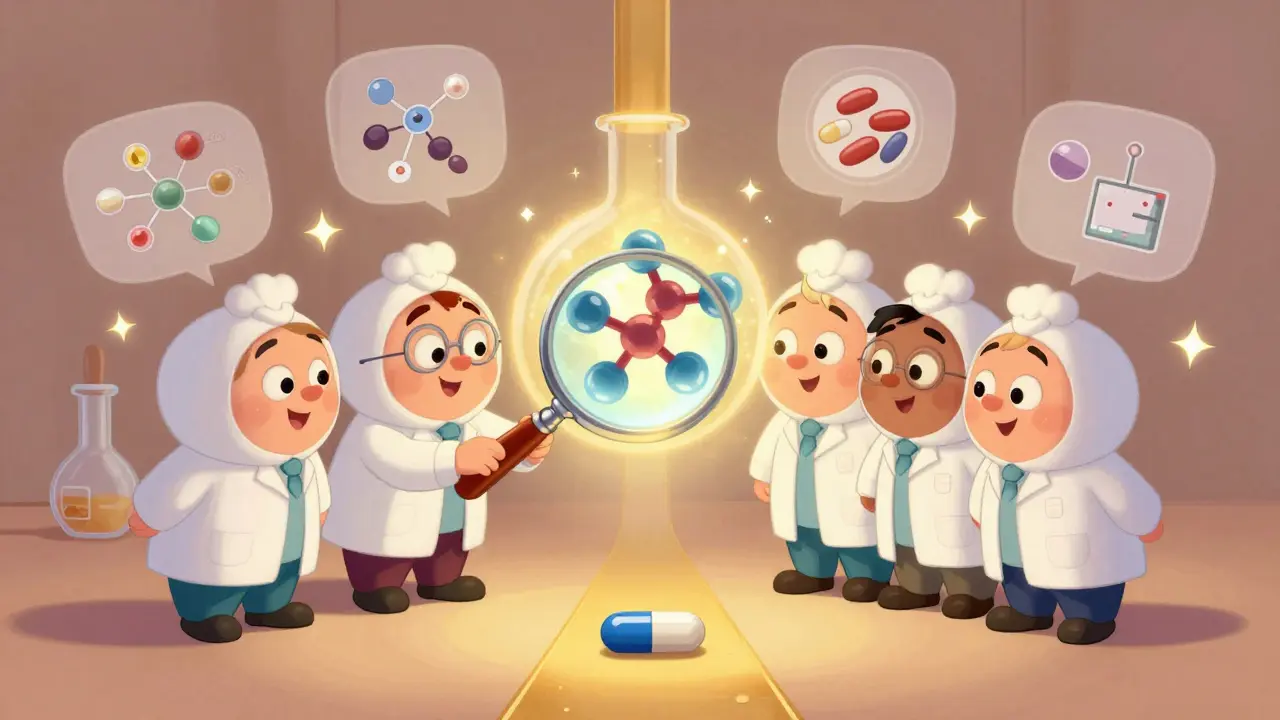
When you pick up a prescription at the pharmacy and see a label that says generic instead of a brand name, you might wonder: Is this really the same thing? The answer is yes - but only because of a highly controlled, science-driven manufacturing process that’s more rigorous than most people realize. Generic drugs aren’t knockoffs. They’re exact copies in every way that matters: same active ingredient, same strength, same way of working in your body. But how do they get from a lab to your medicine cabinet? Here’s how it actually works.
Step 1: Reverse Engineering the Original
Before a single tablet is made, manufacturers have to figure out exactly what’s in the brand-name drug. This isn’t guessing - it’s forensic chemistry. They take apart the original product, analyze its molecular structure, and map out every ingredient. The brand-name drug is called the Reference Listed Drug (RLD) the FDA-approved brand-name drug that serves as the benchmark for all generic versions. Every component - the active pharmaceutical ingredient (API) and all the inactive ones (called excipients like fillers, binders, or coatings) - must be identified. This step is critical because even small differences in excipients can affect how the drug dissolves or is absorbed.Step 2: Designing the Formula Using Quality by Design (QbD)
Once they know what’s in the original, manufacturers don’t just copy it. They use a science-based framework called Quality by Design (QbD) a systematic approach to drug development that identifies critical factors affecting quality before manufacturing begins. This method, developed by the International Council for Harmonisation (ICH) a global organization that standardizes pharmaceutical regulations across the U.S., EU, Japan, and other regions, focuses on three things:- Critical Quality Attributes (CQAs): What features of the drug must be perfect? For example, how fast it dissolves in your stomach.
- Critical Material Attributes (CMAs): What properties of the raw ingredients matter? Like the particle size of lactose or the purity of the API.
- Critical Process Parameters (CPPs): What steps in manufacturing can change the outcome? Like mixing time, temperature, or pressure during compression.
This isn’t trial and error. It’s a data-driven system where every variable is tested and mapped. If a batch of tablets doesn’t dissolve within the required time window, they trace it back to the excipient supplier - not the machine.
Step 3: The Seven Stages of Manufacturing
Once the formula is locked in, production begins. Here’s the exact sequence:- Formulation: The API and excipients are weighed and mixed in precise ratios. Even a 0.1% error can throw off absorption.
- Mixing and Granulation: Powders are blended until uniform. Then, they’re turned into granules - tiny clumps - to ensure even flow during pressing.
- Drying: Moisture is removed. Too much water? The tablet might crumble. Too little? It won’t bind properly.
- Compression and Encapsulation: Dry granules are pressed into tablets using high-pressure machines. Capsules are filled with powder or pellets. Each tablet must weigh within ±5% of the target if under 130mg, or ±7.5% if between 130-324mg, per FDA rules.
- Coating: Tablets get a thin layer - sometimes for taste, sometimes to control release. A delayed-release pill, for example, might only dissolve in the intestine, not the stomach.
- Quality Control: Every batch is tested. They check for identity (is it the right drug?), strength (does it have enough active ingredient?), purity (is there contamination?), and dissolution (does it release the drug at the right speed?). Dissolution tests simulate how the drug behaves in your gut. If it doesn’t match the brand-name drug within the 80%-125% range, the whole batch is rejected.
- Packaging and Labeling: Bottles or blister packs are filled. Labels must list the generic name, strength, manufacturer, and lot number. Crucially, they can’t look like the brand-name version - U.S. trademark law blocks that.
Step 4: Meeting CGMP Standards
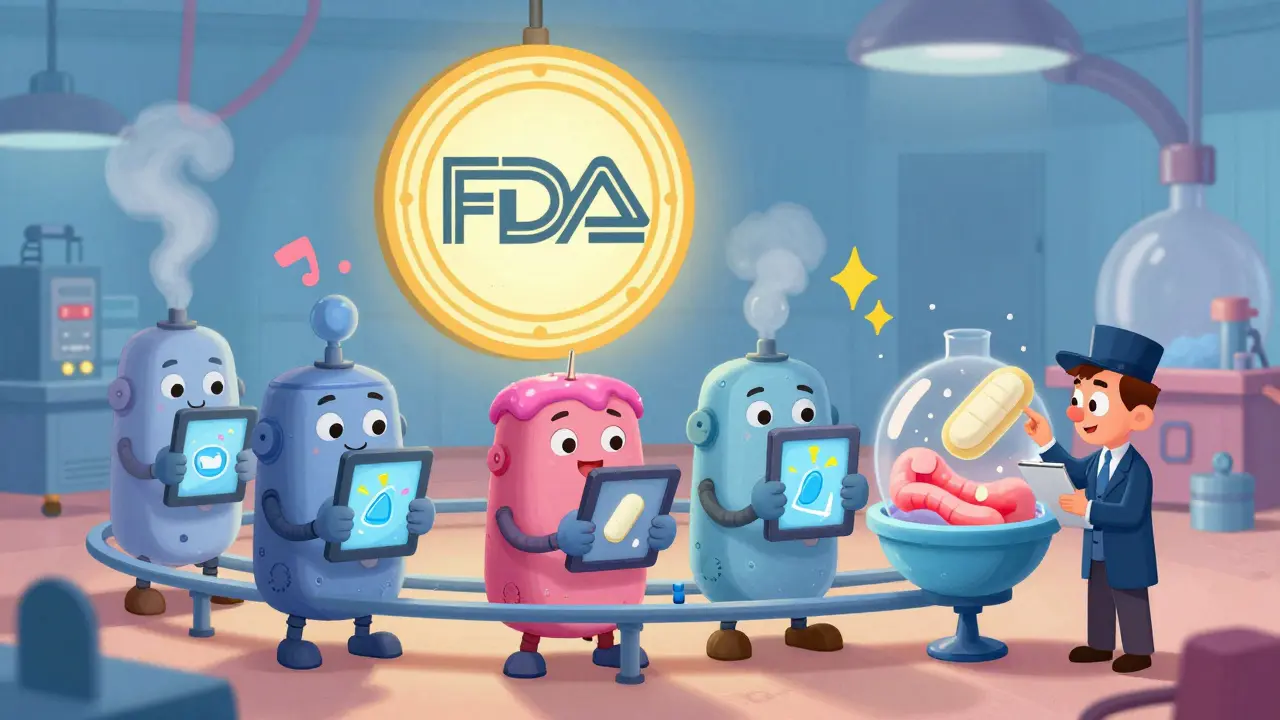
All of this happens inside a facility that follows Current Good Manufacturing Practices (CGMP) the FDA’s mandatory standards for drug production that ensure consistent quality and safety. These aren’t suggestions - they’re law. Facilities must control:- Temperature (20-25°C)
- Humidity (45-65% relative humidity)
- Cleanroom class (ISO Class 5 for sterile processes, Class 8 for non-sterile)
Workers wear full protective gear. Air is filtered. Surfaces are sanitized. Every machine, every batch, every step is documented. If a machine breaks down, they can’t just fix it and keep going. They have to investigate why, document it, and prove the product wasn’t affected. The FDA inspects these facilities regularly - and shuts them down if they fail.
Step 5: The ANDA Approval Process
Manufacturing the drug is only half the battle. Before it hits shelves, the company must submit an Abbreviated New Drug Application (ANDA) the regulatory pathway for generic drugs that allows approval without repeating full clinical trials to the FDA. This is called "abbreviated" because it doesn’t require new safety or efficacy studies - it relies on the brand-name drug’s data. But here’s what it still needs:- Bioequivalence Testing: 24-36 healthy volunteers take both the generic and brand-name drug. Blood samples are taken over hours to measure how much drug enters the bloodstream (Cmax) and how long it stays (AUC). The generic’s values must fall within 80%-125% of the brand’s - with 90% confidence. If it doesn’t, the application is denied.
- Manufacturing Inspection: The FDA sends inspectors to the plant. They check records, equipment, training logs, and even how workers handle deviations.
- Labeling Review: The label must match the brand’s in wording and warnings - except for the name and manufacturer.
The FDA aims to review ANDAs in 10 months under GDUFA IV (2022), down from 17 months a few years ago. But complex drugs - like inhalers or topical creams - can take up to 36 months.
Why Some Generics Are Harder Than Others
Not all generic drugs are created equal. Simple pills - like metformin or lisinopril - are easy to copy. But complex products? Not so much.Take Clobetasol Propionate a topical corticosteroid used for skin conditions, which took 7 years and $47 million to replicate as a generic. Why? Because skin absorption isn’t easy to measure. A generic version might look identical, but if it doesn’t penetrate the skin at the same rate, it won’t work the same way. The FDA now has specific guidances for these tricky products - 127 as of 2023.
Another challenge? Excipient Variability minor differences in inactive ingredients that can drastically affect drug performance. A pharmaceutical engineer on Reddit with 12 years of experience said: "A slight change in lactose particle size from your supplier can completely throw off your tablet hardness and dissolution profile." One batch passes. The next fails. That’s why quality control isn’t a one-time check - it’s continuous.
Quality and Trust: What the Data Shows
Despite rumors, studies show generics work. In a 2023 survey by the Association for Accessible Medicines a nonprofit that represents generic drug manufacturers and promotes affordable access, 89% of pharmacists reported no meaningful difference in patient outcomes between generics and brands. And the numbers speak for themselves: 90% of U.S. prescriptions are filled with generics. They’ve saved the healthcare system over $1.7 trillion in the last decade.Of course, there are exceptions. In 2021, Teva recalled 14 generic products due to CGMP violations at its Puerto Rico plant. But that’s not the norm - it’s a warning. The FDA issued 234 warning letters to generic manufacturers in 2023, mostly for poor investigation of out-of-spec results (37% of cases) and inadequate process validation (29%).
On the flip side, generics like Mylan’s version of Sofosbuvir a hepatitis C drug originally priced at $84,000 per course, reduced to $28,000 as a generic proved that generics can deliver life-saving results at a fraction of the cost - without sacrificing safety.
What’s Next for Generic Drugs?
The future of generics is being shaped by new tech. The FDA approved 17 facilities using continuous manufacturing a modern production method where drug ingredients flow through machines in real time, reducing batch failures. This cuts production from weeks to hours and improves consistency. Vertex’s cystic fibrosis drug, made this way, hit 99.98% batch acceptance - far better than traditional methods.AI is also stepping in. Pfizer’s pilot program cut visual inspection errors by 40% in 2023. And "digital twins" - virtual models of production lines - are being tested to predict failures before they happen.
But challenges remain. Over 78% of U.S. active ingredients come from China and India. That’s efficient - but risky if supply chains break. And as more blockbuster drugs lose patents (like Eliquis and Stelara), the race to make generics will intensify. Companies are now competing not just on price, but on speed and complexity.
Final Thought: You’re Getting Exactly What You Pay For
Generic drugs aren’t cheap because they’re low quality. They’re cheap because the system is designed to cut out unnecessary costs - not corners. The same strict rules apply whether it’s a brand-name drug or a generic. The FDA doesn’t lower its standards. It just doesn’t make you pay for 15 years of clinical trials twice.If you’ve ever worried about switching to a generic, the data says you shouldn’t. The science, the regulation, the manufacturing - it’s all built to make sure you get the same medicine. Just at a price that lets millions of people afford it.
Are generic drugs as safe as brand-name drugs?
Yes. The FDA requires generic drugs to have the same active ingredient, strength, dosage form, and route of administration as the brand-name version. They must also meet the same strict standards for purity, stability, and performance. Every generic drug undergoes bioequivalence testing to prove it works the same way in the body. The FDA inspects manufacturing facilities - whether for brand or generic - using the same CGMP rules. Millions of people use generics safely every day.
Why do generic drugs look different from brand-name drugs?
U.S. trademark law prevents generic drugs from looking identical to brand-name versions. That means color, shape, size, and even flavor can be different. But these changes only affect appearance - not how the drug works. The active ingredient and its performance in your body remain unchanged. If you’re concerned about confusion, talk to your pharmacist - they can tell you which generic version matches your previous prescription.
Can generic drugs have different side effects?
The active ingredient is identical, so the core side effects are the same. But generics may use different inactive ingredients (like dyes or fillers), which can cause rare allergic reactions in sensitive individuals. For example, someone allergic to a specific dye used in one brand might react to that dye in a generic version - even if the active ingredient is the same. These cases are extremely rare. If you notice a new reaction after switching, report it to your doctor and pharmacist.
Why are some generic drugs more expensive than others?
Price differences come down to competition. When multiple companies make the same generic, prices drop fast - sometimes by 80% within two years. But if only one or two companies can make a complex drug (like an inhaler or injectable), there’s little competition, so prices stay higher. Manufacturing complexity, supply chain issues, and patent delays also affect pricing. It’s not about quality - it’s about market dynamics.
Do generic drugs take longer to work?
No. Bioequivalence testing requires that generic drugs reach the same peak concentration in the blood (Cmax) and total exposure (AUC) as the brand-name version, within a tight range. If a generic took longer to work, it would fail the test and be rejected by the FDA. Some people report feeling a difference - but this is often due to placebo effect, changes in packaging, or psychological factors. Scientifically, there’s no evidence that generics are slower.
How long does it take to make a generic drug?
For simple pills, it typically takes 3-4 years and $5-10 million. This includes reverse engineering, formulation, testing, and FDA review. Complex drugs - like nasal sprays or extended-release capsules - can take 7-10 years and over $50 million. The FDA’s goal is to review ANDAs in 10 months under current rules, but complex products often take longer due to additional testing requirements.
Can I trust generics made outside the U.S.?
Yes - if they’re approved by the FDA. The FDA inspects all manufacturing facilities worldwide, whether in the U.S., India, China, or elsewhere. Over 78% of active ingredients come from abroad, but every facility must meet U.S. CGMP standards. The FDA doesn’t allow imports from unapproved plants. If a foreign facility fails inspection, the FDA blocks its products. So, the country of origin doesn’t matter - the inspection record does.
What’s the difference between generic and biosimilar drugs?
Generics are copies of small-molecule drugs - pills or injections with simple chemical structures. Biosimilars are copies of biologic drugs - complex proteins made from living cells (like insulin or Humira). Biosimilars are harder to replicate because their structure is more complex. They require more testing and aren’t automatically interchangeable. While generics are approved via ANDA, biosimilars go through a separate pathway. Both are cheaper than brand-name drugs, but biosimilars are typically more expensive than generics.
Hugh Breen
March 15, 2026 AT 07:07Lorna Brown
March 16, 2026 AT 19:10Rex Regum
March 17, 2026 AT 21:46Kelsey Vonk
March 18, 2026 AT 06:03Emma Nicolls
March 19, 2026 AT 23:45Jimmy V
March 21, 2026 AT 08:55Richard Harris
March 22, 2026 AT 09:00rakesh sabharwal
March 23, 2026 AT 04:45Aaron Leib
March 24, 2026 AT 01:30Dylan Patrick
March 24, 2026 AT 01:40