
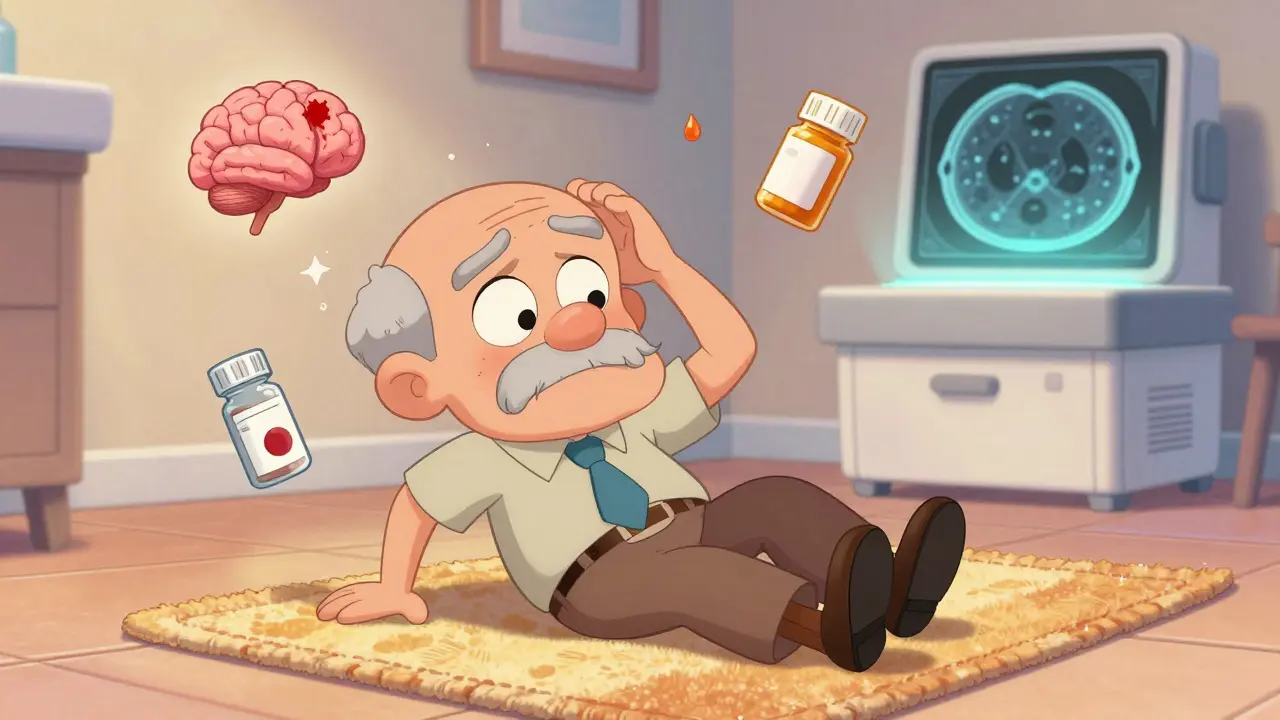
When you’re on blood thinners, even a small bump on the head can feel like a red alert. That’s because these medications - whether it’s warfarin, rivaroxaban, apixaban, or aspirin - make your blood less likely to clot. That’s good for preventing strokes or clots in your legs, but it’s dangerous if you hit your head. A minor fall, a slip on the bathroom floor, or even a light collision during a walk can lead to bleeding inside the skull. And here’s the scary part: you might not feel it right away.
Why Even Minor Head Injuries Are Risky on Blood Thinners
People on anticoagulants are 2 to 3 times more likely to have bleeding inside the brain after a head injury than those not taking these drugs. This isn’t theoretical - it’s backed by data from the American College of Emergency Physicians (ACEP) and real-world emergency room stats. In 2024, about 1 in 10 emergency visits for head trauma involved someone on blood thinners. Most of them were older adults with atrial fibrillation or a history of clots.
What makes this worse is that symptoms don’t always show up fast. You might feel fine after a fall, walk into the ER, and get a clean CT scan. But that doesn’t mean you’re out of danger. Delayed bleeding can happen 24 to 72 hours later. One study found that up to 1% of patients with normal initial scans still bled internally days after the injury. And if you’re on a DOAC like rivaroxaban, stopping it suddenly to "play it safe" can trigger a stroke. It’s a tightrope walk between two life-threatening risks.
When You Absolutely Need a CT Scan
Guidelines from Washington State, ACEP, and the American College of Surgeons all agree on one thing: if you’re on blood thinners and you hit your head, get a CT scan - don’t wait. You don’t need to be knocked out, vomiting, or bleeding from the ear. Even subtle signs matter.
Here’s when to go straight to the ER and demand a head CT:
- You lost consciousness - even for a few seconds
- You’re confused, dazed, or can’t remember what happened
- You have a headache that keeps getting worse
- You feel nauseous or vomited more than once
- You fell from a height - even just a step or a curb
- You have a visible bump, bruise, or cut on your head or neck
- You’re 65 or older - age increases bleeding risk, even with minor trauma
- You have a history of brain surgery or a previous bleed
Some people think, "I didn’t hit my head hard - it’s probably fine." But with blood thinners, the force doesn’t have to be high. A stumble on the rug, a bump against a doorframe, or even a sudden stop in the car can cause internal bleeding. The rule isn’t about how hard you hit - it’s about what’s happening inside your skull.
What the CT Scan Looks For
The standard test is a non-contrast head CT. It’s fast, widely available, and shows bleeding, swelling, or fractures clearly. Radiologists use special "bone-algorithm" settings (0.5 mm to 1.25 mm slices) to catch tiny skull fractures that might not show up on regular scans. These fractures can be a clue - they often mean there’s more damage beneath the surface.
The scan looks for:
- Subdural hematoma - bleeding between the brain and its outer lining
- Subarachnoid hemorrhage - bleeding around the brain’s surface
- Intracerebral hemorrhage - bleeding inside the brain tissue
- Skull fractures - especially those that extend into the sinuses or ear canals
Even if the scan is clear, your doctor will still check your blood. They’ll order a PT/INR test if you’re on warfarin, or check your kidney function if you’re on a DOAC. These help determine how long the drug will stay active in your system and whether you need reversal agents like Idarucizumab (for dabigatran) or PCC (for warfarin).
What Happens After the Scan
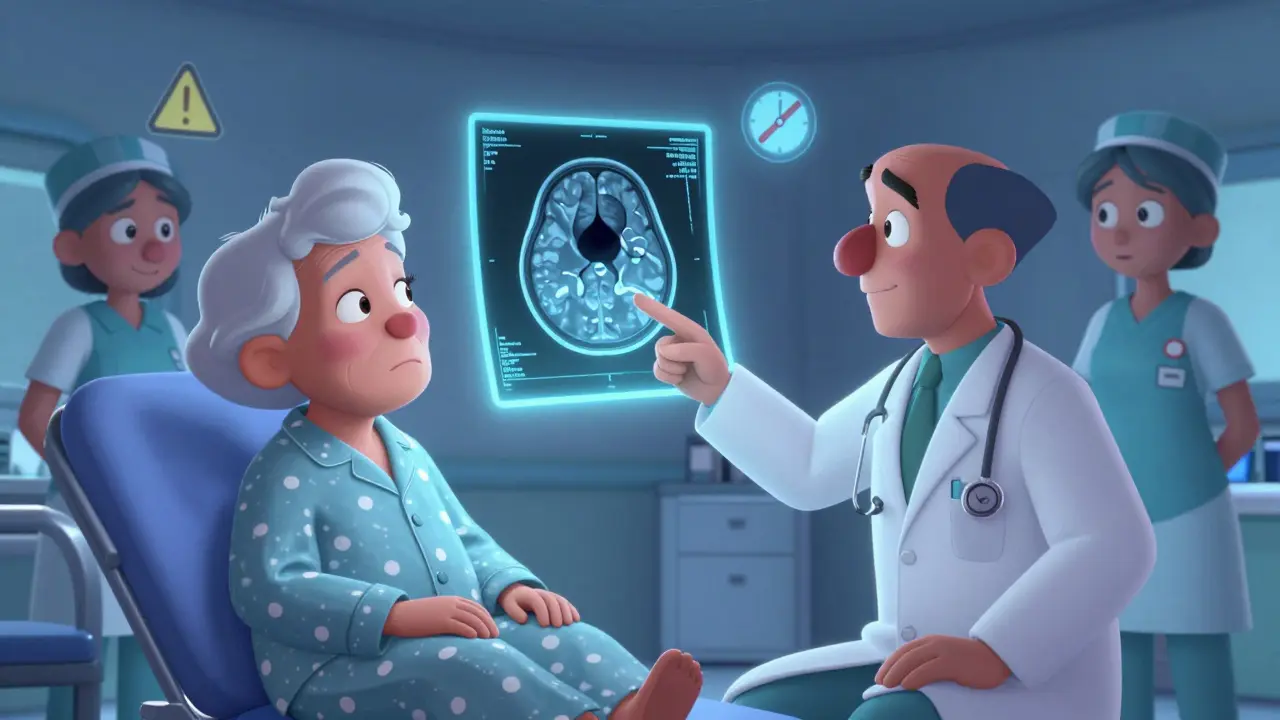
If the CT shows bleeding, you’ll likely be admitted. Doctors may reverse your anticoagulation, monitor you closely, and possibly call in neurosurgery. But if the scan is normal, the next question is: Can you go home?
Some hospitals follow a 6-hour observation rule. You’re kept in the ER or a monitored bed for 6 hours after the injury. If your condition doesn’t change - no worsening headache, no confusion, no vomiting - and your INR is under 3.5 (if on warfarin), you might be discharged. But if you’re on a DOAC and your INR isn’t relevant, the decision is trickier. Some places, like Johns Hopkins, still keep patients overnight just to be safe.
Here’s what you should never do:
- Stop your blood thinner on your own - you could have a stroke
- Wait to see if symptoms get worse - don’t gamble with brain bleeding
- Assume a normal scan means you’re safe forever - delayed bleeding is real
The Big Mistake: Stopping Blood Thinners Too Soon
One of the most dangerous missteps doctors see is when patients - or even some ER staff - decide to stop the blood thinner "just in case." A case from the University of Texas shows a patient on rivaroxaban had a negative CT scan, so his meds were paused. Three days later, he had a stroke. The clot that had been forming in his heart suddenly broke loose.
Reversing anticoagulation isn’t a free pass. It’s a medical decision. You need neurology and hematology input. Sometimes, the risk of stopping the drug is higher than the risk of bleeding. That’s why guidelines stress: never stop your blood thinner without talking to your doctor.
What to Watch For After Discharge
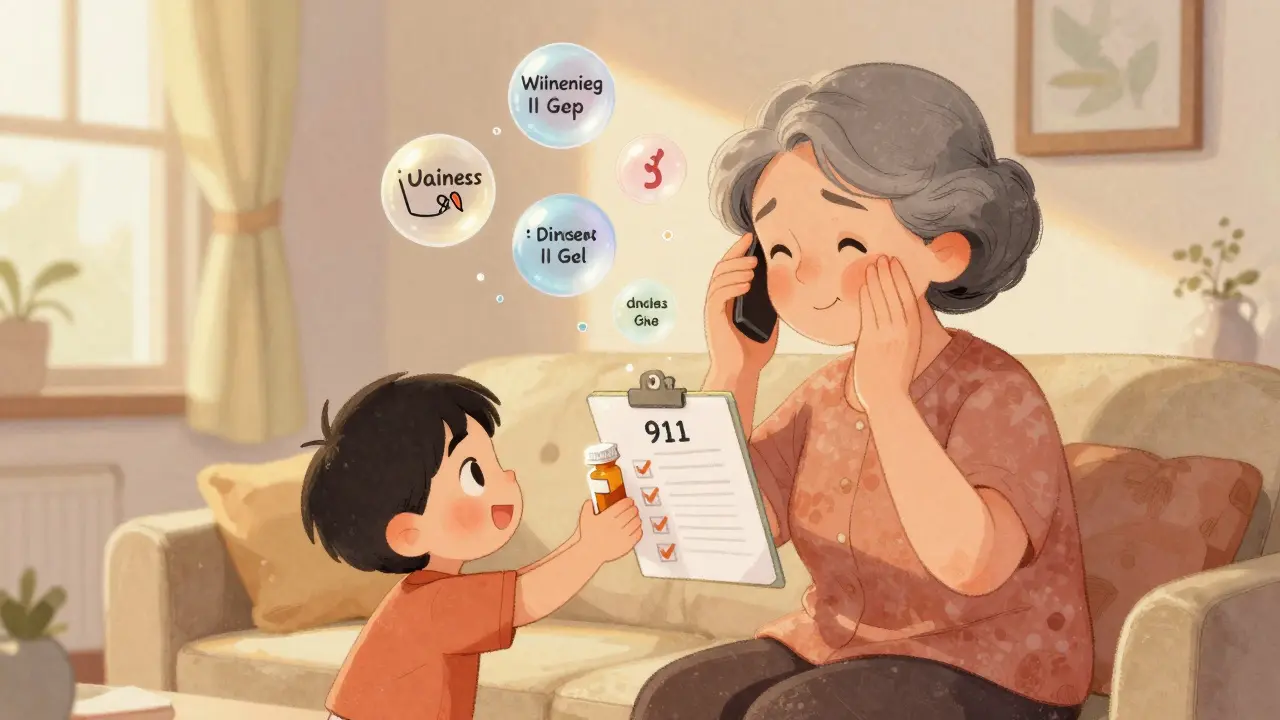
If you’re sent home with a normal scan, you still need to be vigilant. Symptoms of delayed bleeding can show up days later. Keep an eye out for:
- Worsening headache, especially if it’s different from your usual headaches
- Confusion, trouble speaking, or slurred speech
- Weakness or numbness on one side of your body
- Drowsiness or difficulty waking up
- Seizures or vision changes
- Repeated vomiting
If any of these happen, go back to the ER - no excuses. Don’t wait until morning. Don’t call your doctor first. Go straight to the hospital. Time is brain.
What’s Changing in 2026
Doctors are starting to use new tools. The FDA-approved Banyan Brain Trauma Indicator - a blood test that checks for two brain proteins (UCH-L1 and GFAP) - is now being used in some ERs to help decide who really needs a CT. It’s not perfect, but for older patients with mild symptoms and normal mental status, it can reduce unnecessary scans.
Researchers are also working on a modified version of the Canadian CT Head Rule specifically for people on DOACs. It’s expected to be ready by 2025. Until then, the safest rule is simple: if you’re on blood thinners and you hit your head, get scanned. No exceptions.
Bottom Line
Head injuries on blood thinners aren’t something to shrug off. They’re a medical emergency - even if you feel fine. The risk of bleeding inside your skull is real, and it doesn’t always come with warning signs. A CT scan is quick, safe, and can save your life. Don’t let fear of radiation or inconvenience stop you. The cost of waiting is too high.
Keep your anticoagulant list handy. Tell every ER staff member you’re on blood thinners. Bring your medication bottle. And if you’re over 65, talk to your doctor about fall prevention - because the best head injury is the one you never get.
Do I need a CT scan after a minor head bump if I’m on blood thinners?
Yes. Even if the bump seems small, you should get a non-contrast head CT. Blood thinners increase your risk of internal bleeding, and symptoms can be delayed. Guidelines from ACEP and Washington State recommend immediate imaging for any head injury in anticoagulated patients, regardless of how minor it seems.
Can I wait and see if I feel worse before going to the ER?
No. Delayed intracranial bleeding can occur 24 to 72 hours after the injury - sometimes even later. Waiting increases the risk of irreversible brain damage or death. If you’re on blood thinners and you’ve hit your head, go to the ER immediately. Don’t rely on how you feel.
What if my CT scan is normal? Can I stop taking my blood thinner?
Never stop your blood thinner without talking to your doctor. Stopping it can cause a dangerous clot to form, leading to a stroke or heart attack. A normal CT doesn’t mean you’re out of danger - it just means there’s no active bleed right now. Your doctor will decide whether to pause, reverse, or continue your medication based on your specific risk factors.
How long should I be observed after a head injury on blood thinners?
Observation time varies by hospital. Some discharge patients after 6 hours if they’re stable and have no signs of bleeding. Others, especially in trauma centers, keep patients for 24 hours. The key is monitoring for worsening symptoms - not just the scan result. If you’re discharged, you must be able to recognize danger signs and return immediately if they appear.
Are there any blood tests that can replace a CT scan?
Not yet. The Banyan Brain Trauma Indicator (a blood test measuring UCH-L1 and GFAP proteins) can help rule out the need for a CT in some low-risk patients with normal mental status, but it’s not reliable enough for people on blood thinners. CT remains the gold standard. Blood tests may help in the future, but for now, imaging is essential.
What’s the most common mistake people make after a head injury on blood thinners?
The biggest mistake is stopping their blood thinner on their own. Many think it’s safer to pause the medication after a head injury. But that can lead to a stroke. The real danger isn’t just bleeding - it’s the clot that forms when the anticoagulant is stopped. Always consult your doctor before changing your medication.
Should I avoid blood thinners altogether if I’m at risk of falling?
Not necessarily. The decision to continue or stop blood thinners should be made by your doctor based on your overall risk - not just your fall risk. For many people, the risk of stroke from atrial fibrillation far outweighs the risk of a head injury. Talk to your doctor about fall prevention strategies - like removing tripping hazards, using grab bars, and doing balance exercises - instead of stopping your medication.
Stephen Rock
January 21, 2026 AT 09:14Look, if you’re on anticoagulants and you so much as sneeze wrong, you’re already halfway to the ER. I’ve seen guys in their 70s walk into the hospital after tripping over a rug and walk out with a 30-day admission. No drama. No ‘maybe.’ Just scan. Now. The data’s clear. The guidelines are clear. Stop pretending it’s a choice.
And for the love of god, don’t stop your meds because some Reddit guru told you to. You think you’re being smart? You’re just buying a one-way ticket to a stroke.
It’s not about fear. It’s about math. 2-3x higher bleed risk? That’s not a whisper. That’s a siren.
Roisin Kelly
January 21, 2026 AT 20:31So let me get this straight - the government and Big Pharma want us to believe that a simple head bump is a death sentence unless we get a CT scan? Meanwhile, the radiation from that scan is gonna give us cancer in 15 years. But sure, let’s just throw money at every minor fall because ‘better safe than sorry.’
My grandma fell off a toilet in 1998 and lived to 94. No scan. No meds. Just grit. We used to be tougher. Now we’re a nation of hypochondriacs with insurance cards.
They’re milking this. Every scan = $$$.
Melanie Pearson
January 21, 2026 AT 23:16It is imperative to underscore that the clinical guidelines referenced herein are not suggestions but evidence-based imperatives derived from rigorous meta-analyses conducted by the American College of Emergency Physicians and corroborated by the American College of Surgeons. The notion that a ‘minor’ head injury warrants anything less than immediate neuroimaging in the context of anticoagulant use is not merely misguided - it is a clinically indefensible position that endangers public health.
Furthermore, the persistent cultural tendency to minimize trauma in elderly populations, particularly under the guise of ‘not wanting to overmedicalize,’ constitutes a form of ageist negligence. The data are unequivocal: age is an independent risk multiplier. To delay imaging is to gamble with neurologic integrity.
It is not paranoia. It is protocol.
Rod Wheatley
January 22, 2026 AT 06:12Hey everyone - I’m a nurse in trauma, and I see this every single day. I’ve held the hands of people who thought they were fine after a fall… and then, 48 hours later, they couldn’t speak. Their families didn’t know what to do because they waited.
Don’t wait. Don’t text your cousin who ‘knows a guy.’ Don’t Google it. Don’t wait until morning. Go now. The CT takes 10 minutes. The scan doesn’t hurt. The radiation? Less than a cross-country flight.
And if you’re on a DOAC - don’t panic. Just tell the ER you’re on rivaroxaban or apixaban. They know what to do. You don’t have to be a hero. You just have to be smart.
Bring your pill bottle. Write down when you took your last dose. That’s it. That’s the difference between life and a nightmare.
You’re not being dramatic. You’re being responsible. And that’s worth celebrating.
And if you’re worried about stopping your meds - I’ve seen the strokes. I’ve seen the families. I’ve seen the guilt. Please. Just talk to your doctor. Don’t self-medicate your fear.
Uju Megafu
January 23, 2026 AT 12:01Let me be clear - this is not about medicine. This is about control. They want you scared. They want you running to the hospital for every little thing. Why? Because hospitals make money off scans. Doctors get paid per procedure. Pharmacies sell you more pills to ‘fix’ the side effects of the pills they gave you.
My cousin in Lagos got hit with a coconut and didn’t go to the hospital. He drank ginger tea, slept it off, and went to work the next day. He’s alive. He’s fine. But here? You’re told to panic over a stubbed toe.
This isn’t safety. This is fear-mongering dressed up as science.
And don’t tell me ‘it’s different here.’ We’re all human. We all bleed. Why are we being treated like fragile glass?
Dee Monroe
January 23, 2026 AT 19:02There’s something quietly tragic about how we’ve turned health into a series of checkboxes and risk matrices - as if the body were a spreadsheet and every bump a line item that must be justified. We’ve outsourced intuition to algorithms, and now we’re terrified of silence - of the quiet space between a fall and a symptom. But the body doesn’t always scream. Sometimes it whispers. And if you’re not listening - if you’re too busy optimizing your life for efficiency - you’ll miss it.
I think about my father, who fell on ice in January and insisted he was fine. He wasn’t on blood thinners. But he had a slow bleed. He didn’t die from the fall. He died from the assumption that ‘if I feel okay, I am okay.’
Maybe the real question isn’t whether to get a CT. Maybe it’s whether we’ve forgotten how to listen - to our bodies, to our elders, to the quiet, unquantifiable truth that sometimes, the best medicine is not a scan, but presence. Presence before panic. Presence before protocol.
And maybe - just maybe - we should be teaching people how to be still with uncertainty, instead of training them to panic at the first sign of risk.
But I know. That’s not marketable.
So we scan. And we medicate. And we wait. And we hope. And we forget that we’re not machines. We’re flesh. And flesh remembers - even when the brain doesn’t yet know how to tell you.
Sangeeta Isaac
January 24, 2026 AT 22:04so like… i fell off my bike last week and cracked my head on a curb? i was on apixaban. i went to the er. they did the ct. zero bleed. zero fracture. zero drama.
but then the nurse was like ‘hey you good?’ and i said ‘yeah’ and she said ‘cool, but if you start feeling like your brain is a wet sock, come back.’
so i did. and she laughed. and i laughed. and we both knew: it’s not about being scared. it’s about being smart.
also, i brought my pill bottle. they loved me. i think they gave me a free gummy bear.
tl;dr: scan. don’t stop meds. bring your bottle. laugh when you can. your brain will thank you.
Alex Carletti Gouvea
January 26, 2026 AT 07:13Why are we letting foreign medical guidelines dictate our healthcare? ACEP? That’s a U.S. organization. But now we’re bending over backward for some ‘international consensus’? We’ve got our own experts. Our own data. Our own system.
And don’t get me started on these DOACs - these newfangled pills from Europe. Warfarin was good enough for my dad. It’s monitored. It’s cheap. It’s American. Now we’re handing out rivaroxaban like candy and telling people to get a CT for every sneeze?
Stop outsourcing your common sense. We don’t need a CT for every bump. We need better education. Better training. Not more scans.
Let’s fix the system - not just scan the symptoms.