
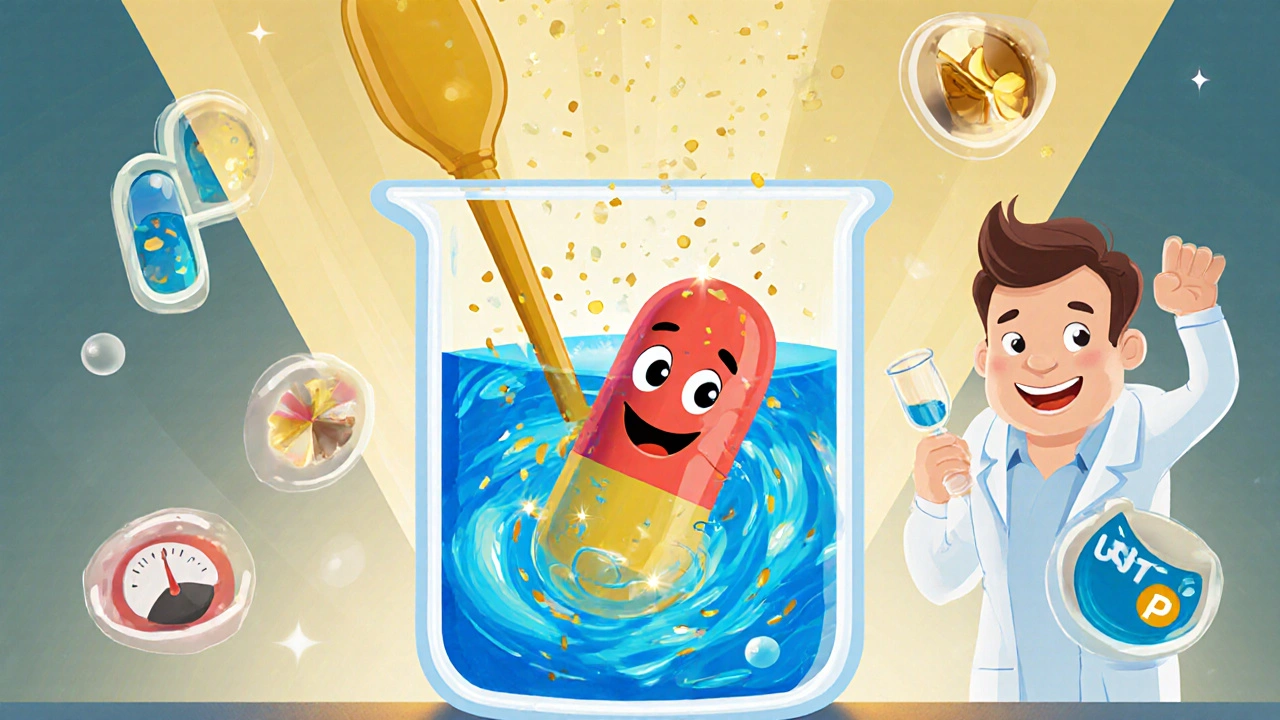
When you pick up a generic pill at the pharmacy, you expect it to work just like the brand-name version. But how does the FDA make sure it actually does? The answer isn’t in clinical trials on thousands of people-it’s in a lab, using a simple machine that measures how fast the drug dissolves. This process is called dissolution testing, and it’s one of the most powerful tools the FDA uses to guarantee that generic drugs are safe and effective.
Why Dissolution Testing Matters
Generic drugs are cheaper because they don’t need to repeat expensive clinical trials. Instead, they must prove they’re bioequivalent to the original drug-meaning they deliver the same amount of medicine into your bloodstream at the same rate. But running human studies for every single generic version isn’t practical. That’s where dissolution testing steps in.Dissolution testing is an in vitro (in the lab) way to predict what happens in vivo (in the body). If a generic tablet releases its active ingredient at the same speed and amount as the brand-name version under controlled lab conditions, it’s very likely to behave the same inside your body. This saves time, money, and avoids putting patients through unnecessary testing.
The FDA requires this test for nearly all oral solid pills, capsules, and suspensions. It doesn’t apply to liquids you swallow or creams you rub on your skin-those are already dissolved or absorbed differently. But for anything you swallow as a solid, dissolution testing is non-negotiable.
How the FDA Sets the Rules
The FDA doesn’t guess at dissolution standards. Every method is built on real data from the original brand-name drug. Manufacturers must show they’ve tested their product under the exact same conditions used for the reference drug. This includes:- Specific equipment (usually USP Apparatus 1 or 2-think rotating baskets or paddles in a beaker)
- Exact volume of fluid (typically 500 to 900 mL)
- Correct pH buffer (mimicking stomach or intestine conditions)
- Precise rotation speed (usually 50 to 100 rpm)
- Defined sampling times
For most immediate-release pills, the standard is simple: at least 80% of the drug must dissolve within 45 minutes. But that’s not a one-size-fits-all rule. A drug like metformin, which dissolves easily, might only need to hit 85% at 30 minutes in 0.1N HCl. A slow-release painkiller? That’s a whole different test.
The FDA uses a tool called the f2 similarity factor to compare the dissolution profile of the generic to the brand-name version. Think of it like a score out of 100. An f2 of 50 or higher means the two profiles are statistically similar. If it’s below 50, the FDA will ask for more data-or deny approval.
Classifying Drugs: The BCS System
Not all drugs are created equal. The FDA uses the Biopharmaceutics Classification System (BCS) to group drugs by how well they dissolve and how easily they’re absorbed. This determines how much testing they need.BCS Class I drugs-like atorvastatin or levothyroxine-are highly soluble and highly absorbable. For these, the FDA allows a “biowaiver.” If the generic matches the reference drug’s dissolution profile under standardized conditions, no human bioequivalence study is needed. That’s a huge shortcut for manufacturers and faster access for patients.
BCS Class II drugs-like itraconazole or fenofibrate-are poorly soluble. These are tricky. A small change in the tablet’s ingredients can make a big difference in how fast the drug dissolves. For these, the FDA demands a method that can tell the difference between good and bad formulations. The dissolution test must be “discriminatory.”
BCS Class III drugs dissolve well but aren’t absorbed easily. The FDA is currently exploring whether dissolution testing alone could justify biowaivers for these too. If approved, it could cut development time for dozens of new generics.
Testing for Complex Products
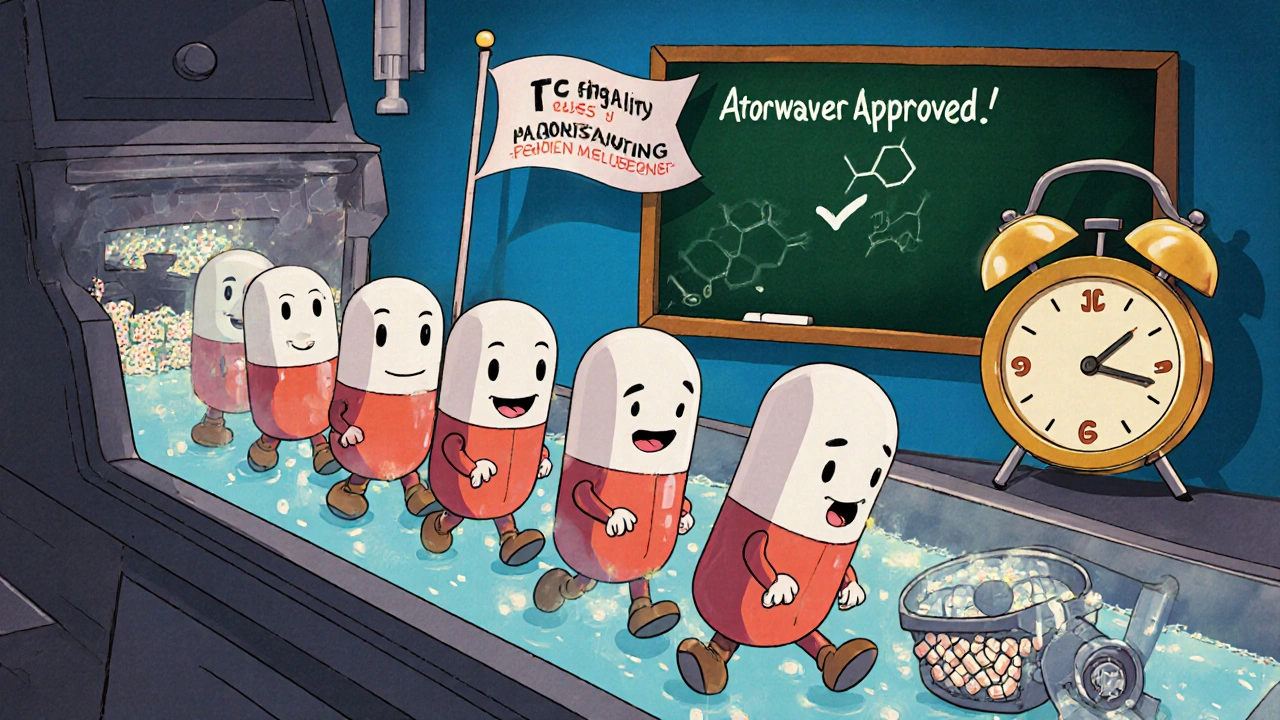
Not all pills are made the same. Immediate-release tablets are straightforward. But extended-release, delayed-release, or enteric-coated pills? Those need more.For a drug that’s supposed to release slowly over 12 hours, the FDA doesn’t just check one time point. They test at multiple intervals-say, 2, 4, 6, and 12 hours-to make sure the release curve matches the original. And because some people drink alcohol with their meds, manufacturers must test how the drug behaves in fluids with up to 40% ethanol. This is called “alcohol challenge testing.” If the drug dumps all its content too fast in alcohol, it could be dangerous. The FDA has rejected generics for this reason.
Even small changes-switching a filler, changing the tablet press, or moving manufacturing sites-trigger a requirement to re-test dissolution. The FDA’s SUPAC-IR guidelines say: if the dissolution profile shifts, the product might not be the same. That’s why companies spend months validating their methods before submitting an application.
What Manufacturers Must Submit
Applying to the FDA isn’t just sending a form. It’s submitting a thick dossier-often 50 to 100 pages-of dissolution data. This goes into Module 3.2.P.5 of the ANDA (Abbreviated New Drug Application). The dossier must include:- Proof the dissolution method works (validation)
- Robustness data (what happens if pH changes by 0.1? If temperature varies?)
- Comparative profiles against the reference drug
- Statistical analysis using the f2 factor
- Justification for why the chosen conditions reflect real-world performance
The FDA’s Dissolution Methods Database is a lifeline for manufacturers. It lists recommended test methods for over 2,800 drug products. If your drug is in there, you can follow the FDA’s method directly. If not, you have to build your own-and prove it’s as good.

What Happens When Results Don’t Match?
Sometimes, a generic product shows different dissolution results but still works in people. In those cases, the FDA doesn’t automatically reject it. They may approve it with different dissolution specifications-meaning the generic gets its own acceptance criteria, even if it’s not identical to the brand.This isn’t a loophole. It’s science. If human studies show the drug is bioequivalent, but the lab test doesn’t perfectly match, the FDA looks at the whole picture. Maybe the brand’s method isn’t discriminatory enough. Maybe the generic’s method is better. The goal isn’t to copy the brand exactly-it’s to ensure the patient gets the same benefit.
The Bigger Picture
Dissolution testing isn’t just about compliance. It’s about efficiency. By using this tool, the FDA avoids running thousands of human bioequivalence studies. It reduces costs, speeds up approvals, and gets affordable medicines to patients faster.Since 2020, the use of standardized dissolution methods has grown from 25% to 35% of generic approvals. By 2025, that number could climb higher, especially as BCS-based waivers expand. But the FDA’s message is clear: dissolution testing must be product-specific. You can’t reuse a method from one drug for another. Each one needs its own scientifically grounded approach.
This system works because it’s rooted in real-world performance. It’s not about making the pill look the same-it’s about making it act the same. And that’s what matters to patients.
Is dissolution testing the same as bioequivalence testing?
No. Bioequivalence testing measures how much drug enters the bloodstream in humans. Dissolution testing measures how fast the drug comes out of the pill in a lab. The FDA uses dissolution data as a reliable predictor of bioequivalence-so for many drugs, they don’t need to run human studies at all.
Can a generic drug fail dissolution testing but still be approved?
Yes, but only if human bioequivalence studies show it works the same way in the body. The FDA may then set custom dissolution specifications for that generic, even if they’re different from the brand-name drug. This is rare and only happens when the original method isn’t scientifically sound.
Why do some generic drugs dissolve slower than others?
Because they’re designed differently. Some are made to release slowly (extended-release), others are coated to protect the drug from stomach acid. The dissolution test must match the intended release pattern. A slow-dissolving pill isn’t necessarily worse-it’s just built for a different purpose.
How does the FDA decide which dissolution method to use?
They look at the reference drug’s approved method, the drug’s solubility (BCS class), and whether a USP method exists. If none are available, manufacturers must develop a new method and prove it can distinguish between good and poor formulations. The FDA reviews and approves it during the application process.
Are dissolution tests the same worldwide?
No. The FDA has its own standards, and other agencies like the EMA in Europe or PMDA in Japan have different guidelines. But many countries follow similar principles. The FDA’s approach is considered one of the most rigorous and is often used as a benchmark.
What happens if a generic drug changes its formula after approval?
Manufacturers must notify the FDA and re-run dissolution tests under SUPAC guidelines. If the dissolution profile changes significantly, the FDA may require new bioequivalence data or even withdraw approval. This prevents hidden changes that could affect safety or effectiveness.
What Comes Next?
The future of dissolution testing is moving toward more realistic conditions. Researchers are testing methods that mimic the human gut-adding enzymes, changing pH over time, and using fluids that better reflect what’s in your stomach after eating. These “physiologically based” methods could make dissolution tests even more accurate.For now, the system works. Millions of people take generic drugs every day, trusting that they’re just as effective as the brand. That trust is built not on marketing, but on science-on machines spinning in labs, on data points, on standards that don’t cut corners.
Alex Czartoryski
November 18, 2025 AT 19:01Victoria Malloy
November 18, 2025 AT 19:59Gizela Cardoso
November 19, 2025 AT 02:03kim pu
November 20, 2025 AT 00:06malik recoba
November 21, 2025 AT 14:41Sarbjit Singh
November 22, 2025 AT 18:02Angela J
November 22, 2025 AT 23:33Sameer Tawde
November 23, 2025 AT 07:45Duncan Prowel
November 25, 2025 AT 00:45Bruce Bain
November 25, 2025 AT 13:48Jonathan Gabriel
November 27, 2025 AT 08:03Don Angel
November 27, 2025 AT 15:17benedict nwokedi
November 28, 2025 AT 17:58