

Working out with diabetes doesn’t have to mean avoiding exercise because you’re scared of crashing. But if you’ve ever felt shaky, sweaty, and dizzy halfway through a run - or woken up in the middle of the night with a dangerously low glucose level after a good day of activity - you know the fear is real. About 50% of adults with type 1 diabetes avoid exercise just because they’re worried about low blood sugar. The good news? You can still lift, run, swim, or dance without crashing. It just takes a few smart moves.
Why Exercise Drops Your Blood Sugar
When you move, your muscles need fuel. They don’t wait for insulin to tell them to grab glucose from your blood. They just take it - directly and fast. That’s why even a 20-minute walk can lower your glucose by 30 to 50 points. And it doesn’t stop when you stop. Your body stays more sensitive to insulin for up to 72 hours after exercise. That’s why a midday bike ride can cause a low at 2 a.m. Plus, if you’re on insulin, your body already has extra insulin floating around. During exercise, that insulin works harder - sometimes like 2 to 3 times its normal effect. So even if your numbers looked fine before you started, you could still drop fast.Check Your Numbers - But Don’t Wait for the Crash
Don’t wait until you feel awful to check your glucose. The rule is simple: if it’s under 90 mg/dL before you start, you need to eat. For readings between 90 and 150 mg/dL, you should still eat something, especially if you’re doing moderate to intense exercise. The American Diabetes Association recommends 15 to 20 grams of carbs if your glucose is below 100 mg/dL. That’s about:- Half a banana
- 4 glucose tablets
- 6 ounces of regular soda
- 1 small apple
Timing Matters More Than You Think
Exercise at the same time every day if you can. Why? Because insulin works on a schedule. If you always take your fast-acting insulin at 7 a.m. for breakfast, your blood sugar will drop hardest between 9 a.m. and 11 a.m. - that’s peak insulin time. Avoid working out then unless you’re prepared to eat more. Also, check your insulin-on-board (IOB) before you start. That’s how much active insulin is still working in your body. If you’ve got 1.2 units on board, it might act like 2 to 3 units during exercise. That’s a recipe for a low. If your IOB is high, consider reducing your next bolus or lowering your basal rate.Not All Workouts Are Created Equal
Here’s the surprise: not every kind of exercise drops your glucose the same way. Aerobic exercise - like jogging, cycling, swimming - steadily pulls glucose out of your blood. It’s predictable, but risky if you’re not careful. Resistance training - lifting weights, bodyweight exercises - actually helps protect you. A 2018 study showed that doing 45 minutes of strength training before 45 minutes of cardio cut glucose drops by nearly 40%. Why? Lifting triggers your liver to release glucose. It’s like hitting a natural sugar boost button. High-intensity intervals - even 10 seconds of all-out sprinting - can stop a low before it starts. Research shows that a quick burst of speed before or after your workout can keep glucose stable for up to 45 minutes after. One user on Diabetes Daily said adding just one 10-second bike sprint before his daily workout cut his lows from 4 per week to 1 every two weeks.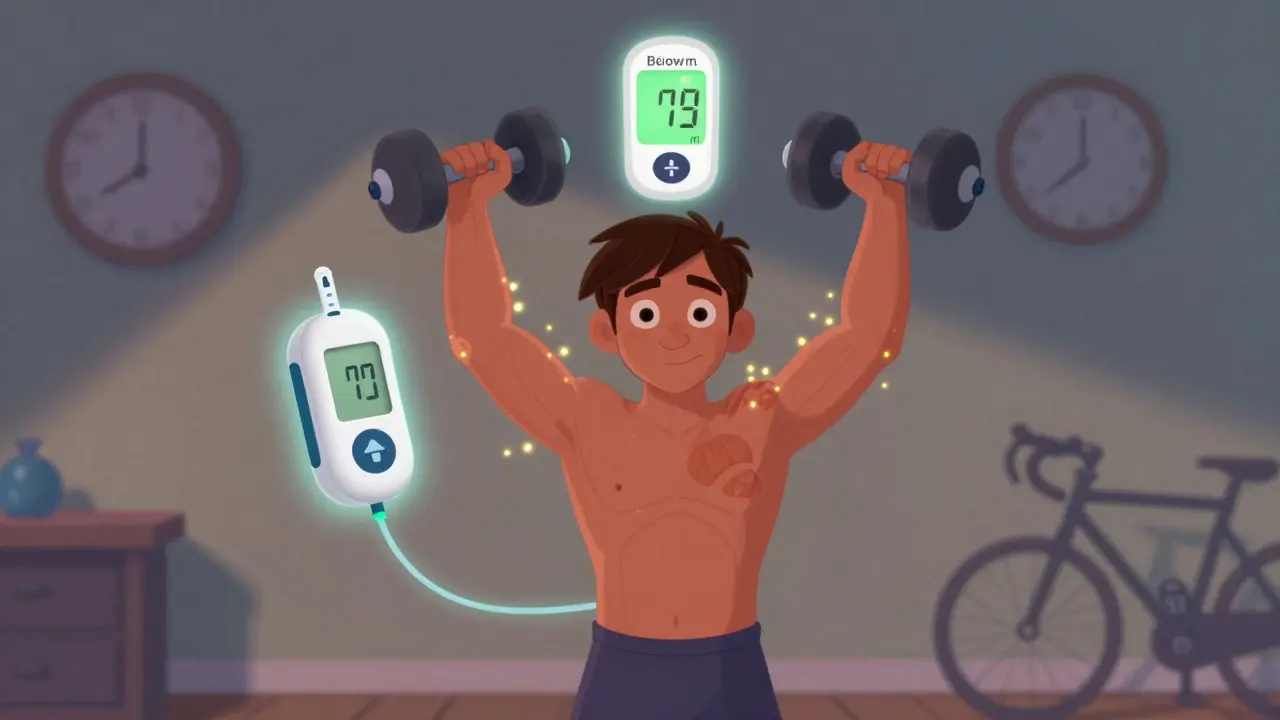
Use Your Tech - It’s Not Just for Alerts
If you use a continuous glucose monitor (CGM), you’re already ahead. But most people don’t use it to its full potential. Dexcom’s G7, released in late 2022, has an “exercise mode” that lowers alert thresholds by 20 mg/dL during activity. That means it won’t scream at you for a 85 mg/dL reading - because it knows you’re moving. And now, pumps like the Tandem t:slim X2 have an “Exercise Impact” feature. It uses machine learning to predict your glucose drop based on your past workouts. If you’ve done 30 minutes of cycling at 6 p.m. three times this week and always dropped 50 points, it will automatically reduce your insulin delivery before you even start. Don’t have a pump or CGM? You can still track patterns. Write down what you ate, what you did, your starting glucose, and how you felt. After a few weeks, you’ll start seeing your personal patterns. Maybe you always drop on Tuesdays after lunchtime walks. Maybe you’re fine after morning weights but crash after evening yoga. That’s your data. Use it.What to Do After the Workout
The danger doesn’t end when you stop. Up to 70% of people with type 1 diabetes get a low 6 to 12 hours after exercise. That’s called delayed-onset hypoglycemia. It’s why so many people wake up at 3 a.m. with sweating, confusion, or a heart pounding. To prevent it:- Check your glucose before bed. If it’s under 120 mg/dL, eat a snack with 15 grams of carbs plus a little protein - like peanut butter on toast, cheese with an apple, or a small yogurt.
- Set an alarm to check again at 2 a.m. if you did a long or intense workout.
- Reduce your nighttime basal rate by 10-30% if you’re on a pump. Many people find this prevents overnight lows without needing extra snacks.
What Not to Do
Don’t skip meals to “save” carbs before exercise. That’s a trap. You’ll start low and crash harder. Don’t rely on “feeling” your lows. Hypoglycemia unawareness is real - especially if you’ve had diabetes a long time. You might not feel anything until it’s too late. Don’t overeat. Eating 50 grams of carbs just because you’re going for a run can leave you high later. Stick to the 15-20 gram rule unless your glucose is under 70. Don’t assume your body will respond the same way every time. One user on Reddit said: “I did the same 5K run at the same time, with the same insulin on board - one day I was at 70, the next I was at 180. It’s maddening.” That’s normal. Stress, sleep, hormones, weather - they all change your response. Track it. Adapt.
Start Slow. Learn Your Body.
Managing exercise with diabetes isn’t something you master in a week. It takes 3 to 6 months of consistent tracking to really understand your patterns. Start with short, low-intensity workouts. Walk for 15 minutes. Check before, during, and after. Adjust. Try again. Slowly build up. If you’re new to lifting, start with bodyweight exercises. Squats, push-ups, and lunges. Three times a week. Then add weights. Then add cardio. Layer it. And remember - the goal isn’t perfection. It’s consistency. Even if you have a low once a week, you’re still moving. You’re still stronger. You’re still in control.What Experts Say
Dr. Michael Riddell from Toronto’s Krembil Research Institute says: “A short sprint isn’t affected by prior low blood sugar - it still works to raise glucose.” That means even if you’re feeling shaky, a 10-second all-out burst can save you. UCLA Health endocrinologists stress: “The more insulin you have on board, the higher the likelihood of a low.” So check IOB. Always. And while most guidelines say to eat carbs if you’re under 100 mg/dL, some doctors like Dr. Anne Peters suggest that for high-intensity workouts, starting at 150-180 mg/dL might actually be safer. It’s not one-size-fits-all. Test it. See what works for you.The Bottom Line
You don’t have to choose between health and safety. You can have both. Exercise lowers your risk of heart disease, improves insulin sensitivity, and helps you sleep better. But it needs respect. Not fear. Check your numbers. Eat smart. Time your workouts. Use your tech. Track your results. And don’t be afraid to try a quick sprint before your run. It might just be the trick you’ve been missing. The future of diabetes tech is here - pumps that predict lows, CGMs that adapt to activity, and artificial pancreases that even deliver glucagon during exercise. But until then? You’ve got the tools. You just need to use them.Quick Reference: Exercise & Blood Sugar Checklist
- Check glucose 15-30 minutes before exercise
- If under 90 mg/dL: eat 0.5-1.0 g carbs per kg body weight
- If 90-150 mg/dL: eat 15-20g carbs before starting
- Check every 30-60 minutes during longer workouts
- Check again 1-2 hours after, and before bed
- Consider a 10-second sprint before aerobic exercise
- Do resistance training before cardio to reduce drop
- Reduce basal rate 50-75% if using a pump, 60-90 min before exercise
- For nighttime lows: eat 15g carbs + protein before bed after intense activity
- Track everything - workouts, food, insulin, glucose - for at least 4 weeks
John Chapman
December 31, 2025 AT 23:40YESSSS!!! 🚀💪 Just did a 20-min HIIT session and threw in a 10-second sprint before - no crash, no panic, just gains. This post is pure gold. Stop overthinking and start moving. Your body’s smarter than your fear.
Hanna Spittel
January 2, 2026 AT 21:27They don’t want you to know this, but insulin pumps are secretly tracking your workouts to sell you more data to Big Pharma. 😏
Brady K.
January 4, 2026 AT 15:15Let’s be real - the 50% of Type 1s avoiding exercise aren’t scared of hypoglycemia. They’re scared of consistency. The real enemy isn’t insulin, it’s the 3 a.m. glucose check that ruins your sleep schedule. And yes, IOB is a myth if you don’t track it against your circadian rhythm. You think your liver’s just gonna release glucose like a vending machine? Nah. It’s a fickle bastard that responds to stress, sleep debt, and whether you ate pizza last night. If you’re not logging every variable - food, mood, moon phase - you’re just guessing. And guessing with diabetes is how you end up in the ER with a glucagon pen in one hand and a sobbing partner in the other.
Also, the ‘sprint before cardio’ trick? It’s not magic. It’s epinephrine. Your body’s fight-or-flight response is basically a glucose firehose. Use it. Don’t fear it. Your adrenal glands are your secret weapon.
And to the people saying ‘just eat more carbs’ - you’re not solving the problem, you’re masking it. That’s like putting duct tape on a leaky pipe and calling it a fix. You need to understand the flow, not just the volume. Your insulin sensitivity isn’t static. It’s a living, breathing, hormone-swinging entity. Treat it like a relationship. Not a spreadsheet.
And no, your CGM’s ‘exercise mode’ isn’t AI. It’s just a lower alarm threshold. The algorithm isn’t predicting your drop - you are. You just need to stop outsourcing your biology to a device that doesn’t know you had a fight with your mom at 7 a.m.
Stop waiting for permission to move. Start tracking. Start adapting. Start owning your numbers. The tech is here. The knowledge is here. The only thing missing? Your discipline.
Marilyn Ferrera
January 6, 2026 AT 04:36Thank you for this. So many people skip the ‘why’ behind the numbers. This isn’t just advice - it’s physiology.
Bennett Ryynanen
January 6, 2026 AT 05:10Bro, I did a 5K yesterday and my CGM went from 130 to 62 in 22 minutes. I ate 4 glucose tabs and still felt like a zombie. Why? Because I didn’t check IOB. Lesson learned. This post saved my ass.
Kayla Kliphardt
January 6, 2026 AT 22:44I’ve been trying to start running again. I’m nervous about lows, but this made me feel like maybe I can do it without feeling like I’m walking into a minefield.
Branden Temew
January 7, 2026 AT 13:40So the ‘sprint before cardio’ thing works because you’re triggering a catecholamine surge - adrenaline and noradrenaline - which forces hepatic glucose output. But here’s the twist: if you’re chronically stressed, your adrenals are already fried. That sprint might just make you crash harder. Your body doesn’t care about your fitness goals. It cares about survival. If you’re sleep-deprived, anxious, or eating processed crap, your ‘trick’ might backfire. So ask yourself: are you training your body… or just training your hope?
Frank SSS
January 8, 2026 AT 07:49Ugh. I tried all this. Wrote down everything. Did the sprints. Reduced basal. Ate the snacks. Still woke up at 3 a.m. with a heart rate of 140. I’m just tired of fighting my own body. Maybe I should just… stop.
Brandon Boyd
January 8, 2026 AT 12:00Frank, I hear you. I’ve been there. But hear this - every time you move, even a little, you’re winning. That 3 a.m. low? It’s not a failure. It’s data. You’re not broken. You’re learning. Keep going. One walk. One squat. One check. One snack. You got this.
Deepika D
January 9, 2026 AT 11:46As someone who’s lived with type 1 for 32 years, I’ve tried everything - from yoga to CrossFit. The biggest game-changer? Strength training before cardio. It’s not just a trick - it’s science. Your liver becomes your ally. And don’t forget hydration - dehydration makes insulin work harder. I drink 16 oz of water before every workout now. Small things. Big impact. You’re not alone. We’ve all been there. Keep showing up. Even on the days you feel like quitting.
Harriet Hollingsworth
January 10, 2026 AT 05:39This post is irresponsible. You’re telling people to eat sugar before exercise? That’s just encouraging poor habits. If you can’t control your blood sugar, maybe you shouldn’t be exercising at all. You’re putting lives at risk.
Robb Rice
January 11, 2026 AT 00:44Harriet - you’re misinformed. Eating 15-20g carbs before exercise isn’t ‘poor habit’ - it’s prevention. And if you’re not exercising, you’re increasing your risk of cardiovascular disease, neuropathy, and early mortality. This isn’t about sugar - it’s about safety. Please stop spreading fear.
Martin Viau
January 11, 2026 AT 22:22USA has the best CGMs. Canada? We’re stuck with 2015 tech. Why? Because our government doesn’t care. I had to buy my Dexcom from Amazon US. Shameful.
Paul Huppert
January 13, 2026 AT 20:33Just wanted to say - I started walking 15 minutes after dinner last week. Checked my numbers. Ate half a banana. Didn’t crash. Felt proud. It’s tiny. But it’s mine. Thanks for the reminder that progress doesn’t need to be loud.