
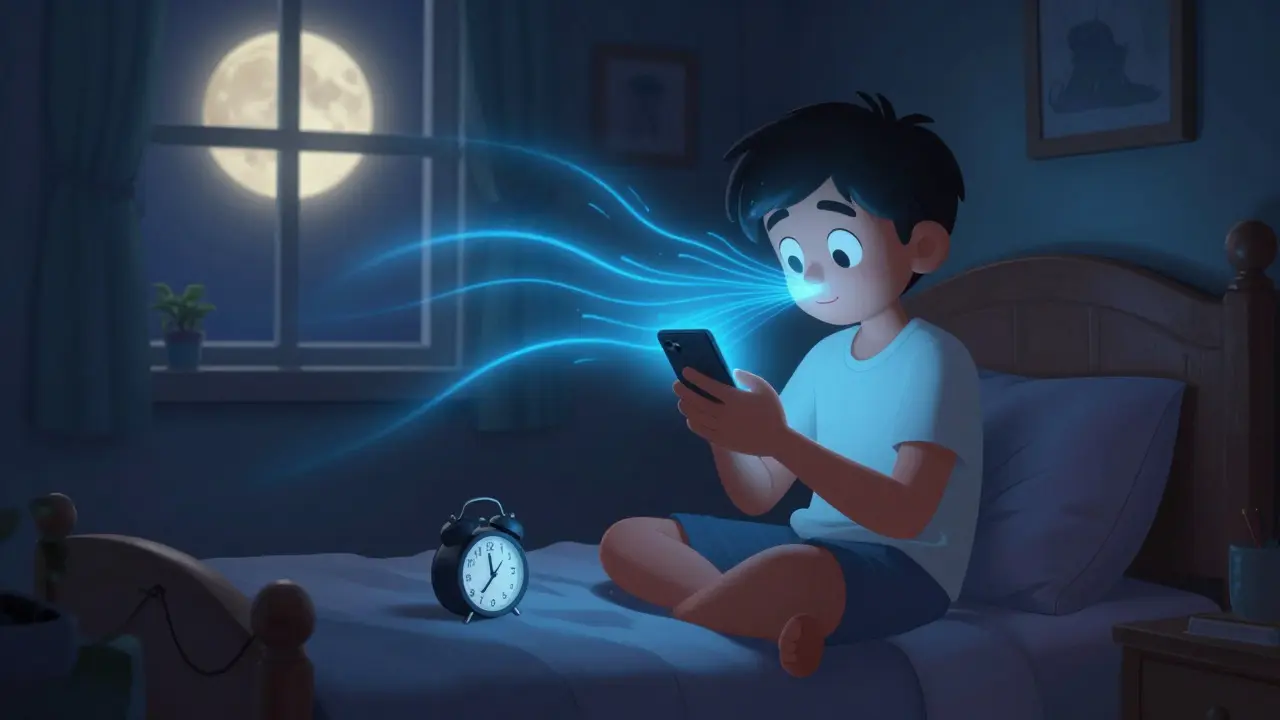
Most people know they should put their phones down before bed. But few realize blue light is the real culprit behind why sleep feels so elusive-even after eight hours in bed.
It’s not just about scrolling too late. It’s about the specific type of light your phone, tablet, or laptop emits. Blue light, especially in the 460-480 nanometer range, tricks your brain into thinking it’s still daytime. Your body stops making melatonin, the hormone that tells you it’s time to sleep. Without it, you lie awake longer, wake up more often, and feel groggy even when you think you’ve slept enough.
Why Blue Light Disrupts Your Sleep
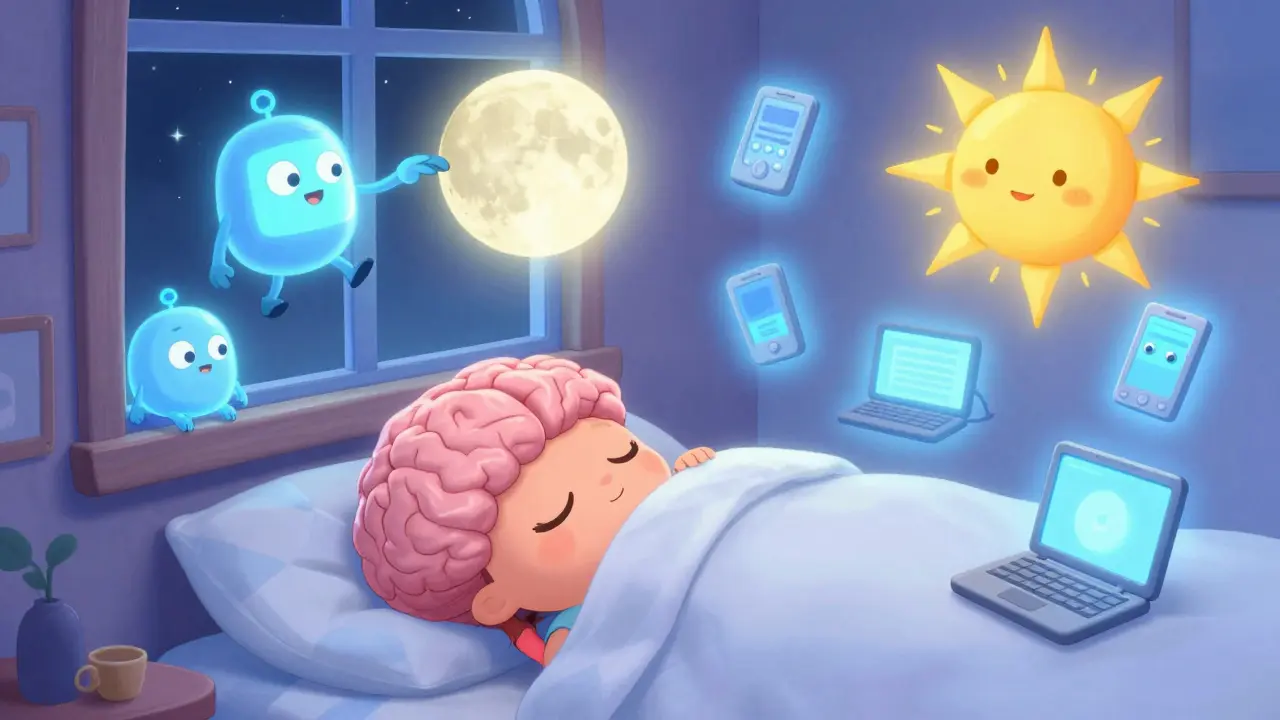
Back in 2012, Harvard researchers proved something simple but powerful: six and a half hours of blue light suppressed melatonin for three hours. Green light? Only one and a half. That’s not a small difference-it’s a biological reset. Your internal clock, or circadian rhythm, depends on light cues. Natural blue light in the morning wakes you up. Artificial blue light at night tells your body to stay alert.
Modern LED screens are packed with it. While old incandescent bulbs released about 15% blue light, today’s smartphones and monitors emit 30-40%. That means even if you dim your screen, you’re still flooding your eyes with the wrong kind of light. At 30 centimeters away, two hours of scrolling before bed exposes you to 30-50 lux of blue light-enough to slash melatonin by half compared to dim red light.
It’s not just about falling asleep. It’s about staying asleep. Studies show people who use screens close to bedtime report more nighttime awakenings and less restorative deep sleep. One 2023 study found that even people who thought they were sleeping fine had lower sleep efficiency when they used phones after dark.
The Science Behind the Confusion
You might have heard conflicting things. Some studies say blue light doesn’t matter as much as we think. A 2022 University of Toronto study claimed that when you control for total light exposure, the color (blue vs. yellow) doesn’t change melatonin levels. That’s true-but it misses the point.
Most people don’t use screens under lab conditions. They use them in dim rooms, with brightness cranked up, for hours. That’s not a controlled experiment. That’s real life. And in real life, blue light from screens is often the brightest thing in the room at night. That’s what your body reacts to.
Also, some research focuses only on melatonin. But sleep isn’t just about one hormone. Blue light affects your brain’s alertness centers, your heart rate, and even your body temperature-all things that need to drop for deep sleep. Even if melatonin isn’t fully blocked, your nervous system stays on high alert.
And then there’s the content. Scrolling through TikTok, replying to work emails, or watching a tense show isn’t relaxing. It’s stimulating. That’s not blue light’s fault-it’s your brain’s. But the two work together. Blue light delays sleep onset, and stressful content keeps you wired. Together, they’re a double hit.
What Experts Actually Recommend
The American Academy of Sleep Medicine says: avoid screens for at least one hour before bed. That’s not a suggestion. It’s a clinical guideline based on data from over 10,000 adults. In fact, 83% of Americans use devices within an hour of sleep-exactly the group with the worst sleep quality.
Harvard Medical School goes further. They recommend no bright screens after 9 p.m. if you sleep at 11 p.m. That’s because melatonin starts rising about two hours before your ideal bedtime. If you’re staring at a screen at 10:30, you’re fighting your own biology.
But here’s the good news: you don’t need to quit screens cold turkey. You just need to change how and when you use them.
Practical Rules That Actually Work
Here’s what works, based on real user results and lab-tested strategies:
- Stop screens 90 minutes before bed. This is the most effective rule. In a Sleep Foundation survey, 83% of people who stuck to this cut their sleep onset time from over 45 minutes to under 20.
- Use Night Shift or f.lux. These features reduce blue light by about 60%. They’re not perfect, but they help. Turn them on at sunset, not just before bed.
- Lower brightness below 50 nits. That’s roughly 30% of max brightness. If your screen feels like a flashlight, it’s too bright.
- Keep devices at least 40 cm away. Distance cuts exposure dramatically. Holding your phone 10 cm from your face triples the light hitting your eyes compared to 40 cm.
- Try blue-light-blocking glasses. Studies show they improve sleep satisfaction and reduce time to fall asleep. But 22% of users say the yellow tint makes screen work annoying. Use them only in the hour before bed, not all day.
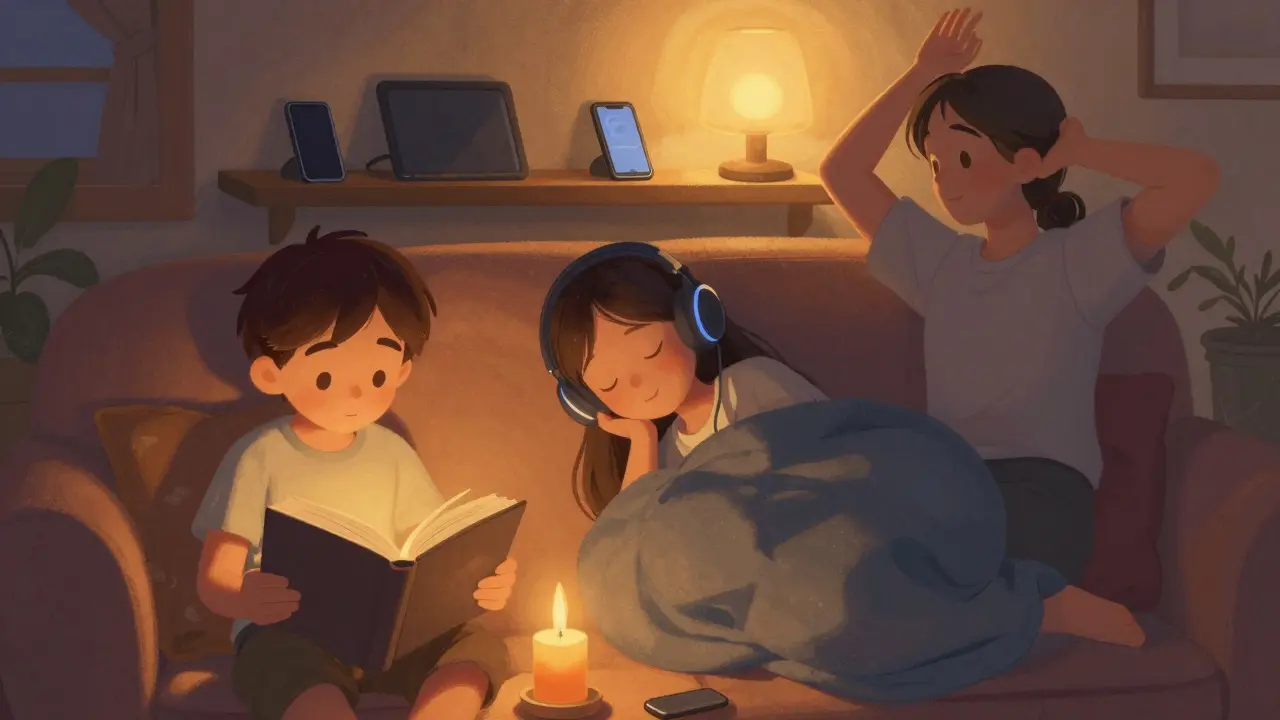
One of the most overlooked tricks? Replace screen time with something calm. Read a physical book. Listen to a podcast with your eyes closed. Do light stretching. Journal. These activities don’t just block blue light-they signal to your brain that it’s time to wind down.
What Doesn’t Work
Blue light filters alone won’t fix sleep if you’re still scrolling through Instagram at 1 a.m. The filter reduces light-but not stimulation. If your mind is racing, no yellow tint will help.
Also, don’t rely on “sleep mode” apps that claim to track your sleep quality. Most are inaccurate. Your body doesn’t care about your app’s sleep score. It cares about whether you’re exposed to bright light and mental stress in the hour before bed.
And avoid the myth that “I’m used to it.” Your body doesn’t adapt to sleep disruption. It just gets worse over time. Chronic poor sleep increases risk for diabetes, heart disease, and depression. That’s not fearmongering-it’s what the data shows.
What’s New in 2026
Apple’s Sleep Focus mode, introduced in iOS 17, now automatically dims your screen and silences notifications one hour before your scheduled bedtime. Android has similar features in Pixel and Samsung devices. These aren’t gimmicks-they’re built into the OS because the science is solid.
Also, a new test called Chronomics launched in early 2024. It uses a simple saliva swab to analyze your genes and tell you how sensitive you are to blue light. Some people are naturally more affected than others. If you’ve tried everything and still can’t sleep, this might be worth exploring.
The National Institutes of Health just funded a $2.4 million study on teens and blue light, with results expected in mid-2025. Early data suggests adolescents are even more vulnerable than adults, likely because their eyes are clearer and their screens are used longer.
Final Advice: Start Small, Stay Consistent
You don’t need to overhaul your life. Start with one change: no screens in bed. That’s it. Then add a 30-minute buffer before sleep. Then move to 60. Most people find that after five days, it becomes automatic. A University of Glasgow study showed it takes an average of 5.7 days to form the habit.
And if you slip up? Don’t beat yourself up. Just reset the next night. Sleep isn’t about perfection. It’s about patterns. The more you protect your evening hours from blue light and mental noise, the more your body will thank you with deeper, quieter, more restorative sleep.
It’s not magic. It’s biology. And biology always wins-if you let it.
Does blue light from screens really affect sleep?
Yes. Blue light, especially between 460-480 nanometers, suppresses melatonin production-the hormone that signals sleep. Studies show even short evening exposure can delay sleep onset by 20-30 minutes and reduce sleep quality. This is backed by Harvard Medical School, the American Academy of Sleep Medicine, and multiple peer-reviewed studies.
How long before bed should I stop using screens?
The American Academy of Sleep Medicine recommends at least one hour. For better results, aim for 90 minutes. Research shows people who follow the 90-minute rule cut their time to fall asleep from over 45 minutes to under 20 minutes. If you can’t avoid screens entirely, use blue light filters and lower brightness.
Are blue-light-blocking glasses worth it?
For many, yes. A 2023 review found users wearing blue-light-blocking glasses for two hours before bed reported better sleep satisfaction and longer sleep duration. However, 22% of users say the yellow tint makes reading or working on screens uncomfortable. Use them only in the hour before sleep-not all day-to avoid eye strain.
Can I just use Night Shift or f.lux instead of stopping screens?
They help, but they’re not a full solution. These features reduce blue light by about 60%, but they don’t eliminate stimulation from content. Scrolling through social media or watching a thriller movie still keeps your brain active. Combine filters with screen-free wind-down time for the best results.
Is blue light the only reason I can’t sleep?
No. While blue light is a major factor, stress, caffeine, irregular sleep schedules, and mental stimulation from content also play big roles. The best approach combines blue light reduction with good sleep hygiene: consistent bedtime, no caffeine after 2 p.m., a cool dark room, and relaxing pre-sleep routines like reading or meditation.
Do children and teens need stricter screen limits?
Yes. Teens are more sensitive to blue light because their eyes are clearer and they often use screens for hours before bed. Studies show they lose more sleep than adults from evening screen use. Experts recommend no screens in bedrooms and a hard cutoff 90-120 minutes before bedtime. Schools and parents are increasingly adopting “digital sunset” rules for this reason.
Kelly Beck
January 5, 2026 AT 04:46OMG YES THIS. I used to scroll till 2am and wonder why I felt like a zombie. Then I tried the 90-minute no-screen rule and my sleep went from ‘meh’ to ‘I actually woke up refreshed’ 😭✨ I even started reading physical books and now I miss the quiet. My cat even judges me less. Life changed. Try it. You won’t regret it. 🌙📚
Molly McLane
January 5, 2026 AT 08:39Really appreciate how you broke this down without making people feel guilty. So many sleep articles sound like ‘you’re doing it wrong’ but this feels like a friend handing you a warm blanket and saying ‘here, try this’. I’ve started using f.lux at sunset and it’s made a noticeable difference. Also, the part about distance-40cm? That’s like holding your phone at arm’s length while lying down. Genius. 🙌
Katie Schoen
January 5, 2026 AT 10:57Blue light? Nah. I just need to stop pretending I’m not addicted to TikTok at 1 a.m. 😅 The science is solid, but let’s be real-it’s not the light, it’s the dopamine drip. I’ll use blue blockers, sure, but I’m also deleting the app. No more ‘just five more minutes’ while my brain screams for mercy. #DigitalDetox
Beth Templeton
January 5, 2026 AT 19:50Stop screens before bed. Done. Next.
Tiffany Adjei - Opong
January 7, 2026 AT 07:10Okay but have you considered that maybe your circadian rhythm is just broken because you work 9-5 and your body thinks it’s 1970? Blue light isn’t the villain-it’s capitalism. We’re all sleep-deprived zombies because we’re scheduled like robots. Fix the system, not your phone settings. Also, ‘Night Shift’ is a marketing ploy. I’ve seen the patents. 🤷♀️
Ryan Barr
January 7, 2026 AT 21:16Harvard study? Cute. The real issue is that you’re not optimizing your sleep architecture. Melatonin suppression is a symptom, not the cause. You need to track REM cycles, HRV, and core body temperature nadir. Otherwise you’re just doing placebo sleep hygiene.
Cam Jane
January 8, 2026 AT 11:46Biggest win for me? Switching from phone scrolling to audiobooks with headphones and eyes closed. No blue light, no mental stimulation, just voice and calm. I started with ‘The Midnight Library’-now I’m hooked. And yes, I use blue light glasses for 30 min before bed. Not perfect, but better than staring at Instagram. Small steps, people. You got this.
Dana Termini
January 9, 2026 AT 09:36I’ve tried all the tips. Some worked, some didn’t. The 90-minute rule felt impossible at first, but after a week, I didn’t even think about my phone. It became natural. I don’t need to be told what to do-I just needed to see it done right. This post did that. Thank you.
Wesley Pereira
January 9, 2026 AT 20:17Y’all actin like blue light is the devil. Bro, I got a 4k monitor, 300 nits, and I’m still sleeping 7 hours. You’re overcomplicatin’ it. It’s not the light, it’s the anxiety. You stress about sleep, so you can’t sleep. Chill. Also, typo in ‘f.lux’-it’s ‘flx’ in the code. Just sayin’.
Isaac Jules
January 11, 2026 AT 01:39Oh wow. Another ‘sleep guru’ pushing fear-based marketing. You think people don’t know about melatonin? You think we’re all idiots who don’t know how to use night mode? Wake up. This is just another way to sell you blue-light glasses and $200 sleep trackers. Your ‘science’ is cherry-picked. I’ve slept with my phone on my chest for 10 years. I’m fine. You’re not.
Amy Le
January 12, 2026 AT 19:56Blue light? In America? Please. We’ve got more problems than screens. You think your iPhone is ruining your sleep? Try working two jobs, paying rent, and raising kids. Sleep is a luxury for the privileged. Meanwhile, I’m scrolling because I’m exhausted and have 12 minutes before my alarm. Don’t lecture me. 🇺🇸
Pavan Vora
January 14, 2026 AT 15:19Wow, this is so good... I mean, really, really good. I live in India, and here, everyone uses phone till 3am because of hot weather and noise pollution... but I tried your 90-minute rule, and... wow... I slept like a baby... I mean, like a baby who didn't cry... I mean, like a baby who was well-rested... 🙏🌙
Stuart Shield
January 14, 2026 AT 17:06This is the kind of post that makes you feel seen. Not just informed-seen. Like someone finally looked at the messy, chaotic, beautiful mess of modern life and said, ‘Yeah, it’s hard. Here’s how you can gently reclaim your nights.’ I’ve started lighting a candle and reading poetry before bed. No screens. Just ink and quiet. It’s not perfect. But it’s mine. Thank you.